Stop Using Generic AI In Your Ecommerce Business
Most ecommerce founders are handing serious decisions to AI that doesn't know what it doesn't know, and the results can be expensive. Marissa Rodriguez, founder of Through Experience and a fractional CMO and COO for a decade before that, joins Matt Edmundson to explain why industry-agnostic AI is dangerous for first-time founders. They cover the moment she watched ChatGPT invent a 20% advertising budget for a pre-revenue founder with zero basis, what it actually took to train an AI on her own frameworks (one module grew from six videos to fifty), and where she tells founders to point AI first. Her closing argument is simple. There are only three actions that matter online, click, subscribe, and buy, and everything else is noise.
Marissa Rodriguez watched a pre-revenue founder hand their financial model to ChatGPT and get a confident answer anyway. No revenue, no sales history, nothing to extrapolate from. ChatGPT decided the business needed to spend 20% of revenue on paid advertising and said so without asking a single question first. "On what basis?" Marissa asked when she saw the model. "You've never launched. You're pre-revenue. Where did ChatGPT get that 20% was the right number?"
Marissa is the founder of Through Experience, a mentorship platform for ecommerce founders. She spent her first decade in direct-to-consumer ecommerce as a fractional CMO and COO, scaling brands across fashion, wellness and CPG, before she started building AI trained on her own frameworks for the founders and small teams she now mentors. Twenty years of watching businesses get built, and broken, has given her a clear read on what's going wrong with AI in ecommerce right now. Founders are taking advice from something that sounds confident without checking whether it actually knows the business.
The Qualifying Question Test
Here's the thing about a good operator. Before they tell you what to do, they ask you questions. What's the weight of the item you're shipping? Have you actually launched yet? What's your average order value? A generic AI skips straight past all of that and gives you an answer anyway.
"ChatGPT is making these crazy assumptions," Marissa said. "It's not asking you any qualifying questions. It doesn't understand why it needs to know the weight of an item before it can make an assumption on what your shipping costs are going to be."
That gap matters most for first-time founders, which is most of ecommerce. If you've never built a P&L before, you have no way of knowing that a 20% ad spend assumption is nonsense for a business that hasn't sold a single unit. You don't have the experience to catch the AI's mistake, so you follow it.
The uncomfortable part is that this isn't limited to the obviously generic tools. Marissa pointed out that some of the AI being sold specifically for ecommerce right now is just as hollow. "You're even seeing the AI that's being produced by some of the biggest SaaS companies in the world. They're technologists; they're not operators. And the minute an operator starts working with the AI, they're like, whoa, this isn't right, why is it saying this, this doesn't look good."
A tool built by people who've never run a store will confidently tell you how to run one. That's the trap, not the technology itself.
Building AI That Has Actually Done the Job
Marissa's answer is to train AI the way you'd train a new hire, except the new hire gets decades of your actual judgement instead of a two-week induction. She's been doing exactly this for her own frameworks, and it's taken far longer than she expected.
She started with an email marketing module that already existed as a course. Six videos, 45 minutes. Simple enough, she thought, to translate into something an AI could teach. It became 50 videos. "There was so much more than I anticipated that I actually had to sit down and give it the context for understanding. When does a business need this versus when does a business need that? The answer isn't always just black and white, and the same for everybody. You have businesses with different AOVs, different customer paths to purchase."
Three things separate AI that's actually done the job from AI that's just talking a good game.
Context beats content. It isn't enough to feed an AI your playbooks. It needs the reasoning behind every decision, including the exceptions to your own rules. "It's amazing how much of your experience maybe you've never thought about, because they're exceptions to rules. The moments when you actually go against what you would normally do because the context makes sense."
Guardrails before assumptions. A properly trained AI knows which questions it has to ask before it can answer, and which parts it can research on its own. Marissa's financial model builder, for instance, knows it can look up an industry-standard return rate, but it won't touch a founder's ad spend assumption without asking about revenue stage first.
Push back; don't accept the first answer. This part sits with the founder, not the AI. "How many people are afraid to push back or question? How many people will take what AI does at face value and just be like, okay, this is good, and not actually look through it? You wouldn't just accept whatever a human would tell you. You'd fact-check them, or probe, or look to go deeper." A well-trained AI doesn't remove the job of questioning it. If anything it makes the questioning more useful, because there's a real answer worth digging for.
Where the Difference Shows Up
The gap between generic and operator-trained AI isn't abstract. It shows up the moment you ask for help with something specific to your industry.
"If you want to be a good tennis player, you're not going to go to a basketball coach." Someone like Alex Hormozi has data on thousands of businesses and is genuinely smart, but he isn't an ecommerce operator. An AI trained on his frameworks will give good general business advice. It won't give you the best ecommerce advice, because that's not what it's been fed.
The same split shows up inside a single discipline. Email marketing for a law firm and email marketing for an ecommerce business both involve, well, email marketing. "They both might have email marketing, but it's just going to look different, and it needs to do different things." An AI trained on one won't automatically transfer to the other, no matter how capable the underlying model is.
Matt's seen a version of this at Aurion too, feeding the team's own mobile optimisation playbook into AI to build an internal tool rather than relying on anything generic, and watching mobile conversion move as a result on their own site. Different tool, same underlying principle. The model is only as useful as the expertise sitting behind it.
What Operator-Trained AI Actually Delivers
When the training is right, the payoff for a small or mid-sized ecommerce team is real, and it lands in two places first.
The numbers come first. Most ecommerce businesses, in Marissa's experience, don't have a proper financial plan at all. "The amount of ecommerce businesses that don't have a real plan in terms of what they're trying to do is staggering to me." An AI trained with decades of financial models behind it can walk a founder through a P&L line by line, know when to ask about shipping weight before assuming a cost, and know when it's safe to pull an industry benchmark instead. That's hours of work from a Boston Consulting Group analyst or a freelance financial modeller, made accessible to a business that could never have afforded either.
Email marketing comes second, and for Marissa it's where AI delivers the clearest win for smaller teams. "Something that in the past would cost you three thousand to ten thousand dollars a month for an agency or multiple freelancers to support with, email marketing is an area that AI can do a huge amount of fantastic work on." The ceiling isn't the model's capability here, it's whether the AI actually understands your customer's path to purchase, your AOV, and the difference between a one-time buyer and a subscriber.
Where to Start
You don't need fifty training videos of your own to get something useful from this. A few things travel from Marissa's approach into any ecommerce business.
- 1Get your numbers straight first. Before anything else, build or rebuild your P&L and your financial model. If you're using AI to help, make sure it's asking you questions rather than handing you assumptions.
- 2Try email marketing as your AI quick win. It's the area most likely to pay for itself fast, especially if you've been relying on an expensive agency or freelancer for something AI trained properly can now do.
- 3Check who built the AI, not just what it can do. Ask whether the people behind it have actually run an ecommerce business, or whether it's industry agnostic and built by technologists. The difference shows up the first time it gives you advice that doesn't fit your business.
- 4Push back every time. Don't take the first answer at face value. Ask it to show its working, ask why, ask what it's assuming. Treat it the way you'd treat a confident new hire, not an oracle.
- 5Feed it your exceptions, not just your rules. The real value in your own experience is in the moments you broke your own pattern because the situation called for it. That's the part most people never think to write down, and it's the part that makes the difference.
Marissa keeps her own approach to ecommerce simple. There are only three actions that matter online. Click, subscribe, and buy. Everything AI touches in your business should be in service of getting better at one of those three, not at chasing whatever's loudest on LinkedIn this week.
So before you hand your numbers, your email marketing, or your next big decision to an AI, it's worth asking who actually taught it what it knows. We're all tempted to take the fast, confident answer. The founders who get this right are the ones willing to stop and ask where that confidence came from.
Subscribe at ecommerce-podcast.com for a new conversation with an ecommerce operator every week.
Full Episode Transcript
Read the complete, unedited conversation between Matt and Marissa Rodriguez from Through Experience. This transcript provides the full context and details discussed in the episode.
Full Episode Transcript
Read the complete, unedited conversation between Matt and Marissa Rodriguez from Through Experience. This transcript provides the full context and details discussed in the episode.
[00:05] **Matt Edmundson**: Well, hello and welcome to the eCommerce Podcast. My name is Matt Edmundson, and it is great to be with you on this beautiful day wherever you are in the world. Thank you so much for joining us. On this show, we talk about all things to do with ecommerce, as you would expect given the name of the show. It's great to be with you. I've been doing ecommerce for A long time. I call myself an ecommerce dinosaur. I've been around ecommerce since 2002 was when I did my first ecom website, that we launched. So I've been running ecommerce businesses really since then and it's, it's amazing. I love it. I love ecommerce and I love doing this show because I get to talk to experts and founders from all over the world about how to run our ecommerce businesses better, learn from their expertise, their stories, their insights. And today is no exception. So if you're new to the show, make sure you like and subscribe and do all of that good stuff. And of course, if you are a returning listener, which I know many of you, in fact, the vast majority of you returning, let's be real, you're a legend. Thanks for staying connected. Thanks for listening to the show. We've got a great show coming up. No pressure to our guest because we've not had the conversation yet, but we've definitely got a great show coming up. I'm really looking forward to it since we did a pre-call actually. But yeah, thanks That's it from me. Let's jump straight into it, shall we? Marissa, how are we doing?
[01:25] **Marissa Rodriguez**: I'm great. Thanks for having me. Thanks.
[01:28] **Matt Edmundson**: Yeah, well, you're welcome. Now, first off, let's deal with the, both the location and the accent because they are, they're not the same, are they?
[01:36] **Marissa Rodriguez**: They're not the same. I am American and I am based in Athens, Greece.
[01:42] **Matt Edmundson**: Yeah, which is, is, is, I, I think good on you. Why would you not want to go live in Athens for a little bit?
[01:52] **Marissa Rodriguez**: You know, I was, I came to Greece on vacation by myself and I was working remotely from here as one can do in ecommerce. And I just realised like, why am I in New York City? Like really, why am I in New York City when I can be in Greece and I can be in Athens and in the Greek islands? And that was in 2021 and I never looked back.
[02:14] **Matt Edmundson**: Fantastic. Fantastic. And you're enjoying it, obviously, in Greece. What is it about Greece that keeps you there?
[02:22] **Marissa Rodriguez**: Oh, I just love it. Well, first of all, I think there's something that I really just love about being in this side of the world, waking up in the morning and North America is sleeping, and I have like 8 or 9 hours of the day to myself before, you know, everyone is blowing up my phone and my Slack. And that was such a change from life in New York City where like my alarm would go off at 6:00 AM, I was at the gym by 6:45, rushing through my morning before like my first, you know, 9:00 AM call. It was just a complete change of lifestyle. And then I just think, you know, I'm from an island, I'm from Puerto Rico, born and raised. I really gravitate towards islands. The Greek islands are just magical. There's so many of them. There's so much to see that I really just feel like it's a country that you could explore for the rest of your life and still not fully understand all of it, see all of it. And I have zero connection to Greece, by the way. Like, I speak about Greece as if, like, this is, like, a place that I'm from. I have zero family, like, lineage in Greece. I knew no one in Greece. Greece is not even a place that in Puerto Rico, like, growing up, it was not a place that was on the radar, really. Puerto Ricans go to Spain, they go to Italy. So, so yeah, it surprised me as much as it surprised everybody else in my life when I You know, announced to everybody that I was moving here at 38 years old. Yeah.
[03:48] **Matt Edmundson**: That's fantastic. I love it. I think that's brilliant. I, why not? My, I've mentioned before on the show, my son, my youngest son, my middle child, he, he, I think like a week or so ago moved to Bali and he's doing the digital nomad thing, you know? And I'm like, well, good on you, bud. Why would you not? Right? Part of me is like, that would be a nice thing to do.
[04:10] **Marissa Rodriguez**: Yeah. I never— the truth is, I never saw myself as the digital nomad type. Like, full disclosure, I moved to Greece with like 14 luggages. I don't travel lightly. I knew people that were nomads, like really, like, you know, 90 days or 3 months in one country, and then they would be in another country. And like, that was not me. But looking back, if I could go back and talk to younger Marissa, I would definitely tell her to travel and work remotely a lot sooner than I did it, right at the age of 38. Because knowing what I know now, I would have had a lot more fun had I done it sooner. You know, anyways, everything happens when it's meant to happen.
[04:56] **Matt Edmundson**: Well, yeah, I mean, you know, you're out there now, which is which is fantastic. Now, for those of us who might not know about you, for those listening to the show, just sort of give us the brief. Elevator pitch into all things Marissa.
[05:08] **Marissa Rodriguez**: Yeah. So, I started my career in wholesale and retail and working with some ecommerce brands as early as 2006. I then decided in 2015 that I wanted to go all in specifically to direct-to-consumer ecommerce. And then that's what I've been doing ever since. I was launching and scaling brands as a fractional CMO and COO. For you know over ten years, and then I started creating digital products, courses, programmes to be able to reach more people and help more people with e-commerce. And now I do a little bit of everything from you know mentorship to coaching to programmes to building out AI solutions for e-commerce. I'm doing a bit of everything, to be honest.
[06:00] **Matt Edmundson**: Yeah. What's floating your boat at the moment?
[06:01] **Marissa Rodriguez**: Yeah. I don't know if there's anything that's slowing my boat at the moment. I think that I'm really— I think I'm— I don't think there's anything slowing it, actually. I think that I'm in a moment in time right now where I'm—
[06:18] **Matt Edmundson**: Sorry, I said floating, not slowing.
[06:19] **Marissa Rodriguez**: Sorry, I said—
[06:23] **Matt Edmundson**: I think there's a bit of a delay, but I said, what floats your boat, not what slows your boat.
[06:29] **Marissa Rodriguez**: I was like, that's so interesting. Is something slowing my boat? Nothing's slowing my boat. That's why I was like, I was like, wow, is this like a good question? Are we getting deep here? I was like, what is slowing my boat?
[06:44] **Matt Edmundson**: I tell you what, I tell you what, Marissa, you are the quintessential professional because you just carried on talking. You were like, what are you—
[06:51] **Marissa Rodriguez**: I was really trying to think about it. I was like, this is, this is a deep question. What is slowing me down right now in life, you know? Business and otherwise. Honestly, what's floating my boat is I have a very— I feel very excited right now. Like, I haven't felt this excited since like 2015, when I first went all into direct-to-consumer, because I feel that we're like, in a very similar moment in time, right? Like, in 2014, 2015, I was really excited because I was like, oh my god, This is it. As someone coming from wholesale and retail, right? I was like, this is a moment in time where small businesses have leverage that they never had before, right? In terms of distribution, you don't need a retailer to give you permission to build a big business. And in a way, I feel that the same thing's happening now, except the new leverage is capabilities. I think that what AI, you know, what it promises and what it could be is groundbreaking for small businesses. It's groundbreaking for your solopreneur, your small teams. And like, that's who I get really excited about. So, I think that that's, that's what, that's the energy that I'm in right now is I feel like we're at another, like, pivotal moment where how business is conducted online for, you know, the everyday person is once again shifting and giving them more leverage and more optionality and more power and more access than ever before. And I think that's like a very exciting, you know, thing to be a part of.
[08:22] **Matt Edmundson**: Yeah, I mean, that makes a lot of sense, doesn't it? And I, I think I share your excitement. I was talking to, a group of individuals this weekend, actually, at an event in the south of France, which was a wonderful place to speak to people. I have to be honest with you, I got to enjoy the weather. But we're, we're chatting away about AI and the impact of AI, and what that means And there's both on one hand, this sort of existential crisis that seems to be going around, like, is AI going to kill us in 3 years versus the man alive, if we could just harness the power of AI, the impact it could have on our businesses is extraordinary, really. So I think you're right. I think it's a really wonderful time to be alive and to have that technology. With the— let me jump straight into this question. Then, Marissa, this is a question I do like to ask people. Given what you've seen, what you know, what you experience with AI and the excitement that you have about it, when you are talking to people, mentoring people, et cetera, what's the biggest single mistake we're all making where AI is concerned in your opinion right now?
[09:33] **Marissa Rodriguez**: Well, that one's easy for me to answer because I think that AI First of all, when I talk about what I get excited about AI, I want an AI— what I'm building right now and what I'm working on is taking my entire, all my systems, my frameworks, my methodology, everything that I know and feeding it into an AI, right? What I get scared about, and also, I've seen it in practice, is when we're talking about generic AI or prompts or out-of-the-box chat or Claude, or even when you see people that have AI businesses for AI, that are teaching solutions that are industry agnostic, that they work for everybody. That I'm just like, what are we doing? What do you mean? No. Like, no, there's things that are very industry-specific. And having a generic AI working with you, I think you're gonna end up in a bad place. I mean, I've seen it from, you know, people putting together financial models and P&Ls with ChatGPT. And it's like ChatGPT is making these crazy assumptions. It's not asking you any qualifying questions. It doesn't understand why it needs to know the weight of an item before it can, you know, make an assumption on what your shipping costs are going to be. So, if you're a first-time founder, which most of the people in ecommerce are first-time founders that have, you know, no domain or subject matter expertise, potentially, you're going to be blindly following the advice of an AI that really doesn't know what it's doing. And so, I think that's the biggest issue that I see is that The power of AI is to harness it with that expertise and embed that inside. And then, I think that it's a game changer for small businesses, right? Because you can afford sort of like the brain of people that really know what they're doing via an AI. You can access that judgment. You can access that knowledge. That's what I think changes the game as opposed to a generic prompt. And some of the stuff that's being sold right now for ecommerce is really bad. It's generic. It doesn't have any context to it. It's like you can't give advice. You can't tell someone what to do if you're missing context or you don't even know how to ask for it. So, I think that's the main issue that I see with AI right now is that. And you're even seeing like the AI that's being produced by some of the biggest SaaS companies in the world. It's like, you know, they're technologists. They're not operators. And so, to an operator, the minute that they start working with the AI, they're like, whoa, this isn't right. Why is it saying this? This doesn't look good. This isn't the way that I would do it. And so, that's fundamentally, I think, where the opportunity is, right? To get an AI that is trained and built and designed by people that actually have done that job, as opposed to not.
[12:25] **Matt Edmundson**: It's a really interesting point. I mean, I'm a big fan that AI needs a couple of things to function well, right? It needs clear instructions, it needs context, and it needs to know what good looks like. And so what you're talking about is both the context of knowing what good looks like. And I was intrigued by the fact that Alex Hormozi started advertising a few weeks ago. I don't know what it's called, but there's like, you know, for however many thousand pounds a year, I can, I can sort of connect to his AI system, which has got, you know, the whole Alex Hormozi sort of system in the AI, all of his transcripts, all of his meetings, all of his notes, all of his frameworks, his books, everything. Is all in that AI. And so when you talk to it, you're kind of talking to Alex. You've got that context. And people seem to be doing rather well with it. And so you're in— I think what you're saying is really interesting because the frontier models have got so good. The problem is it's this middle bit that you're talking about. It's like giving it all the context that people need to make the right calls, the right decisions. So how do you— If I was a founder, how do I get around that? How do I deal with that?
[13:38] **Marissa Rodriguez**: Well, I think you have to be really, you know, I think in a way, it's the same advice that I've always given to people. You surround yourself with someone that's actually done what you want to do or been where you want to be. And so, someone like an Alex Hormozi is super smart and has data at this point now of, like, thousands upon thousands of businesses that have willingly just given him the data. But he's not an expert in ecommerce. He doesn't do ecommerce, right? And so, you're gonna get, I'm sure, good advice on some level, but not the best advice you could for ecommerce. It's like I always say to people, I'm like, if you want to be a good tennis player, you're not going to go to a basketball coach. You got— you're going to go to a tennis coach who's going to help you with your tennis game, right? It's like, but it's the same sort of like principle. I think the first thing is that. I think the second thing is, you know, whoever you're getting AI solutions from. Again, try to do a little bit of research to make sure that they are tailored for your industry as smart as they are, right? Email marketing if you are a law firm is not the same thing as email marketing if you are an e-com business. You know what I mean? Like, yes, they both might have email marketing but it's just going to look different and it needs to do different things. So, that's what I would— that's my biggest thing. And it takes time to build into AI and train the AI and give it decades' worth of experience. It's also when you start doing this, which I've been doing this, which is why I think about it so much. It's amazing how much of your experience maybe you've never thought about because they're exceptions to rules. They're the moments when you actually go against what you would normally do because the context makes sense or because you feel like you should be heading in a different direction. And when you really start to think about all the different layers of training, judgment, and context, and experience into the AI, you realise it's a big job, which is why, you know, most of what's out there is generic and, you know, oversimplified to what it needs to be in order to really be helpful for a business.
[15:40] **Matt Edmundson**: Yeah, I mean, I've done a similar thing to you. We've taken all our frameworks and our understanding, and we've thrown them into— I throw them into it, but maybe not the right technical term, but we've put them into AI. And so when the team here question, we use Claude, but when a team questions Claude, we've got this layer called SAM, which is all our frameworks, it's all our understanding, it's that whole context, and it's always perpetually learning as we, as we're going along. And we found that as we've done that, the output has got much better. I guess I'm just, I'm just kind of, I'm aware that Like you said, it wasn't pretty, it wasn't as straightforward as I thought it was gonna be just to do a brain dump from my head into AI. That took a fair bit of time. I don't know if you found that.
[16:31] **Marissa Rodriguez**: Yeah, because even, you know, in my case, I began with already mapped out curriculum because I had digital products and, you know, info products. So I was like, how difficult could this be? Right. But let me give you an example. I took an email marketing, I had an email marketing module that was originally like 6 videos and 45 minutes. And I was like, okay, if I really need to teach AI everything about email marketing, let me break this up. And it went from 6 videos to 50 videos because there was so much more than I anticipated that I actually had to sit down and give it the context for understanding. Like, you know, when you do this versus when you do that. When does a business need this versus when does a business need that? You know why? The answer isn't always just black and white and the same for everybody. You know, because you have businesses with different AOVs that might have just different customer paths to purchase. Just to, you know, what are all the ways that I drive revenue via email? Well, this is what I would do for one business. But this is something else I would do for another business. And this is something. So, it definitely took longer than I thought. And then, you have the whole layer of like, that's the first thing of the AI knowing and being able to give advice and being able to To tell you what to do and maybe even quantify, like, the revenue loss for you. But then, there's the other layer of the AI actually doing part of the work for you, you know, filling out the reports, pulling the information that historically we've needed to pull from multiple sources to understand. And then, obviously, you know, actually creating output. So, yeah. But it's been very fun. And it's been, I think, really— I keep getting very excited, even when, like, it's like, oh, we pulled back a layer and we're like, oh God, we have to go further. Or why is it doing this? It's going rogue. And like, this is nowhere in any of the information it got. So, it just blatantly made this up. I'm still very excited by what it can do for small businesses because I have been there. When you don't have a budget, when you don't know how you're going to get something done, it's just, it changes the game for your small to mid-sized businesses. It just, you know, but yes, it was, it's been more than I thought it would be.
[18:50] **Matt Edmundson**: I, I, I thought it was quite cathartic actually trying to, when we sat down with AI and we're distilling our frameworks like you, I, like you, I've, I, I kind of understood what our frameworks were because we taught them to others. But there's, like you say, there's a lot of nuance where when you're chatting to AI and you're like, let me tell you what I think. I think it's almost like therapy for the e-com founder, right? Because you're like, ah, so this is why I think, and when AI says to you, well, hang on a minute, why do you think that way? And you're like, well, this is why I think that way because of this story. And you kind of explain it. It's one, I think it's empowering to relive your past victories. If that, because sometimes I think we've forgotten things. 2, it's good to understand how much you actually do know. But 3, it highlights what you don't know. Yeah. And, and shining a light on what you don't know, which is what we did. And again, I've mentioned this before on the show, and I don't want to say the same story more than, you know, a few times, but probably the most powerful thing that we've done recently was understanding that our frameworks around mobile optimisation weren't up to scratch. And so we had Adam Pearce on the show, talked to him, used the show as a foundation Did a whole bunch more research, threw that in there, and we created a playbook which became something that we could feed into the AI model. The AI model then enabled us to create something called Moby, which analyses the mobile site. Well, on our own personal site that we did that on, our mobile conversion went up 400%. Right now, that's a lot.
[20:26] **Marissa Rodriguez**: Yeah.
[20:27] **Matt Edmundson**: When you're turning over millions on a website. That's a significant amount of sales increase. And so it's just the power of this is if you get the right information to AI, it can really help you. So know what you know and put that into AI. Know what you don't know, and let AI help you. I think it's a, it's a, my, my story is, it's extraordinary. And I, I, I'm enjoying the fact that you're finding similar things, Marissa.
[20:55] **Marissa Rodriguez**: Yeah, I am. I also think that there's, like, a human training that's also required on how to work with AI efficiently, you know? Yeah. And I found how many people are, like, afraid to push back or question. How many people will take what AI does at face value and just be like, okay, yep, this is good, and not actually look through it. You know, it's kind of the way that you would work with a human, right? You wouldn't just accept whatever a human would tell you. You would fact-check them, or you would, you know, probe, or you would look to go deeper. And so, I think that that part of it will be really interesting to see how that develops over time, and people get, I think, more confidence in working with AI, because I think that's also a really big part of it. The success that you're going to have with the output is also driven by how you're able to question and drive the process with the AI as well.
[21:47] **Matt Edmundson**: Yeah. Yeah, again, I would wholeheartedly agree. I think where I'm at with AI and where the majority of the team are at with AI are 2 different things, right? Because I spend so much of my life in here trying to figure it out. So yeah, I, I think part of my job is to get them to use AI better. I mean, we've spent a lot of time, money, and energy trying to get the AI working well enough so that somebody who doesn't know how to use it necessarily can come in and hit the ground running with it. And that's been super powerful. I think we had a guest on the show recently talking about this, about how AI should be treated as a staff member. And you don't have somebody come into your building and you sit them down in front of a desk and they do some work and you go, thanks for that. And you just accept everything on face value. You train the new member of staff, you give them the playbooks, you double-check their work, you want to onboard them well, you spend time with them. And I think you're right with AI, you've got a similar thing. You've got to do that. Pushback. How do you— I guess people listening to the show will be listening to that and going, great, this is all great. And I, I get that we need to, you know, get this knowledge and, and so on and so forth. And we can research that. How do you push back? How do you get the best out of AI? What have you found that works?
[23:06] **Marissa Rodriguez**: Well, I mean, assuming that you have an AI that has the content in it and has the knowledge base in it, then, you know, I, I think that a lot of it is the dialogue with the AI. I think a lot of it is, you know, letting— kind of the way that you were saying earlier, you know, letting the AI understand what you're trying to do, what you want to achieve, what the goal is, even with the content, even with the knowledge base. I think that's really important. I also think that who's using the AI is also important. Like, if you are a subject matter expert that's using AI to, you know, increase your output or your capabilities, That's really different than if you are a small business and you are using AI to help your VA learn how to do something. You know, because maybe you don't want to hire out that role. You've trained the AI and now you have a VA that you are, you know, gonna put on that task. That's also different. So, I think it also depends like who is using it and for what purpose are they using it. Across the board, I think it's the same thing, though, that I would say to you before. I think that you have to be clear on what you're trying to do. You have to push back. You have to not accept the first thing that you get back. The more you can give it directions or examples, the better. You know, but I think that you always have to understand, like, for your team, who's using it, and then what kind of additional coaching do they need in order to get the best out of it? Because if they're not a subject matter expert, but they're using AI to facilitate a job or a role for you, then I would be paying attention to how they're working with the AI to try to give them coaching on the best way to increase their confidence when they're doing something that they're not an expert in. Does that make sense? That's like a whole other layer.
[25:00] **Matt Edmundson**: Yeah, no, absolutely. I'm thinking of someone that I know right now. I think their overreliance on AI to do their job has been It's been quite fascinating to see because the default assumption is AI knows more than them because it's AI. And actually just having the confidence just to step back and push back. It's not like AI's got a self-esteem problem. It's okay to push back. It's okay to ask. One of the things that we've done, and I don't know if you've done something similar, Marissa, I'd love to hear your thoughts on this if you have. We set up, an AI board of directors. Okay. This was, a thing of maybe about, I guess, about 12 months ago. But it's been such a thing for us that it's a practice that we've kept whereby you tell AI to, in effect, you have different agents who represent different people. So for us on our AI board, we of course have Jeff Bezos, right? Because why would you not? We have Steve Jobs, we have Warren Buffett, and a few other people, you know, who make up this AI board. And what's fascinating is when you present something to them, the pushback you get is, is quite fun. And actually, when the agents start pushing against each other, when Steve Jobs starts going to Jeff Bezos, no, that's not how I would do it. And you're watching this conversation unfold. I mean, apart from just being quite good fun and obviously very made up, you can start to see reasoning and questions appear. And having that sort of multiple personalities, in an AI board as agents— I am very aware it's not Steve Jobs, I'm very aware it's not Jeff Bezos— it— but as a thinking exercise for me, I find it's quite fascinating because you get all these different opinions on something. All these different questions, and it causes you to think and have to make a decision yourself, which I think is really, really helpful and has been for me. I don't know if you've done something similar.
[27:04] **Marissa Rodriguez**: I haven't done something similar, but, like, what a fun exercise to do. And the implications of it are obviously greater than business, right? Like, you could— life, you could literally create anyone that has, like, a profile where there's enough information on the internet on them and on what they've said, what they've read, what they've done, speeches they've given. I love that. No, I've never done that. I've never thought about doing that. But I think it would be a lot of fun to do that on a personal level.
[27:40] **Matt Edmundson**: Well, to be fair, I have different boards for different areas of life. So, we've got the AI board for our e-com business. And then I've got an AI board, not necessarily for life, but for some of these things over here, you know, these different projects that I'm involved with. And then you get different people involved. Like if you need a storyteller, go get Malcolm Gladwell, you know? And it's, again, you have to take it with a pinch of salt in many ways, but just enjoy it and have some fun with it. I remember the first time I sort of, I put the board together. It doesn't take long. It's just, you know, simple stuff to do. We put the board together and I must have spent 6 hours just locked in a room, just going backwards and forwards, asking questions, answering questions, thinking about the company in ways that I'd never done before, you know, because it was the first meeting and they were grilling me about the business. And I think in the prompt I said, grill me, don't be brutal, you know, don't— I don't be timid, don't be shy, don't try and please me, just We want to get the best outcome. And so, I found it both quite difficult, but also quite liberating all at the same time.
[28:50] **Marissa Rodriguez**: Yeah. Yeah. No, I love that. That's a nice one. I'm going to do this exercise. It's a nice one. I'm going to do it. I don't know that I would want all of the founders that I've worked with over the last 20 years to do it, because quite my experience with most founders is that there's too many opinions. They have a hard time focusing, right? Like, they go to dinner with an investor who has a friend who has a cousin who did this. And, you know, a lot of the time, my job was to sort of like get them to have blinders on and just focus on what needs to get done. So, I don't know that I would want— I would give them that exercise, but I'm dying to take on that exercise. I think it would be a great one for me.
[29:33] **Matt Edmundson**: How would you— going back to your previous point, too much decision, too much choice. How could you use, I suppose, AI to help you then as a founder there? How would you distill choice down to what's important? Because you're right, there are so many options. There's so many people telling you what to do. How do you distill it down to what's important specifically for you? That's a really big question. I think that's almost bigger than the question than what slows your boat, Marissa, but have a go.
[30:00] **Marissa Rodriguez**: You know, I've always said that my opinion about ecommerce and, you know, probably life in general is that you don't have to be, you don't have to be good at a lot of things. You have to be great at a few things. And so I have, you know, talked extensively about shiny object syndrome and like how difficult it is in ecommerce. It's just, you know, an echo chamber of like every day someone's like, this is the new thing, the hot thing. And I'm like, let's not forget that there's only like 3 actions a person can take on the internet that matter to an ecommerce business: click, subscribe, and buy. That is it. So, you know, we got to drive the traffic. How are we going to consistently drive the traffic so that it clicks? Right. And so I would always be like, on certain levels, you got to be great at, you know, paid ads, you got to be great at email marketing, you got to be great at the content that fuels both of them. And then obviously, like, you have to have the ecosystem, the ops to support it, you know, from inventory to your reporting and analytics to, you know, your unit economics. So, I'm more on the camp of less is more than— and I'm more on there's a lot of things that you could do. But what are like the key things that you have to do in order to really grow this business? So, that's always been my perspective. My perspective has always been like you're either going to win at something that's consistent, repeatable, scalable, Or you're going to be in a business that is, you know, having peaks and valleys. And I've never wanted to be in one of those businesses that have peaks and valleys. So I've always opted for the ones that I can, can scale predictably their growth.
[31:49] **Matt Edmundson**: Yeah. Yeah. I love that. Click subscribe and buy, become good at a few things in, in those areas. And I think that's quite empowering, isn't it? Because it enables you to say no to a lot of things and not worry about it. Um,
[32:07] **Marissa Rodriguez**: It's not easy, and it's hard when you have a content engine, right? 24/7. When, you know, 24/7, whether they're on LinkedIn or whether, you know, you're, you're hearing on Instagram, you're seeing things people are telling you, like, this is how you build your business. No, this is how you do it. This is how you do it. I think it's harder than ever to just focus on what I call, like, the very, like, mundane you know, tasks that are required in ecommerce when you look around and everyone else is doing these like fun things. It's really hard to narrow it down. You know, you have this sense of like, am I missing out? You know, should I be building a personal brand? Is my personal brand what's gonna get people to buy my product online? Like, you know, there's just all sorts of noise.
[32:55] **Matt Edmundson**: Yeah, that's so true. That's so true. And it's— I think your first 5 years of business are learning actually what is noise and what's relevant for you, isn't it? I, I— you— I think you, you get clearer as you spend longer in it. But at the same time, you're right, the fear of missing out is a really powerful psychological thing, isn't it, that wants to draw you back into these things?
[33:15] **Marissa Rodriguez**: It's a fear of missing out. It's also the way that the content machine is, The way that it works, right? People make claims without context attached to it. So, you know, if I had a dollar for every time a founder came to me and they were like, so-and-so said they're doing X. And I'm like, okay, but is so-and-so in your same business model? Are they 100% direct-to-consumer like you are? Or are they also doing wholesale? Or are they also selling on other? You know, like there's content, in my opinion. Like oftentimes you're you're lacking context, so it looks like a shiny thing, and you're like, "I want to be doing that. It's working so well for them." And it's like, "Yeah, but that's not your business model. That's their business model. If you want to be in their business model, you can. There's trade-offs on both sides, right?" Yeah.
[34:11] **Matt Edmundson**: So true.
[34:12] **Marissa Rodriguez**: Yeah.
[34:12] **Matt Edmundson**: It is so true. I I'm I'm. We could talk about this all day, Marissa. I think we could. But let me ask you, where should founders— what's the sort of checklist, maybe is a better way to phrase the question, that founders could have of areas where you think, right, if you are a founder, if you're new to AI, or you've been sort of on the outskirts, you're not like a full-blown expert and your whole system's already set up, but if you're sort of thinking about it and playing about it, where would you start? What are the quick wins? What are the areas that you see having the biggest impact? Like start here, then go here kind of a thing. I don't know if you— I appreciate that's, you know, what kind of business you have, but in general, where would you start and where would you go next?
[34:59] **Marissa Rodriguez**: Are you asking for ecommerce in general, or is this for AI and ecommerce?
[35:06] **Matt Edmundson**: Oh, well, let's go with AI and ecommerce. And if there's difference between that and ecommerce in general, I'd love to talk about that as well. But start with AI and ecommerce.
[35:17] **Marissa Rodriguez**: Well, I think they're probably very similar. I think that the first thing that everybody needs to get straight, and a lot of people don't have straight, is, you know, the numbers. The amount of ecommerce businesses that don't have, you know, a real plan in terms of what they're trying to do is staggering to me. That's where I begin. We have to first have the numbers. We have to make sure the business is capitalised properly. We have to know what success looks like. And I think that also what what the founder views success at, right? I'm going to give a founder that wants an exit a very different business strategy than a founder that wants a lifestyle business that's going to pay them a certain amount, you know, every single year. So, I think to me, like, figuring out success, figuring out the financial model, the P&L, what it's going to actually cost you. And I think that now, with AI, what's beautiful, right, is that we can deploy resources. So, potentially there's savings with AI. If you have a good AI and you've trained it and it knows what it's doing, you can save on some of these line items. And you can redeploy that into either, you know, more paid ads, more inventory, more money for you at the end of the year, whatever you want. But that's where I would actually first start. Then, you know, for me, I think one of the most— the hardest areas for ecommerce businesses to often do really well, especially your small and mid-sized businesses, is actually email marketing, where I think AI can do a huge benefit, you know, something that in the past would cost you $3,000 to $10,000 a month for an agency or multiple, you know, freelancers to support with. I think email marketing is an area that AI can do a lot of really, like, fantastic work on. You know, and then I would move through the other marketing areas. But I would start with, I would start with the numbers. And, You know, like anything else, I think my advice is always going to be not to use a generic AI, out-of-the-box AI, or an industry-agnostic one, to really find one that has been, you know, trained by operators that actually has knowledge and context and all that kind of stuff. But that's probably the 2 big areas where I think it's like the most helpful immediately are in the numbers side and really like wrapping your arms around that. The P&L and the financial model. And then actually, like in email marketing, I think it's a huge win for small businesses. Awesome. And then obviously, like in all the other areas, I'm a little more apprehensive about AI when people are talking about it, like replacing, you know, you're not going to need a media buyer. It's just a button. Like, I'm still not there actually with something that's as important as driving traffic to your site, you know, at a price that makes sense. Um,
[38:09] **Matt Edmundson**: Yeah,
[38:09] **Marissa Rodriguez**: If anything, it's maybe more distrusting of media buyers because I'm like, are you just put— like, I need to actually see what's happening. And I'm probably like a lot more on top of that role than ever before. Did I answer the question or did I just go off on like a tangent? That, that's where I'd start though. I would start with the numbers.
[38:28] **Matt Edmundson**: Yeah, that was a good, good place to start. I, I mean, I, I, I, I want to go down that media buying thing, but we won't. I, I want to stay on track a little bit. The, the numbers then. So coming back to the And sorry, just to come back to the one point you did mention, which I thought was really important, and I just want to emphasise, is this idea of AI replacing humans. Now, I get that AI can, you know, when it comes to graphic design, for example, AI can do the job of a pretty competent graphic designer. And like you were saying, you know, with the media buying, AI could now do the role of a media buyer. Is it going to do a great job? I think like you, I think it's dangerous to assume you still don't need a person in that chain. The same with, I mean, we've talked about it around content for months, haven't we? That how do you avoid the AI slop? Well, you need somebody to check it before it goes out there. You need somebody to read it and go, yes, I'm happy with that, or no, this needs to change. And I think the same is true with everything that AI does. So I would agree. I think probably the best named AI out there is Microsoft's Copilot because I see AI as a copilot. Probably the worst AI out there, in my opinion, is Microsoft's AI Copilot, but that's another story. I just think it's a mindset you have to get into. Let's go back to the finances quickly if I can. What are maybe 2 or 3 things that you see there that founders aren't tracking, but could easily do something with where AI is concerned? What are maybe 2 or 3 metrics that you really like?
[40:06] **Marissa Rodriguez**: So, the question is, where are founders maybe not utilising AI to the level that they should utilise it to? Well, again, I think that I come from a different— I have, you know, 15 years of financial models that were built for me by third parties, you know, everywhere from, you know, people in Boston Consulting Group to a guy in India, like every type of financial model that you can imagine, you know, from a subscription business to a subscription and regular ecommerce business. And so now, for me, it's really easy. It's wonderful. I can plug all— I've plugged all of that in. And I have, you know, a financial modeler who is better than anyone that I've worked with. But it also has, like, a list of questions where it understands it cannot proceed without getting those questions answered, right? And in some cases, it also knows the questions where it can find industry information online. You know, if you have a business that, you know, wants to figure out what to assume for a return rate or what to assume for a discount rate based on their product category, it knows where it can go, like, you know, look out and where it needs information from the founder to actually come back and say, hey, you know, back to the shipping analysis, have you weighed this product? What is the average weight of it in the box? Do you know? Do you know? You know, so I think that if a founder has this sort of template of a P&L of every single line item, I think going back and forth with a trained AI can be incredibly helpful in terms of understanding costs, in terms of knowing, even for a human, right? What's the difference between hiring a graphic designer that does direct-to-consumer that's based in the US versus hiring one that's based in the Philippines versus finding talent that's based in Brazil? Like, doing that kind of competitive analysis is so much easier, so much faster now. And that can make a big difference when you start to, you know, you're really massaging those line items to get to what your fiscal plan is going to be and your people plan is going to be. I think it's wonderful to use it like that. Or to also validate if you're in contract negotiations with a 3PL, putting that contract into the AI and asking its opinion or asking for it to maybe do a little bit of a comp landscape for you on other 3PLs that might be better options for you. I don't know if I answered your question. But I think that there's a lot of— in some cases, the AI is really, really great, any AI, at giving you information it finds on the internet that makes sense for you. In other cases, you need an AI that knows to ask you first before it makes assumptions. Like this founder sent me a P&L that ChatGPT created for it. And ChatGPT just made up the paid advertising line. ChatGPT just decided like 20% is what you need for paid advertising. And I'm like, on what basis? You've never launched. You're pre-revenue. Where did ChatGPT get that 20% was the right number? You know what I mean? So, but I think it's incredibly helpful for everybody. It's just, you just need to make sure that you're You're giving it the right information. You know what you can ask it to do, and you know what it needs guardrails before it like moves forward. So I don't know if I answered your question, actually.
[43:52] **Matt Edmundson**: No, that's great. That's really. I think it was a great answer, and I I I I I love it. I think it's such a powerful thing. You know, I was I'm I'm sort of saying. Yeah, we've probably made that mistake. Yeah, we've probably made that one. I, I, we got a contract, last week, and I, I had to read through it 3 times because the numbers weren't making sense. And so just doing what you're saying, just rather than just accepting ChatGPT's answer, we were like, hang on a minute, I need you to show me the maths. I, I need you to walk me through the maths like I'm a 10-year-old because I'm just not getting it right now. And it was very, very helpful. In fact, one of my favourite things to say to AI is just assume I'm thick, I'm stupid, I'm like a 10-year-old in— do you know what I mean? I just explain it to me like I'm like that, and it usually does a pretty good job of helping me get to where I need to be. Marissa, listen, thank you so much for coming on the show. I'm aware of time, and it's flown by at 1,000 miles an hour, as it always does. If people want to reach out to you, if they want to connect with you, what's the best way
[44:58] **Marissa Rodriguez**: They should find me on LinkedIn for sure, Marissa Rodriguez, because I spend quite a lot of time on LinkedIn. They can also find me at throughexperience.com. They can also find me on Instagram, Marissa_ThroughExperience.
[45:15] **Matt Edmundson**: Fantastic. We will, of course, put all of those links in the show notes. So, if you're listening on a podcast player, just scroll down through the show notes, you'll find them. If you're on YouTube, just go to the description, the links will be there. Of course, all the links will be on the website at ecommercepodcast.net. Just find this episode's page on the website and you'll be able to click through and connect with Marissa to your heart's content. But do connect with her, connect with her on LinkedIn, go and say hello. I'm sure she would appreciate it. It's always nice to connect with new people. But Marissa, thank you for coming on the show. I like to do this thing called saving the best till last, as I mentioned. Just in closing, for anyone that's sort of still listening, Out of everything that we've talked about, what's the number one thing you want founders to know where AI is concerned? I think I know the answer already, but let's just bring it home. What is the key takeaway from your point of view where you're just like, do this and it's gonna make such a massive difference?
[46:08] **Marissa Rodriguez**: Yes, please, please do not use AI that is industry agnostic, that is designed for any industry. You're not gonna get the greatest results. Please do not just use, you know, ChatGPT or Claude out of the box. I mean, have you actually looked at Reddit? There's a lot of misinformation on the internet. And you do not want to be on the receiving side of that. Please do find AI solutions that have been created and designed by operators that have done the actual job. You're going to get there faster. It's going to have a better result for you and for your business.
[46:44] **Matt Edmundson**: Fantastic. Fantastic. Marissa, thank you. I loved it. I feel like I could talk another hour without too much trouble, but thank you for coming to us via Athens and New York. It's been amazing.
[46:55] **Marissa Rodriguez**: Thank you so much for having me. And I've enjoyed it as well. I could definitely talk to you for at least another hour.
[47:01] **Matt Edmundson**: Maybe we'll do part 2. We'll do part 2 soon. But thank you. Well, that's it this week, ladies and gentlemen, from the eCommerce Podcast. Thank you so much for joining us. As I mentioned, Everything you need to know is on the website at ecommercepodcast.net. The transcript from today, the notes from today, the links from today, a really detailed blog post. There's even prompts and stuff you can put into AI from today's show if you also give it the transcript. There's all kinds of cool stuff there. So just go ahead and check that out. But thank you so much for joining us. I will see you next week. But from Marissa and myself, that's it. Thank you so much. Bye for now. Bye.
Meet your expert
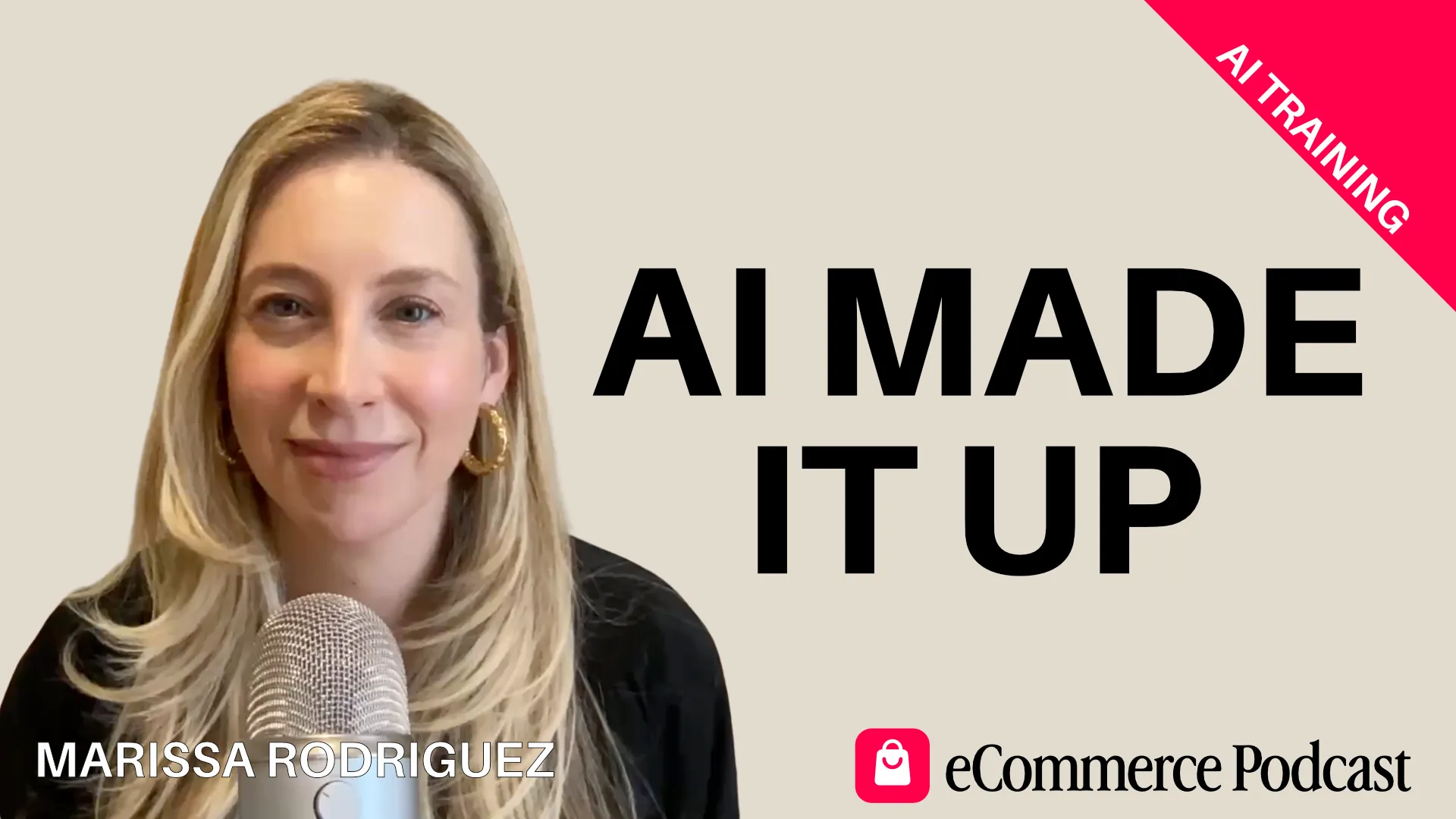
Marissa Rodriguez
Marissa Rodriguez
Through Experience