Product Descriptions That Actually Convert
Most eCommerce product descriptions are invisible. Copied from the manufacturer, pasted without thought, identical to every competitor. Matt Edmundson shares how rewriting 400 product descriptions at Jersey Beauty Company transformed a commodity site into a brand with personality, and reveals the narrative binding framework from cognitive science that makes copy 42% more memorable after 30 days. Through real examples — a framing square, a fountain pen, a USB disco light, and an airsoft tactical vest turned mission briefing — discover the three principles that turn forgettable spec sheets into stories that actually sell.
It started with 400 products and a copywriter named Beth.
Back when I ran our Jersey Beauty Company website, we had a significant problem. We were selling exactly the same products as half a dozen other sites. We used the same images. Had the same product descriptions as everyone else because we were all using the same manufacturer-supplied copy. We all just copied and pasted without a second thought.
And as a results we looked identical to everyone else. A commodity in a sea of commodities. And the only way to compete in that scenario is to be the cheapest or offer the best value. And I wanted out of that little race-to-the-bottom strategy we all just seemed to have adopted.
So we made a decision. We'd rewrite everything. Not with AI – this was before ChatGPT existed – but with Beth, who had a real flair for words. We started with our top 20 products. Then the next 20. And it took months.
But we stopped being the same as everyone else. We had personality. We had a voice. We became us.
Was it worth the months of work?
Absolutely.
The Copy Everyone Ignores
And since then, I’ve seen the same issue every. Just last weekend, I was shopping for a framing square. A framing square is a carpenter's tool used for roofing and timber framing, and woodworkers like me also use it to get 90-degree angle marks. Niche, I know – but I needed one.
I found the Milwaukee one I wanted. Great product. And the reason I wanted that specific one was that I watched a YouTube video showing it in a jig, and I wanted to build one using that same square. And that video, by the by, had over 500,000 views. I was sold.
So I googled it and found seven different UK distributors. I opened all their sites in separate tabs and looked at each page. And here's what I found:
Site 1: "Reinforced frame. Laser etched markings provide superior visibility."
Site 2: "Reinforced frame. Laser etched markings provide superior visibility."
Site 3: "The Milwaukee Aluminium Framing Square is a strong and versatile framing square..."
Site 4: "Laser etched markings provide superior visibility. Precision scribe notches for easy marking."
Site 5: "Reinforced frame. Laser etched markings provide superior visibility."
Basically, all the sites had the same copy. Word-for-word in some cases.
Not one of them mentioned the YouTube video that had convinced me to buy. Not one of them told me why this square was worth the extra money over a cheaper alternative. None of them gave me a reason to choose their site over the others. I ultimately decided on which one to order based on the total price (sales price + shipping). Race to the bottom again.
The product copy didn't matter because nobody made it matter.
The Assumption That's Killing Your Conversions
Here's what I see constantly when working with e-commerce founders:
Assumption #1: "We use manufacturer copy because that's what everyone does."
Yes. And that's exactly why you look identical to everyone else. That’s why pricing is such an issue.
Assumption #2: "Product copy doesn't really matter as long as the site looks good."
So it becomes the last thing you think about. An afterthought. Or worse – thrown to ChatGPT with a prompt like "write a product description for this" and whatever comes out, goes live.
Assumption #3: "Nobody reads product descriptions anyway."
Wrong. The people who are actually deciding whether to buy do read them. They're looking for reasons to say yes. Or reasons to leave.
So, what if you gave them something worth reading?
The Science of Copy That Sticks
Research from UC Davis found something fascinating about memory.
The hippocampus – our brain's memory centre – actively binds separated events into unified narratives. When content creates a coherent story with causal connections between events, it becomes 42% more memorable after 30 days compared to disconnected facts.
This technical term used in cognitive science is "narrative binding." And it's the difference between a customer who forgets you the moment they close the tab and one who remembers your brand weeks later.
Cox & Cox, a UK homeware retailer, put this to the test. They restructured their product descriptions using a proper narrative framework. The result? 36.7% increase in revenue per visitor.
Not a redesign. Not new products. Just better words.
The Three Principles of Copy That Converts
So for Narrative Binding to work in e-commerce, there are three principles that we have to understand and use:
1. Causal Sequencing
Don't just list features. Show the chain: Feature → Benefit → Outcome.
Before: "Reinforced aluminium frame"
After: "The reinforced aluminium frame means it won't bend mid-cut, so your measurements stay true even after years of heavy use"
2. Character Continuity
Include people in your description. The maker. The typical customer. The reader as the protagonist of their own story.
Before: "Popular with professionals"
After: "Join the 2,000+ carpenters who've made this their go-to square"
3. Thematic Consistency
Weave a thread throughout. Craftsmanship. Adventure. Self-care. Precision. Whatever fits your brand and product.
When all three principles work together, your product description becomes a mini-story instead of a spec sheet.
A Full Example: The Fountain Pen Transformation
Let me show you what happens when you apply all three principles to a single product. Now I am a big fan of fountain pens. I have found one that I love, and it’s on the desk in front of me. So how would I make it work with this?
Standard approach (without narrative binding):
Artisan Fountain Pen - £95
Our Artisan Fountain Pen features a hand-crafted stainless steel nib for smooth writing. The premium resin body provides perfect balance and comfort during extended writing sessions. Available in midnight blue, burgundy, and forest green.
Specifications:
- Medium nib size
- Cartridge/converter filling system
- Weight: 28g
- Length: 138mm
- Includes one ink cartridge and gift box
Informative. Accurate. Forgettable.
Narrative binding approach:
The Artisan's Journey: From Blank Page to Written Legacy - £95
Every writer knows that moment – staring at the blank page, waiting for inspiration to strike. That's where the Artisan Fountain Pen begins its work.
Crafted by master pensmith Thomas Fletcher, who spent 20 years perfecting his technique in Florence, the Artisan transforms the simple act of writing into something profound. As your hand grips the balanced resin body, you'll feel the same connection to your words that Thomas felt when creating the pen.
The hand-crafted stainless steel nib responds to the subtlest changes in pressure, allowing your emotions to flow through your words – gentle and precise for reflective passages, bold and confident for declarations of purpose.
Many of our customers report that their writing changes when using the Artisan. "I started writing letters again," says Rebecca, a Social Media Consultant from Bath. "I found myself slowing down, thinking more carefully about my words. The pen became a bridge between my thoughts and the page."
Choose your companion in midnight blue for professional correspondence, burgundy for creative writing, or forest green for personal journaling. Each colour carries its own story, waiting to become part of yours.
Your Artisan arrives in a handcrafted wooden case, itself a story of sustainable forestry. Inside, you'll find your first ink cartridge – the beginning of countless pages that will carry your legacy forward.
Technical Details: Medium nib size | Cartridge/converter filling system | Weight: 28g | Length: 138mm
See the difference?
Causal sequencing: The pen's craftsmanship → affects how it feels → influences the writing experience → changes how customers approach writing.
Character continuity: Thomas Fletcher (the craftsman), Rebecca (a customer), and the reader as the protagonist on a writing journey.
Thematic consistency: The journey from blank page to written legacy runs throughout. Craftsmanship. Tradition. Personal connection to writing.
The narrative binding approach creates a story arc that helps customers visualise themselves using the product. Rather than presenting features, it creates meaningful connections between the pen's attributes and the customer's life.
The Perspective Shift (For Gift Products)
I recently acquired a gift company called Seven Yays. Fun products, great concept. But looking at the copy, I noticed something that applies to almost every gift site I've ever seen.
The descriptions were written for the buyer.
"A fun gift that'll make them smile. Perfect for birthdays and Christmas."
Technically accurate. Completely forgettable.
Here's the shift: Gift copy should be written for the recipient, not the buyer.
Take a simple USB disco light. Standard copy:
"A fun little disco light that plugs into any USB port. Creates colourful light effects. Great for parties."
Now, written for the recipient:
"For the friend who turns every kitchen into a dance floor. The one who puts on ABBA while making pasta and doesn't care who's watching. This tiny disco ball plugs into any USB port and says 'yes, you absolutely should have a spontaneous Tuesday night dance party.'"
The gift-giver reads that and thinks: "That's exactly her."
That's when they click "Add to Cart."
The James Bond Transformation
In episode 236, I talked with Matt Anderson about a friend came to me about his airsoft site. I took one look at the product descriptions and saw the problem immediately. Manufacturer specs. Bullet points. Boring.
But his customers? They're 30-somethings who secretly want to feel like international spies. They're buying tactical gear not because they need it, but because it makes them feel like 007.
So I showed him what happens when you transform a standard tactical vest description into a mission briefing:
Before:
XTac-500 Tactical Vest - £149.99
- Constructed with 600D polyester
- MOLLE webbing system
- 6 magazine pouches
- Available in Black, Olive, and Desert Tan
After:
MISSION BRIEFING: XTac-500 Field Operative Vest - £149.99
AGENT STATUS: EYES ONLY
Your upcoming extraction in hostile territory requires specialised equipment. Intelligence has secured the XTac-500 – the same vest relied upon by our operatives in the Kyrgyzstan operation last winter.
The 600D polyester construction withstood small arms fire during the Belgrade incident, while the MOLLE webbing allowed Agent Wilson to adapt his loadout mid-mission when circumstances changed.
Choose your configuration wisely, Agent.
Same product. Same features. Completely different emotional response.
What To Do Next
You don't need to rewrite 400 products by hand (as we did at Jersey Beauty). AI has changed the game.
But AI without direction produces generic slop. The prompts matter. The framework matters.
So I've put together a Product Description AI Prompt Pack with the exact prompts I use:
- The Narrative Binding Master Prompt
- The Gift Product Perspective Prompt
- The Mission Briefing Style (for tactical/adventure products)
- The Origin Story Style (for handcrafted/artisan products)
- The Problem-Solution Style (for practical products)
- Before and after examples
- An implementation checklist
It's free. Grab it below.
Start with your top 20 products. The ones that drive most of your revenue. Transform those first, then work your way down.
We're currently doing this exact project at Seven Yays. I'll share results as we go.
Sources
The 42% memory improvement figure comes from UC Davis fMRI studies on narrative binding and hippocampal activity during story recall.
The Cox & Cox case study and 36.7% revenue increase is documented by AWA Digital in their copy audit research.
The 93.75% conversion improvement from the Six Questions framework is from A/B testing research published on LinkedIn.
Free resource
The STORY-SEO Product Copy Framework
The STORY-SEO Product Copy Framework
Most ecommerce product descriptions either rank but bore people to tears, or read beautifully but never get found. The STORY-SEO Framework solves both problems at once. This free guide includes the complete method for writing product descriptions that rank on Google AND stick in memory, a step-by-step walkthrough with a real product example, an AI prompt you can use immediately, two real before-and-after case studies from a live ecommerce site, plus a gift product adaptation (the THEM Method) for anyone selling products people buy for others.
Get your free download
Full Episode Transcript
Read the complete, unedited conversation between Matt and Matt Edmundson from Aurion. This transcript provides the full context and details discussed in the episode.
Full Episode Transcript
Read the complete, unedited conversation between Matt and Matt Edmundson from Aurion. This transcript provides the full context and details discussed in the episode.
## [00:00:00] Introduction to the eCommerce Podcast
[00:00:05] **Matt Edmundson:** Well, hello and welcome to the eCommerce Podcast. My name is Matt Edmundson, and it is great to be with you today. Let's jump into it, shall we?
## [00:00:18] The Problem with Generic Product Descriptions
[00:00:18] **Matt Edmundson:** Now, most eCommerce product descriptions, well, let's just say they are invisible. Can you tell me what the last product description you actually read said? Could you even give me the gist of what was said?
I find this a particularly hard exercise, and it's not because I haven't seen any or read any recently, but because, let's be honest, they're just so forgettable. So we scroll past them, glance at them. That's about it. We never really remember them. So in this episode, we're gonna dig into how to transform your boring product copy into descriptions that actually stick in people's minds and ultimately drive our website sales.
That's the aim, and I know this is a good thing to do because when we restructured product descriptions, uh, in one of our own e-commerce businesses. We saw conversion rate shift dramatically, and it's not just on my own sites that I've seen the benefits either because research shows that properly structured copy is, check this out, 42%.
More memorable after 30 dates. That's after 30 days, right? And I appreciate 42% is a very precise number. Uh, but it's really good news for us, isn't it? Because if we can get our product copyright, then old man alive, could we maybe make a difference to the conversion on our site? But. We've gotta make those changes.
So you can keep using the manufacturer copy, right? Which looks identical to your competitor's copy.
## [00:02:05] The Power of Narrative Binding
[00:02:05] **Matt Edmundson:** Or you can explore what we're gonna look at today, which is something called narrative binding, which is basically the science of copy that converts and figures out how, and we're gonna figure out how do we apply this to our own products, right?
Uh, but before we do. Let me tell you about 400 products and a copywriter named Beth. Oh, yes. Uh, I mentioned, uh, a second ago.
## [00:02:32] Case Study: Jersey Beauty Company
[00:02:32] **Matt Edmundson:** That we restructured product descriptions on our own site. And that site at the time was Jersey Beauty Company. Uh, back when I ran it, I no longer do. Uh, but when I ran Jersey, I noticed right at the start, actually early on in the career of me running Jersey, that we seemed to have a problem.
And that problem I see actually now consistently on quite a few websites, uh, working with eCommerce founders, uh, and operators, eCommerce like Q and Me. I see this problem all over the place. And we were selling, right, exactly the same products as half a dozen other websites, right? So we had the same products, we had the same images, we had the same sort of descriptions, which came from the manufacturer's copy that every other distributor was using, and we just literally copied and pasted it onto our sites without really thinking twice.
Thought about the product copy. So the problem was we looked identical to all of our competitors. We may have had slightly different colored nav bars, but the pictures were the same. The description was the same. What that meant was ultimately we became like a commodity broker. We were selling commodities and I think the only way really to compete when you, when you sort of go down that road is on pricing.
So you then have this scenario where you want to be the cheapest or you may glamorize it and say, actually I want to offer the best value as different language. And lemme tell you, I, we, we experienced that at Jersey and I wanted out of that race to the bottom strategy, we'd all just seem to have adopted.
And if you guys are anything like me, um, maybe you are, maybe you're not, I dunno. But you have, you looked at your competitors and thought, well, man, alive, there's not much difference between us. Um, well, have you looked at your competitors for what? And if you have, how different are you? Right? Especially if you are selling the same products as them, you know, you've got the same suppliers, the same products, the same images, the same product copy.
In that scenario, you've got to ask what makes a customer choose you, and I think it's a really interesting problem to try and get your head around.
## [00:04:52] The Impact of Unique Product Descriptions
[00:04:52] **Matt Edmundson:** And so what we did at Jersey is we made a decision to literally rewrite everything, to rewrite every single product description, which was 400 products. Uh, we also redid the images, but that's probably a story for another podcast episode 'cause we're focusing on product copy now.
Um. This was, lemme tell you, when we did this years before Chat, GPT existed, right? And this is where Beth comes in. She was our copywriter at the time. Beth is an absolute legend. And Hads actually, and still has, if I'm honest with you, a really good flare for bringing products that we were selling to life with really good descriptive content.
We had this brilliant copywriter with Beth, uh, before Beth was Naomi, and we had these 400 products on the site, so you couldn't just do it overnight. You, you couldn't just transform 400 products 'cause it was not possible back then. So we started with our top 20 products. We then went on to, I say we, Beth, started on top 20 products, uh, and then moved on to the next 20 and so on and so forth.
And it actually took Beth a fair while to do it, several months to work through them all from memory, because like I said, she was crafting each one properly. She wasn't just churning out words or slop. Well. What was the result of us doing this? What happened? 'cause that's the important question and obviously something good happened otherwise I would not be recording this podcast right now.
So the simple answer is we stopped being like everyone else. All of a sudden our sight had personality. We had a brand voice. We had become us. So was it all worth it? Was it worth the time, the energy, the resource, all of those months of work? Well, absolutely it was worth it. And if I'm honest with you, it then became part of a much bigger branding exercise where we wanted to take something in effect that was a commodity website and turn it into something that was really unique and that really connected with our customers and we had some really good successes with that.
Now. You might be thinking, Matt, that sounds like an awful lot of work, an awful lot of efforts. And you know what? You are right. Especially 'cause we did, I, I cannot emphasize enough, we did not have AI back then. No. We had Beth, who's better than ai. Um, it was hard work, but it mattered. And let me show you why.
Um, for example, I was shopping right online for a framing square last weekend. Now, for those of you who don't know, a framing square is a carpenter's tool, which is used for roofing and timber framing, and woodworkers, like me use it to get 90 degree angle marks amongst. Other things. Now, I appreciate this as a niche product.
I really do. You might not care about this, but I needed one for a jig that I wanted to build. And I found the Milwaukee one that I wanted. And the reason I wanted this, this specific framing square, because there were cheaper ones out there, was because I watched a YouTube video showing me how to build the exact jig that I wanted to build, and the guy on the YouTube video used a really specific framing square for a very good reason, which I won't bore you with.
Why that particular one? You have to watch the video. Um, but this YouTube video. Was a great video, well done, well produced, engaging, had over half a million views, so I was sold. I wanted that exact square. I knew what I wanted and I wanted to go and get it. So then I did what most of us do. When I wanted to buy one, I went to Google and I Googled the framing square, and that took me to the manufacturer's website, to Milwaukee's uk.
Website. I found the Framing Square on that site, which then took me to seven different UK distributors, and I did what most people did. I opened all seven distributors in different tabs on my browser to just have a quick view across the seven D different sites to figure out who was I gonna buy from. So site one, they said it was a reinforced frame with laser etched markings, which provided superior visibility, which was great.
Site number two said, reinforced frame with laser etched markings, provided superior visibility, and guess what? Sites 3, 4, 5, 6, and seven basically said, right. They all basically said the same thing, copied and pasted from the MA manufacturer. Some of them had tweaked them very slightly. And in some cases it was literally word for word copy, right?
Zero differentiation. No one mentioned, not a single one of them mentioned the YouTube video that had convinced me to buy. None of them mentioned the manufacturer's video, which was on the manufacturer's website. No one told me why this square was worth the extra money. No one gave me a reason to choose.
Their sites over the other six sites. Not a single site did that. So how did I decide? Well, like everybody, pretty much in that place, it all came down to total price, the sales price, plus the shipping costs, and how easy it was to understand both, right? There was one site super cheap, couldn't figure out the shipping costs until you got all the way to the checkout, and I was just not interested.
But anyway, whoever was the cheapest won and it was this race to the bottom again, and I bought my square from one of the cheapest supplier and actually ended up buying a few other bits and bobs, which I needed as well. So they won in the end based on price. Now the product copy, it didn't matter because nobody made it matter.
And I wonder how often that's happening on our own websites too. Like are we making product descriptions that give a customer a reason to chewers, uh, chewers? No, they definitely don't wanna do that. Giving our customers a reason to choose us. Over our competitors, or are we also becoming a little bit invisible?
Now, I've noticed that there are three default assumptions in e-commerce when it comes to product copy that I absolutely think destroy our conversion. See if any of these apply to you. Assumption number one is that we can just use manufacturer's copy, because that's what everyone does, right? It's been given to us.
It's what we did on Jersey. Why do I need to redo it? I don't. They've given it to me. I know. It's good. Oh good. I know it's accurate at least. Um. It's just so much easier, isn't it, to put that on our website, to copy and to paste. But that's exactly why you look identical to everyone else. And I think then that's why pricing can become such an issue because all we've done is made our websites basically commodity websites and we become really good at that.
Right? Which then becomes all about price because we're not standing out in any other way. Assumption number two is that product copy maybe doesn't actually really matter as long as the site look good, right? Does your site look good? And it becomes like the last thing really that we think about an afterthought or worse.
And I mean, worse, we just throw it to Jet GPT with a prompt, like write a product description and then we copy and paste whatever generic slop comes out. That's what goes live. Really, really winds me up. You can instantly spot pure AI product descriptions. You really can. Or maybe it's just 'cause I work with AI so much as I can.
Anyway, the final assumption, uh, assumption number three. Uh, and I think this one's a little bit sneaky, if I'm honest with you. It's that belief that nobody really reads the product descriptions anyway, and I think that's a very wrong assumption. Very wrong indeed. I think the people who actually decide whether to buy from you and buy from me, I think they do read them.
I think they're, they're reading it, looking for a reason to say yes. Or a reason to leave, which is what I did on those seven websites. So what would happen if we gave our visitors something worth reading? Something that was fun, something that was enjoyable, something that was memorable, something that was unique to us.
And this is where it starts to get interesting. Like I said, there's actual science behind why some copy works and why other copy gets forgotten. And in my quest to become better at product copy, because I realized early on in Jersey that this was a winner. So I've spent a bit of time looking at it. I came across some research from uc, Davis, um, and found so.
Fascinating out about memory, the hippocampus. And I'm not a brain scientist. Uh, let me just preface everything, but I do know this, that the hippocampus, which is our brains memory center, actively binds separated events, right? So these separate events that go on in our heads, it will bind them together into unified narratives.
Okay? Narrative binding. And this can go quite deep, right? Uh, it can go really deep. But when it comes to content, basically we need to create a story with causal connections between events, okay? That's what our product descriptions need to do. And if we do that, if we create this story. That's where this magical, 42% more memorable after 30 days compared to distant connected facts comes from 42%.
More memorable, how they measured it, I have no idea. Right. But it's basically more memorable just from restructuring our words, doing it differently, not changing the products, not changing the price, just changing how we describe it, right? So this technical term, which is used in cognitive science, like I said, is called narrative binding.
And it's a difference between a customer who forgets you the moment they close the tab, and one who remembers your brand days, weeks, even 30 days later when they're ready to buy, maybe. So there's a UK, uh, homeware retailer called Cox. And Cox. I've never bought from them, but I did discover, uh, in my research that they restructured their product descriptions using a proper narrative framework.
The result for them. Was a massive 36.7%. Again, another very precise number, 36.7% increase in revenue per visitor. Okay? A 36.7% increase in revenue per visitor, not from a website redesign, not from new products, just from better words on the page. And I think this is the power of getting your product copy.
Right. So enough of the theory. How do we actually do this?
## [00:16:33] Principles of Narrative Binding
[00:16:33] **Matt Edmundson:** Well, there are three principles that make narrative binding work, okay? Which we're gonna go through. And don't worry if you are driving or out walking the dog and you can't take notes, just go to the website. There'll be a comprehensive blog post with all of this information in.
There's gonna be a freebie, which I'll tell you about at the end, so you don't have to. Make up AI prompts, you can just literally use ours, um, and see our process. I'll talk about that more in a minute. But just wanted to say, we're gonna get into some stuff. If you can't take notes, don't worry. Just literally just go to the website, find the blog post, copy, paste it, put it into Claude, put it into whatever AI platform you use, um, and dissect accordingly.
Okay, so principle number one is causal sequencing. So causal sequencing, um, would mean that we don't just list features. Okay. But what we actually want to do is show very specific causal chains. So the features should lead to benefits, which should lead to outcomes. So in a very simple way, how would we do this?
For example, going back to my framing square where all the websites were saying the exact same thing, like reinforced aluminum frame, what would we do? Well, that's an interesting question. So we could say something like, it has a reinforced frame. Or a reinforced aluminum frame, should I say, because that was important to me.
It has a reinforced aluminum frame, which means it won't bend mid cut. So your measurements stay true even after years of heavy use. Can you see the difference between the two? Right. Because a reinforced aluminum frame is a feature, but a reinforced aluminum frame where we take that feature. Then look at the benefit, which is it won't bend, mint cut, and then we throw in the outcome, which is your measurements will stay true even for years to come.
Now we've got a story. Now we've just, within one or two words, we've gone beyond a spec sheet, haven't we? So principle number two is character continuity. And this is where we want to include people in our descriptions because we just vibe better with people, don't we? Like, we wanna include maybe the maker or a typical customer, or even the reader as the protagonist in their own story.
So with the Framing Square, just a simple sentence like. It's popular with professionals, which is written on most sites, is dull and dreary, isn't it? So how do we take that, throw in this idea of character continuity and jazz that up a little bit, right? Uh, like Hannibal from the A team, if you're a person of a certain age, you will know that Hannibal is on the jazz, right?
This is what we're doing with our product descriptions. I appreciate half of you, like Matt, I have no idea what you're talking about. That's fine. That's okay. We'll get back to back to the story character continuity. So what, what about us changing it to something simple like join the 2000 plus carpenters who've made this their go-to Framing Square.
Simple. But now what we've done is create a tribe. We've introduced people and there's a sense of belonging and a story the customer wants to be part of. Right. So that's principle number two. Principle number three is thematic consistency. I love these names. I really do. It's brain science, isn't it? Uh, it's definitely not Matt's naming of things.
Uh, so we've got, uh, causal sequencing. We've got character continuity. And finally we've got this idea of thematic consistency. And this is where we basically weave like a golden thread. Throughout the description, it could be something simple like craftsmanship or adventure or self-care or provision, whatever fits your brand or product.
And we put that in all in our descriptions with the other principles. So when we add all three principles together, our product descriptions become like a mini story instead of just a boring specification sheet.
## [00:20:54] Applying Narrative Binding to Real Products
[00:20:54] **Matt Edmundson:** So let me show you what this looks like when you put all three principles together on a single product.
Now I'm a big fan of fountain pens. In fact, I have this one from Tom's studio right in front of me. Love this fountain pen. Can highly recommend it. Um, how would I, how would I use narrative binding for something like a fountain pen? Now most websites would describe a fountain pen in a very typical way.
So let's say it's called the artisan fountain pen. So we've got the artisan fountain pen. It's 95 pounds. It's handcrafted stainless steel nib for smooth writing. It's got a premium resin body, provides perfect balance and comfort available in midnight, blue, burgundy, or forest green. It's a medium nib size a.
Cartridge converter is available and the weight is just 28 grams now. I mean, okay. It's an interest. It tells me what I need to know, and we've tried to jazz it up by introducing the word, um, premium. Describe the resin board. Basically, it's expensive. We start throwing the word premium about right. Uh. Or we throw in handcrafted to try and jazz it up a little bit.
I'm, we're talking about something a bit more than that. So, because it's, you know, it's accurate, isn't it? It's informative, but it's, it's completely forgettable. How many of you can re just recall what I just said, right? Not many. So, what would happen if we take that same description, the same pen, the same fountain pen, and use narrative binding principles when creating the product?
Uh, the product copy. What about something like this? The Artisan's journey turns a blank page into a written legacy. Every writer knows that moment, staring at the blank page, waiting for inspiration to strike, and that's where the Artisan Phantom Pen. Begins its work crafted by Master Penn Smith, Thomas Fletcher, who spent 20 years perfecting his technique in Florence.
The artisan transforms the simple act of writing into something utterly profound. As your hand grips the balanced resin body, you'll feel the same connection to your words that Thomas felt when creating the pen. Many of our customers report that their writing changes when using the artisan. I started writing letters again, says Rebecca from Bath.
The pen became a bridge between my thoughts and the page. Choose your companion in midnight blue for professional correspondence or burgundy for that creative writing or forest green for personal journeying, uh, journaling. Each color carries its own story and it's waiting to become a part of yours. Now, I dunno what you think about that.
I felt a little bit like Jack, you know, again, I'm showing my age reading the story on a podcast. Um, but it's interesting, isn't it? How the two different descriptions have a very different feel and how one provokes emotion and you are getting carried into the story. It's the same pen, it's the same features, but there's just a story attached to it Now.
And you can see how it works, can't you? So you've got casual, uh, sorry, casual, causal, causal sequencing. Um, so the feature becomes the benefit, which becomes the outcome. You know, the sort of the handcrafted becomes this beautiful, handwritten legacy at the end of it, and it affects how it feels, which influences the writing experience.
Which changes how customers approach writing fundamentally. And then we've got character continuity. So you've got Thomas Fletcher the craftsman, Rebecca the customer, and her testimonial, and you as the protagonist reading this on your own writing journey. And then we've got thematic consistency. So the from blank page to written Legacy, this golden thread runs through the entire description and it was just two paragraphs, right?
So the reader isn't just buying a pen anymore, they're buying an experience. They're buying the beginning of countless pages that will carry their legacy forward. You might think it's OTT, but let me tell you, this stuff works because this is narrative binding in action. Now, some of you may know that I recently acquired a company called Seven Yays.
I've talked about this before on the podcast. It's a gift company. And whilst, uh, gifts are, well, they're a competitive industry, um, I think what Seven Yays does with its packaging is actually really clever and really smart. They've got a lot of fun gift products. I think it's a really great concept. I think the guys that started it did a great job.
Um, but again, one of the things that I've noticed, um. Now we've started to work through the site and we're starting to use our framework, jazz, things that we always start at product. Um, started to look at product copy, right? And we have a problem with the product copy on the website, which we need to work on.
And this is really interesting because this is a, a gift. So we're gonna talk more about this a little bit in the next episode, uh, of the eCommerce Podcast when we jump into brand story. Um. But what I see on quite a lot of gift sites, like seven years, like the one which we now have, is that the descriptions of product copy are written for the person buying the gift, right?
They are in effect, the gift giver. Like this is a fun gift that makes people smile. It's perfect for birthdays and Christmas, and whilst that might be technically accurate, it's. Utterly forgettable, isn't it really? And there's one blindingly obvious problem that we have to think about. The description is written for entirely the wrong person.
'cause on a gift site, the copy shouldn't necessarily be directly written for the person buying the gift. It should be written in a way that includes the story of the recipients. They're the person that they're buying the gift for. Right. So let me show you what I mean. One of the, I wish I had one on my desk, but I don't.
Um, but one of our popular gifts, believe it or not, is a little USB disco light, right? You, uh, you stick it into the bottom of your phone, and when you play music, the LED light creates like a little disco ball effect in time to the music. It's quite a fun little gift. And so the standard copy would say it's a fun little disco light that plugs into any USB port and creates colorful light effects.
Great for parties, right? I mean, it's a tiny light. I'm not sure how big that potty is, but anyway, let's move on. It's fine, isn't it? It's generic, but it's utterly forgettable. So what if we changed it? What if we thought about the person that the. Gift giver is buying for What if we help them see that person in the story?
Character continuity, right? So what if we changed it to something like for the friend who turns every kitchen into a dance floor, the one who puts on ABBA while making pasta and doesn't care. Who's watching this tiny disco ball plugs into any USB port on any phone and says, yes, you should. Absolutely have a spontaneous Tuesday night dance party.
So the gift giver, right, reads that and thinks, that's my friend. That's exactly her right. So that's when they click add to cart. And so we're actually running a project right now on seven Yays, transforming all of our product copy amongst a whole bunch of other things. Like I said, taking it through our framework and over the coming months, 'cause it's gonna be a big project, you will see us extracting a lot of these principles and implementing them on the site.
Stay tuned to EP and uh, if you're not yet a member of Cohort. Can I encourage you, come and join the Cohort groups. Um, we'd love to see you in there. Uh, I was talking to Mike the other day. He is one of the Cohort members. Mike, if you're listening, legend, good to see you, man. Um. And he was saying that before he joined, he was like, what, what does Matt get out of this?
Is this just like some fancy sales pitch and, and genuinely it's not. Um, I just love getting together with other e-commerce and we just shoot the breeze about e-commerce. I will be totally straight. I do get work out of it, that's fine, but I don't pitch anything and we just have a great time and everyone thoroughly enjoys it.
And the reason I'm mentioning Cohort is because if you're in there, I will be sharing. Uh, in much more detail, the stuff that we're doing on the seven Yay site as we go forward, getting your opinion on it, getting your thoughts on all that kind of stuff. So, um, yeah, come follow us in Cohort if you wanna find out all the juicy details.
But let me give you one more example and it was, uh, back in a podcast episode 2 36 where I was chatting with Matt Anderson from Dragonfly ai. And I, I gave the example of someone who approached me about their Airsoft website. Right. And I remember sitting down and talking, uh, with that chap, Matt, his name is, and I took one of, I, I, I took a look at one of the product descriptions.
Um. The bestselling product, and I just read through the product description and it was just the manufacturer's specs. It was their copy, it was bullet points, and it was fundamentally boring, right? And so we were like, you've gotta think about who your customer is. Again, something we'll get into much more in the next, um, solo episode of EP.
So the one towards the end of February. Um. But you gotta think about your customer rights. So they're 30 somethings who secretly want to feel like they're international spies. That's who does Airsoft, right? They're not just buying tactical gear because they need it. They're playing airsoft. They're not going to war for crying out loud.
But they wanna do something which is fun and exhilarating. Exhilarating, and something that makes them feel like James Bond. In fact, I think we use that in the podcast title. Um, so I showed him. Uh, the chapter on the site, a simple way to transform that tactical vest description into what I called a mission briefing.
Okay, so before the product description, read X tac 500 tactical vest. Constructed with 600 D polyester. It's got a webbing system, six magazine pouches. It's available in black olive and desert. 10. I mean, I don't even know what half of that stuff means, but it's, it sounds really dull, right? So happens if we sort of throw that into the mix, the whole idea of, well, what would we write to someone who wants to be James Bond or Jason Bourne, or you know, like a Navy Seals platoon leader.
Um. Which is probably, again, you know, not stereotype, but when I go play paintball in, in Airsoft, this is who I am in my head, right? I'm, I'm a kid. It's in essence. So why was, if we change it, something like mission briefing, the X TAC 500 field operative vest, agent status, eyes only. Your upcoming extraction into hostile territory requires specialist equipment intelligence has secured the X TAC 500.
The same vest relied upon. By our operatives in the Stan operation last winter. Choose your configuration wisely agent, all of a sudden, right? We've got the same product, the same features, but a very different emotional response and I'm, I'm getting sucked into this, right? The reader goes from, that's a vest with pouches to I'm Jason Bourne, which.
Let me ask you, which version version do you think is gonna sell better? Right? And here's the good news, and this is genuinely good news, guys. You do not need to write 400.
## [00:32:52] Using AI for Product Descriptions
[00:32:52] **Matt Edmundson:** Product descriptions, or you certainly don't need to rewrite them, which is what I had to do at Jersey by, well by hand, by somebody sitting down and rewriting them because I think this is where AI has completely changed the game.
Okay. And we can use that. But, and this is crucial, and we've said this a lot on. EP AI without direction produces generic slop. We all know it's true, yet we all take the generic slop, right? The reality of it is we've got to invest time and energy into those prompts. The prompts matter. The framework matters.
And so all I've done is I've put together something which I should really run through some kind of title generator. 'cause the title just defies everything that I've just sold you. Uh, it's called the product description AI Prompt Pact.
Ah, Matt, take your own medicine fella. Um, but it, I mean, as boring as it sounds, it's got the exact prompts that I use. Okay. So it's got the narrative binding master prompt there. Um, that applies. All three principles automatically. It's got a specific prompt, like the, the prompts that I use for the gift site that we're gonna be using on the gift site.
You'll see those. They may change. They're what they are right now. Um, we've got star variations for different types of brands. There's a mission briefing for technical gear, Origin stories, maybe for handcrafted products and prompts we use for the problem. Uh, the PAS problem aware solution problem, agitate solution.
Structure, sorry. PAS structures for practical items as well. So that's all in the freebie, right? And there's obviously a little checklist in there which you can use as well to make sure you've got your product descriptions nailed. It is completely free and the link is in the description below. If you're watching on YouTube, if you're listening to this on the podcast, that's also in the show notes.
Um, but honestly, the easiest way to do it is go to eCommerce Podcast dot net and hit the resources link on the top and you'll see it in there. No problem at all. Or just find this episode on the EP website. There'll be a link, uh, to the download at the bottom of that episode. Um, but it's free. Totally get it and use the AI prompts that we've spent ages figuring out.
Start with your top 20 products, right? The ones that drive your revenue the most. You know, the 80 20 rule, transform those first. See what happens. Do a bit of AB testing as is Matt talking nonsense. Go figure it out, right? Don't just take my word for it. Tweak, find, and figure out what tone of voice, how it works best for you and your brand.
And like I said, I'm doing exactly the same project, um, on the seven years. Sites I say I, I genuinely, I need to stop doing that. It's the team, the team and I will be doing this predominantly the team. Uh, and we'll be sharing the results as we go in e-commerce Cohort. Um, and I'll be talking about it in coming and episodes, like I say, over the coming months.
But if you wanna know more details, do come join us in Cohort and you get to say exactly what happens when you. Or when we implement, uh, this whole strategy.
## [00:35:58] Conclusion and Final Thoughts
[00:35:58] **Matt Edmundson:** But that's it. Hopefully this has inspired you to go and rewrite your product descriptions. There really is a lot of goodness in there that we can use.
And with AI now with the right prompts, there's no reason at all. We have no excuse to have rubbish product descriptions. Um, we genuinely don't. So, uh, hopefully this has inspired you or challenged you or both to go and sort that out. And of course, if no one's told you today. Lemme be the first. You are awesome.
Yes, you are created. Awesome. It's just a burden you have got to bear. So let's just make sure our product copy is also awesome and we'll kill it. Let me know how you get on, make sure you can connect with me on social media at Matt Edmundson. Love to see you on there. Uh, let know how you're getting on.
Love to hear your stories. But that's it from me. I'll see you next time. Bye for now.
Meet your guest
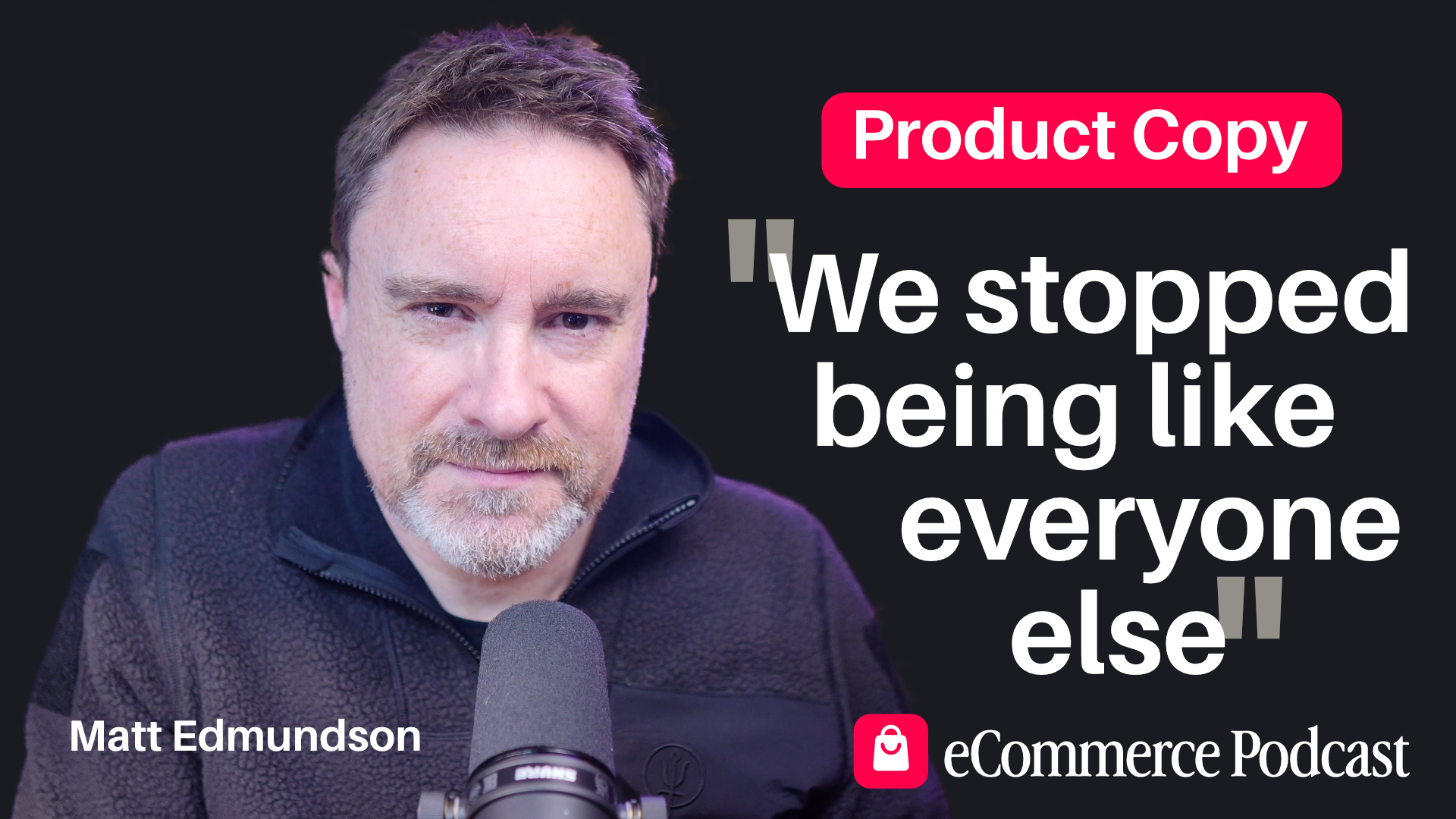
Matt Edmundson
Matt Edmundson
Aurion
Even more episodes...
How to Stop Chargebacks From Destroying Your Profit Margins