How to Get Your Products Recommended by ChatGPT
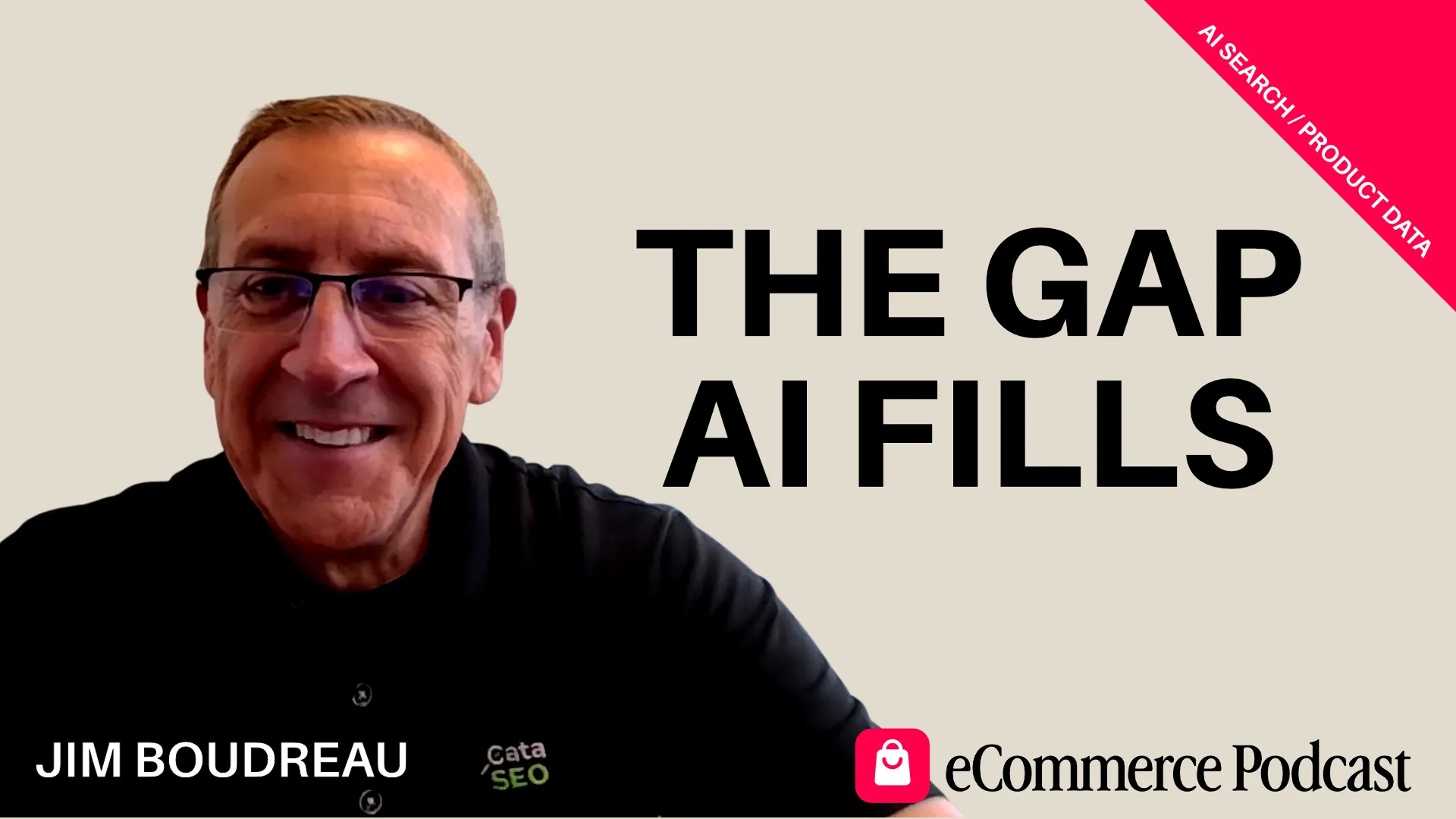
Jim Boudreau has studied SEO since 2001 — and even he had to ask ChatGPT what was actually in the box. In this episode, Jim explains why catalogue-scale SEO breaks the old playbook: once you've got hundreds or thousands of product pages, hand-crafted content stops being realistic, and copying the manufacturer's description starts costing you visibility in Google and in AI search. He walks through what actually moves the needle — product-level metadata, structured data, FAQs, and category pages built to answer the questions customers (and the AI) are actually asking. Jim is the founder of CataSEO, an AI tool that optimises ecommerce catalogues for search and generative AI engines, built in partnership with Moz.
Jim Boudreau has studied search engine optimisation since 2001. Last month, trying to help a friend choose a laptop, he still couldn't find out whether a Microsoft Surface came with its keyboard. Not on the manufacturer's site. Not on any retailer's site. Every product photograph showed the keyboard sitting right there, attached. The only place that told him it was sold separately was ChatGPT.
Jim has been building ecommerce businesses since 1998, long enough to watch most SEO fashions arrive and fade. He's now the founder of CataSEO, an AI tool built in partnership with Moz that does the product-level optimisation work most stores skip once they get past a few hundred SKUs. His argument is that the gap which nearly left his friend guessing about a keyboard is the same gap costing stores their visibility in AI search, and it has a plain, unglamorous fix.
Same Work, New Audience
Jim tells us that if you resell someone else's products, don't copy the manufacturer's description. Every store selling that item has the same paragraph, so Google, and now the AI engines reading the page, has no reason to credit any one of them for it.
What's changed isn't the principle. It's who's reading the page. "Any of the LLMs, they don't care about that beautiful picture, that romanced description," Jim said. "They want to know how do I use it? How do I maintain it? How do I clean it?" The structured, factual detail that used to be a nice-to-have for search rankings is now the only thing an AI engine can actually use to recommend a product at all.
That's the thesis running through this whole podcast episode. AEO, GEO, whatever three-letter acronym you prefer (Jim just calls it "alphabet soup") isn't a new discipline bolted onto SEO. It's the same groundwork, done properly, for a reader that can't be won over by a nice photograph.
The Box Problem
This is where the Microsoft Surface story comes back into it. Every image of the Surface showed it with a keyboard attached. Nowhere on the retailer or manufacturer page was it stated plainly that the keyboard was sold separately. Jim only found out from ChatGPT, and the purchase got pushed off entirely, because nobody wants to buy a laptop that might arrive with no way to type on it.
The pattern repeated with a pair of computer monitors. Jim wanted to know which cables came in the box, bought from, in his words, "the biggest electronics retailer in the US". He couldn't find the answer, so he bought extra cables himself just to avoid the risk of a half-finished setup. Two different products from two different retailers, and the same missing piece of information both times.
Call it the box problem. It isn't really about keyboards or cables. It's about every store assuming a photograph can do the job that only a plain sentence can do. "If it does exist, it's too far below the fold," Jim said of the rare cases where the information is there at all. For a human shopper, that's a return waiting to happen. For an AI engine trying to answer "does this come with a keyboard", it's a product that simply won't get recommended, because there's nothing for the AI to read.
Product by Product, Not Page by Page
Jim's route into ecommerce started by watching two entrepreneurs in Boston build a company called CSN Stores out of small, specific niches, long before it was eventually rolled into Wayfair (their company, not his, but the pattern stuck with him). The lesson he took from it was that people will shop online first for the item they want badly enough to risk putting a card number in. Two years ago, mentoring at a venture studio in Cambridge, Massachusetts, he heard the same AI hype he'd heard during the dot-com boom, and decided the real opportunity wasn't the big dramatic disruption everyone was predicting. It was solving the unglamorous, everyday problem that small and mid-size operators don't have the time or budget to fix themselves.
For Jim, that problem was product-level SEO at catalogue scale. "It's impractical to do SEO on a product level" once a store has hundreds or thousands of SKUs, he said, but that granularity is exactly what AI search rewards. CataSEO works from the bottom up rather than the top down. Instead of trying to win with pillar pages and landing pages, it takes one product at a time, works out who's outranking you and why, then rebuilds the metadata, structured data and supporting content around that specific product. It installs into Shopify, BigCommerce, WooCommerce or Wix.
The practical checklist Jim laid out:
- Don't copy the manufacturer's description. Add something the manufacturer overlooked that made you choose this product for your store.
- Keep URL slugs and page titles tight. A title eaten up by the brand name at the end is wasted space.
- Write alt text that describes the picture, not the product. His example of what not to do is copying the product description into every image's alt tag and tacking "top view" or "side view" onto the end.
- Populate category descriptions properly, with enough real content that it reflects the category rather than just a title.
- Build FAQs at both product and category level, because that's exactly the format AI engines use to answer a shopper's question.
Where This Already Works
The same logic holds up outside the product page. Jim's view on category pages is that they're "dual purpose", a courtesy to the shopper and an education for the crawler at the same time, and he doesn't think the two have to fight for space. Keep products visible near the top of the page, but don't leave the description empty either. If a category genuinely needs more explanation than fits in a paragraph, that's a blog post, not a wall of text wedged above the grid.
Blog posts are where Jim's old-school instincts come through clearest. The question he uses to filter every post before it's published is this. Will the reader, who is also a potential customer, actually benefit from reading it, and will they read it to the end? Posts written as sales pitches fail that test immediately. Posts that answer a genuine question about the category pass it, and they're also the content an AI engine is most likely to lean on when a shopper asks the same question.
He applies the same filter to AI-written content generally. Jim is drafting two books at the moment, both using AI as what he calls a co-writer rather than a replacement, feeding it decades of his own notes and insisting it match his own style rather than invent its own. The output, he reckons, is roughly twice the quality in half the time.
What AI Can't Do
What AI can't supply is the original thought, the pattern recognition that comes from actually watching a category change over years. Jim used the image of training a model on every disaster in history except earthquakes. No matter how much data you feed it, the model still couldn't predict one, because it has no experience of what one actually feels like.
An operator's years in a category are that experience. "It takes the gray hair factor to be able to watch that trend," he said, pointing to how bicycle frames moved from solid steel to alloy to composite over decades, a shift you'd only recognise by having watched it happen. That's the 5 percent, in his estimate, that AI can't give you. It can scrape the internet and hand back the other 95 percent of general knowledge, but the foresight and the judgement stay with the person who's actually been there.
What Changes When You Do This
Stores that get the product-level work right stop losing ground to competitors who've copied the same manufacturer description, because there's finally something in the metadata and structured data to tell one listing apart from another. Categories with real descriptions and FAQs start answering the questions customers are already typing into Google and asking ChatGPT, instead of leaving them to guess or abandon the purchase.
There's an AI-specific upside here too, and it's only going to grow in importance. A product page with clean structured data, accurate specifications and a populated FAQ is a page an AI engine can actually read and recommend from. A page that relies on a nice photograph and an empty category description is one an AI engine will skip past the moment a shopper asks it a direct question, the same way it skipped past every Microsoft Surface listing until Jim asked ChatGPT instead.
Where to Start
Jim's advice for where to begin:
- 1Pick a handful of old products and check them against your own dashboard. Are they tagged properly? How complete is the metadata?
- 2Be honest about what you find. Jim's own phrasing for this is asking yourself "am I original? Am I complete?" about the database itself, not just the storefront.
- 3Fix new products first. He calls these "greenfield" opportunities, a fresh chance to get it right from the first listing rather than fixing it later.
- 4Refresh your oldest products in parallel, because what was stale becomes an opportunity the moment you update it properly.
- 5Once the product level is solid, work upward. Populate category descriptions, add FAQs at both product and category level, and only then turn to blog content.
The common thread is sequencing. Fix the product page before the category page, the category page before the blog post, and don't let any of it rest on a photograph doing a sentence's job.
Jim's best tip for ecommerce founders is to go and look, properly, at your own catalogue, and be honest about what you find. "Really be honest with yourself about the state of your database, not just your store," he said, and that honest look is the whole foundation, in his view, for getting a business to its next level. It sounds simple. But these things always do.
If you want to see where your own catalogue stands, CataSEO is at cataseo.ai, and Jim's team can be reached at info@cataseo.net.
Full Episode Transcript
Read the complete, unedited conversation between Matt and Jim Boudreau from CataSEO. This transcript provides the full context and details discussed in the episode.
Full Episode Transcript
Read the complete, unedited conversation between Matt and Jim Boudreau from CataSEO. This transcript provides the full context and details discussed in the episode.
[00:05] **Matt**: So welcome to the eCommerce Podcast. My name is Matt Edmundson and it is great to be with you today. Hopefully you're having a good day wherever you are in the world, whatever you're doing. Uh, hopefully you're enjoying, uh, your ecommerce business. Like you, I run my own ecommerce businesses. I have done since 2002. I love the process of it. I love the idea of it. I love the impact of it. And the fun of it. I mean, just love so many things. And today I'm sat in the studio, a brand new podcast studio. And it's in the— it's in one of the warehouses we have in Liverpool in the little corner, which is just a wonderful thing. I appreciate if you're watching the YouTube video, like, Matt, that backdrop does not look like a warehouse in Liverpool backdrop. Well, you know, I'll leave that to your own imagination anyway. Uh, we're in the studio, uh, which is in the warehouse, which I, I honestly, our warehouse is crazy right now. There are boxes literally everywhere. We have to figure out what we're going to do. Do we get some more premises? Um, they're all nice problems to have, really. Uh, and one of the things I love to do as an ecommerce entrepreneur, as well as brag about the fact we've got boxes all over the place, is talk to ecommerce experts like today's guest, like Jim, we've got on the show today. Um, and just pick his brains, people's brains, about how to run our e-com businesses better. How— what are we doing wrong? How do we do it right? All that sort of stuff. So that's what we're going to do in today's show. If you're new, make sure you like and subscribe and all of that good stuff. And of course, if you're returning to the show, you, my friend, are an absolute legend. Uh, thank you for coming back. Thank you for enabling us to do what we do. So with all of that said, let me just tell you one more thing before we get into the conversation, and that is, of course, everything we talk about on today's show, all the notes, the script, the links will be on our website at ecommercepodcast.net, all one word, ecommercepodcast.net. You'll find our entire archive of past episodes on that show. You will find links to, um, the cohort groups, which I'm really— they're the thing that I'm just psyched about at the moment. I love our cohort groups. I love getting on the Zoom calls with you guys and just shooting the breeze and talking about ecommerce, what's working, what we're finding. Um, looking at your sites, you know, and we all get to jump in, fellow e-commercers from around the world chatting about e-commerce and what's going on. I love it. I love the groups. People from Australia, from Canada, from the States, from the UK, from Europe, all over the world come and join the groups. They are totally free to join. Um, you'll just get to meet like-minded e-commerce entrepreneurs and founders and marketers from around the world all trying to grow their businesses. Some are just starting out, some have been around a while, let me tell you, uh, but we all share our collective wisdom and insights. Happen once a month on Zoom. So if you fancy it, go to the website ecommercepodcast.net, click the cohort link. I would be really confident if I would say to you, go to ecommercepodcast.net/cohort. I don't know if that link exists. So click the cohort link on the website and you'll find out more information about it. Now. Enough about me. Let's talk about Jim. Jim, welcome to the show, man. How you doing?
[03:24] **Jim**: Great, man. Thank you. And, uh, appreciate the, uh, the, the, uh, opportunity to, to join you for, you know what, uh, you know, 300-something, uh, episodes.
[03:35] **Matt**: Yeah, yeah, we hit the 300 mark a little while ago, so on a screaming our way fast to 400 now.
[03:45] **Jim**: It's amazing how fast the numbers, you know, you know, roll over. Yeah, it is that kind of speedometer of life.
[03:52] **Matt**: Yeah. And before you know it, we'll be at 400. And that's the scary thing. Um, but you know what, I just love the show. I love talking to people like you, Jim, uh, just because you get, you get so much insight, don't you? I mean, after doing 300 episodes, you learn a lot from people, uh, all over the world. And it's a wonderful thing. So for those, Jim, that don't know you, just give us a sort of a brief elevator pitch, who you are, what you do, and why you are
[04:19] **Jim**: Sure. I guess I would say I'm a sort of a lifelong entrepreneur. I've been starting and growing new businesses my entire career. I got into ecommerce in 1998 and, you know, in the days of, in the days of having to build it all yourself or hire some programs and kind of hit it and hope, trust that they know what they're doing. I learned that lesson the hard way, you know, but been building companies of all sorts since, from ecommerce to varying technologies. And then, you know, started an AI company 2 years ago that for now is focused on supporting ecommerce operators and kind of, you know, leveling that playing field between all the behemoths and You know, the operators like yourself.
[05:12] **Matt**: Oh, I— let's just touch on the point. You started in 1998. I— my hat's off to you, sir. I started in 2002. So you've been around longer than me. And that's, that's awesome. I don't get to meet many people that have been in this business longer than I have. And so you would be classed as a fellow ecommerce dinosaur as well, which I love.
[05:33] **Jim**: Dinosaur in probably many forms and fashions.
[05:40] **Matt**: The good
[05:40] **Jim**: news, you know, I'm gonna inherit my father's older than dirt, you know, t-shirt pretty soon.
[05:46] **Matt**: And what a t-shirt to inherit too.
[05:52] **Jim**: Ah, yes,
[05:54] **Matt**: absolutely, absolutely.
[05:55] **Jim**: I'm not fit, but I'm gonna, I'm gonna squeeze into it like, you know, like, uh, Baby Huey.
[05:58] **Matt**: Just be proud to wear it. Um, what's your AI company that you started 2 years ago?
[06:06] **Jim**: So it was, you know, if you go back to the dot-com boom way back when, right when you started and I started, you know, everybody was talking about how tomorrow morning at 11:43 a.m., you know, we're going to flip a switch and all retail stores are going to simultaneously close and all shopping is going to switch online.
[06:29] **Matt**: Yeah.
[06:30] **Jim**: And
[06:31] **Matt**: I didn't believe it then either, Jim. But yeah, I know what you mean. Yeah. Yeah.
[06:34] **Jim**: So, you know, I saw that movie before and I saw, you know, 2 really smart guys from Boston start a little company called CSN Stores and they focused on just little tiny niches. And what they theorized was that people are gonna shop online first for the item that they want so badly that it overcomes their fear of putting their credit card in.
[07:02] **Matt**: Yes.
[07:02] **Jim**: And then they eventually built a few hundred of these stores and, you know, they built out their supply chain, they built out logistics team, and eventually they rolled it up into Wayfair. So 2 years ago, I'm mentoring in a venture studio in Cambridge, Massachusetts, and I'm hearing all the same hype about AI. And it just dawned on me, it's not going to change the world overnight. You know, will it change the world? Absolutely. But where it's going to have the biggest impact is on, you know, small businesses solving these hard-to-find, nagging everyday problems that especially small business owners, medium-sized business owners experience every day.
[07:51] **Matt**: Yeah.
[07:52] **Jim**: And, you know, so that's why I decided to start a company. Right, is I think it just go where the pain is, go where people need the help. And, you know, and ecommerce is certainly one of those markets, you know, where everybody's trying to scratch and claw their way to compete with the Amazons and the other beasts. And so I saw a chance to kind of build some applications that can help.
[08:21] **Matt**: Yeah. What was the problems that you were seeing that you thought, oh, I could solve that with the software? What were some of the biggest problems you were trying to solve there?
[08:31] **Jim**: SEO is a big one, especially with AI search coming on scene. You have in SEO, right? Everybody watching has gotten at least 100 of the emails for $500 a month. We can get you to page 1 in Google. And, you know, you fought the battles, I fought the battles. It doesn't work that way.
[08:58] **Matt**: I wish it did.
[08:59] **Jim**: You know, and, you know, you can, you can get a little bump from doing the pillar pages, the landing pages, the, the blog posts, but sooner or later Google and the other search engines are gonna go, no, you still got the same description for this product that you copied from the manufacturer's site. That everybody else is using, so I'm not going to give you any credit for that. So so
[09:28] **Matt**: yeah,
[09:29] **Jim**: but but when you have hundreds or thousands of products, it's impractical to do SEO on a product level. You know, and but that's what's most important in AI search especially, right? You need that granularity of data. So you know again long story short, right? If you can It's impractical to do SEO on a product level. But, you know, I've also studied SEO since 2001 or '02. You know, if you can't, if it's impractical to do the hard work that you need to, right, either from a money standpoint or a time standpoint, you're never gonna be that number 1, number 2, number 3 site in your category. Yeah. You know, so I think that's, that's the first big opportunity is how do we use AI to do that really challenging, time-consuming, meticulous work to be visible?
[10:29] **Matt**: Yeah.
[10:30] **Jim**: You know, and that's, you know, so we built CataSEO and, and it works, you know, instead of trying to, trying to fool Google from the top down with the pillar pages and such, we start from the, from the bottom up. We take each product one at a time, figure out who you're competing with, why are they getting on page one and you're not? And then we basically say, okay, now that we know what Google likes for that product, we're gonna beat you. And then we're gonna do that first wrapper, right, of that killer product description, which is all your metadata. We're gonna get that all right. And again, that's most everybody, every store I've ever seen, half of it's unpopulated, much less populated the way it's supposed to be.
[11:16] **Matt**: Yeah.
[11:17] **Jim**: And then from there, we're going to wrap it with the structured data that AI likes. So it's, it's really about getting every product perfect, one product at a time, because, you know, any of the LLMs, they, they don't care about that beautiful picture. That romance, you know, that romanced description. They want to know how do I use it? How do I maintain it? How do I clean it? You know what? What are the size? What are the requirements? You know, and so it's ironic that the stuff you need to do to be really solid and visible in AI is all the same fundamental stuff you have to do. Or had to do for SEO.
[12:07] **Matt**: Yeah, that's the interesting thing, isn't it? About what they're now calling AEO or GEO or whatever your three-letter acronym of choice is.
[12:14] **Jim**: I just call it alphabet soup.
[12:16] **Matt**: Yeah, you can see why Google called their company Alphabet Company. But yeah, I you I mean that's the thing. Everyone's talking about how do we do it, and I think they're good conversations. We've had people on the show talking about it, but the the general thing that I've picked up is well if you want. to be recommended by ChatGPT, then do SEO stuff, but well, right? Especially the schema, especially the FAQs, you know, all the sort of things that we've been practicing, I suppose, for the last, what, 8 years in ecommerce? You know, all the things that we've known to do. If you do those well, it seems to be that that's 90% of the battle with AI. Or have I misunderstood it, Jim?
[12:57] **Jim**: No, no, you're— it's, it's absolutely the same battle. You know, the problem is how do you do it when you've got more than 100 products? And then how do you keep it fresh? Right? Because it— when it goes stale, you're, you're toast.
[13:13] **Matt**: Yeah. So how— well, I mean, on that point then, how do you keep it fresh? What are some of the things that you've seen work there?
[13:22] **Jim**: Well, it's a matter of— and, you know, we kind of tried to replicate when we built CataSEO, we tried to replicate what are the best practices, right? And it's kind of in parallel, right? Your new products have got to be perfect, right? Because they're greenfield opportunities. You know, you have that opportunity. You know, there's a fresh landscape for this new product. Be the best from the get-go. But at the same time, you have an opportunity to refresh your oldest products and do that in parallel because now what was, you know, what is old is new again.
[14:04] **Matt**: Yeah.
[14:04] **Jim**: So you're refreshing what is stale and then as you're doing that percolate up, right? So get your category descriptions to be as to be reflective of what's in the category. Get your brand descriptions populated. You know, know more about your brands than anybody else. But you know, that's the thing. I think most e-commerce operators that I've ever met, they're absolute experts in their category. But Google doesn't know that, you know, and ChatGPT doesn't know that.
[14:45] **Matt**: How would you? I mean. I'm kind of keen to start getting a little bit into the weeds here, Jim, with what you're talking about. So I get the product descriptions and the product SEO. You just, you mentioned the category and, you know, we are experts in our categories, but Google doesn't know that. How do we, how do we make sure Google does? What are some of the things that we need to think about and do in those areas? You know, I appreciate we can use your software, but if we're not, what are some of the things that we can, we can think about?
[15:19] **Jim**: Well, you, you have to get the product right. Okay. You know, the biggest thing is the not to do. And the not to do is copy the, you know, if you resell other people's products, is don't copy the original manufacturer's description.
[15:38] **Matt**: Yeah.
[15:39] **Jim**: Okay. Okay. Make it better. Even if you just use ChatGPT, make it better, right? Tell people something about that product that the manufacturer may have overlooked that made it special, that made it something you chose for your store. Yeah. You know, the other thing is then make sure you wrap it with the right metadata. Make sure you follow the rules. Don't let your URL slugs get too long. Don't let your Titles get too long. Nobody cares about your brand name at the end of it if you ate up valuable space in the page title, right? So get that right.
[16:17] **Matt**: Yeah,
[16:18] **Jim**: yeah. Another one is pictures, right? You know, just don't have just one picture, two pictures. Have a— you know, you've got AI tools today that you can put products in a setting. You know, we actually just added that feature on to CataSEO to generate images. But, and this is another funny one. The old trick in alt tags has always been copy the page, copy the product description, paste it in the alt tag and say top view, mid, you know, side view, front view, you know. But what an alt tag is supposed to do is actually describe the picture, not the product. Yeah. So all these little nuances are, you know, really important. But as you do this, as you kind of think about yourself, I know this about this and— right, well, your category description should reflect that. And a lot of people don't put a lot of energy into the category description. A lot of them just give it a title and leave the description empty. Some ecommerce shopping, you know, site templates don't even have the category description populated on the page.
[17:42] **Matt**: Yeah.
[17:43] **Jim**: You know, sometimes it's just inserting a variable in the, in the, in your template. So, and then, and then I think it's, you know, to be that expert, you gotta, you do have to write the blog posts. But you, you don't want to be doing it as a sales pitch. You want to talk, you want to talk about, you know, why do you use X product? Why use Y product? What makes one product different from another? I think that's the other thing is when you're, when you're writing, you want to write based on, you know, your natural instinct is write based on, well, I want to sell more product. But that's not what people want to read. People hate sales pitches. So when you do write, ask yourself this: will the reader who happens to be my customer or potential customer benefit from reading this? And will they want to read it? Will they read it to the end? And I think if you filter it through that lens, You know, you're, you're gonna get a lot more attention to the site. Yeah, you don't need to link to your products. You know, sometimes it's relevant, but you know, they're going to spend time on site, they're going to look around.
[19:02] **Matt**: Yeah, yeah, yeah, yeah, that's interesting. So, uh, the— I'm taking lots of notes here, uh, so if you hear me typing in the background, Jim, I'm just—
[19:14] **Jim**: Oh no, all good.
[19:16] **Matt**: I'm not, I'm genuinely not doing emails. Um, I used to handwrite them, but now in the new studio I have a, I have a keyboard and I, I type them, which is, I don't know which is better actually. Um, so the product we, you've mentioned that you went into detail there, which is great. Obviously, uh, don't use the original description, uh, make it better, uh, using whatever mechanism you can do to use that. I love this idea of telling people something that made it special. Um, or something that the manufacturer overlooked, which is a reason why you're selling it. What, what have they not talked about? Um, and then obviously follow with the right metadata. You've mentioned that, which is great. And then obviously pulling this up to the category. And I, I, I'm glad you drew out the fact that actually a lot of websites I see, the category page is just a title. There is no description. Is there? I guess in my head, I'm, I'm, I'm thinking of 3 different category pages. Jim, and, and I, I don't know what you think is the sort of the, the best template other than I appreciate it depends on the website, right? Um, so template number 1 you've talked about is the category title. Template number 2, you've got the category title with maybe a paragraph of text.
[20:25] **Jim**: Mm-hmm.
[20:26] **Matt**: Template number 3 is category title with maybe 2 or 3 blocks of text with images, a possible video. And products starting to list down at the bottom, but then obviously the length the customer's got to scroll to start to see some of those images is bigger, but the text is fuller. What's your opinion on that? I'd love to hear it.
[20:45] **Jim**: You know, I think you have to have some products, you know, top of fold, right? You can't let your header, your category description block out product because that's why they're there. They want to see the products in that category. Okay, so you're, you're kind of playing sides against the middle, right? You're trying to give a little bit of an idea for the customer. But more than that, you're trying to educate Google, you know, Brave, Bing, whomever, and the LLMs.
[21:19] **Matt**: Yeah.
[21:20] **Jim**: You know, so, you know, it's, it's a, it's dual purpose.
[21:26] **Matt**: Yeah. That's a good way of putting it, is dual purpose, isn't it? And, um, and I think this is what on mobile, this is where you see a lot of accordions starting to now happen, isn't it? It's like you can click to expand this, uh, and we're going to default to it being closed because if you want to read it, you can, but we know Google wants to read this and they can without expanding the, uh, the, the box. And so I'm starting to see a lot of that, especially in mobile design now. So you can concertina things up, right? Does it matter if you do it whereby Um, there was always— I'm going back years in my thinking now, Jim. This is old school conversation in many ways.
[22:00] **Jim**: Yeah.
[22:01] **Matt**: Does it matter if you have the category description underneath the products?
[22:05] **Jim**: I think hierarchically it's going to get devalued by the, uh, the crawlers and, and the, uh, bots. So I think it doesn't have a lot of value there. You know, you can always, as you say, you can accordion it. You can do a— hey, you could write a post, right? You know, let's say it's a really crucial category, you know. So what's important to the user of X category of products? Then do a blog post on it, okay? And say, to learn more about, you know, selecting this product for this use case, right? If that is really a crucial Bit of knowledge, something you're an expert on. Well, that should be a blog post.
[22:50] **Matt**: Yeah,
[22:53] **Jim**: right. You can also do you can also do a pop out.
[22:59] **Matt**: Mm-hmm. Yep.
[22:59] **Jim**: You know, do your three to four line teaser. Click to learn more. Do it as a pop out. Don't affect the page.
[23:07] **Matt**: Yeah, yeah, yeah. No, I like it. I like it. I like the fact you're still using blog posts. We've not talked about that for a little while, actually. But one of the things that is an interesting observation about blog posts, everyone seems to be doing more of them because it's an easy thing to get AI to write now, isn't it? ChatGPT, write me a blog post on this brand of tennis rackets or whatever, and it'll go away and it'll write a blog post. Of course, the problem with it is, we all know, is AI slop. So, um, and it's only going to get worse because AI is using the internet to feed its algorithm, but the content it's feeding the algorithm is more and more the stuff it wrote last year or 2 years ago. How do you, how do you marry up then the creative process here? So there's, there's gonna be The purists which say, I'm going to write the blog post from beginning to end, and I'm going to try and do it in a structured way so it benefits my SEO rankings. I'm going to have an H1. I'm going to have some different headings. I'm going to think about those. I might even research them if I'm there. But I'm going to write this thing. I'm going to write it from the heart. There's on the opposite side, there's the person who is Maybe a little bit more unconcerned about that. They're more concerned about efficiency and optimisation. So they're like, "I don't, I don't care about. I just want to get this thing out now. I want the search engines to read it and understand it. I could care less about anything else." Then obviously you've got people in between, which is where I think most people sit, where it's like it's a hybrid. It's sort of working with AI to create the blog post. What are your tips? What are your thoughts? What are your ideas around creating blog posts for those listening, the founders? How do we create these? good enough for Google, but also in a way that benefits our, you know, like answering your question, will the reader benefit from reading this and will they want to read it to the end?
[25:11] **Jim**: Oh, so here's something I think that is really important to understand about AI. I'm going to use a little, a quick little metaphor. If you trained an LLM on every disaster that ever befell the Earth, in billions of years— volcanoes, hurricanes, you name it— but there was never an earthquake. And again, just say for the sake of conversation, there was never an earthquake. AI could not predict the earthquake.
[25:49] **Matt**: Right.
[25:49] **Jim**: All right. Because it's drawing on experience now. If you're an expert in your product category, right, let's just say, you know, and I'm not in the bicycle business, but bicycle frames. I was a kid, it was a rock-hard, you know, solid steel, you know, rust-away beast. And now you've seen it go from there to alloy metals to every manner of composites, right? Well, it takes the gray hair factor to be able to watch that trend and kind of imagine and know where it's going, right? Maybe you talk to the factory and you, you see what they're doing next. All right. AI cannot give— call it that, that 5% factor,
[26:42] **Matt**: right?
[26:43] **Jim**: You know, it can, like you say, it can go scrape the internet and come up with the 95% of knowledge. But it's not going to come up with that innovation, that perspective, that foresight that you do as an expert.
[26:57] **Matt**: Yeah,
[26:58] **Jim**: right. That's the value, right? And the LLMs are getting smart enough to know, well, geez, an LLM wrote that, so I'm not going to give it a lot of credit.
[27:08] **Matt**: Yeah.
[27:09] **Jim**: So it might say, well, I can see that an LLM wrote this, or at least did a chunk of this, but there is original thought here. Yeah.
[27:16] **Matt**: Yeah.
[27:16] **Jim**: So the way I approach it is I want to write an article about X. I need experts to cite on these points. Okay. They— studies, experts, whatever. I want it to flow like this. I want to make the following points. And oh, by the way, you've already read hundreds of pages that I wrote, hundreds and hundreds of pages that I wrote before AI. So you better write it in my style.
[27:46] **Matt**: Yeah.
[27:47] **Jim**: So I'm saying, give me, you know, give me the outline, fill it in, make these things. So I'm being very, very definitive in what I tell it.
[27:57] **Matt**: Yeah.
[27:57] **Jim**: So can I turn out twice the quality blog post in half the time and get a 75% improvement in efficiency? Yes. But I'm not going to sacrifice the originality, the, the, you know, the gray hair that I've earned for that post because that's really what people are looking for. That's what people wanna read.
[28:20] **Matt**: Yeah, that's super powerful. I like that, the original thought. And actually, I suppose one of the ways that you can use AI, the LLMs, is to help you, is to help extract that original thought from you. Right. And I, I've found AI is quite good at this in terms of if I will sit, if I sit there and say, listen, I want you to ask me a bunch of questions around this topic. Um, what's common knowledge that, you know, you could just write about? What's unique to me? What's, what's, what's interesting here? What's the gold? What's that, you know, that sort of, uh, thing that no one's talked about, the innovation that you mentioned? Mm-hmm. And actually brainstorming with AI in that sense is actually quite helpful to draw that out of you, you know?
[29:08] **Jim**: Yeah.
[29:08] **Matt**: Because I've found sometimes, like, I could sit there and go, I'm sure I've got something here. I'm just not quite sure how to word it. You know, I'm not quite sure what to say or how do I phrase that? And I suppose this is where AI can help you bring that out.
[29:24] **Jim**: Well, you know, it's funny you mentioned that because I'm actually writing 2 books in parallel. That,
[29:31] **Matt**: of course, you are one with your left hand, one with your right hand.
[29:33] **Jim**: Yeah, you're right. But, you know, they've both been in my head for, you know, decades.
[29:40] **Matt**: Yeah.
[29:40] **Jim**: But how do I get it on the page? You know, and the first one, I literally wrote the, you know, an outline and a, and an intro and a draft, you know, an abstract 20 years ago. And just never got around to working on it. I said, you know what, it's time.
[30:00] **Matt**: Yeah.
[30:01] **Jim**: And I've got probably 20 hours into the outline, you know, like a 3-level outline and the flow of it, the intro and, and just the first chapter. So am I going to be able to turn this book out in, you know, 1/3 the time I could write, could have written it by myself? Yeah. But as you said, it's drawing it out. It's making me feed it. It's saying, you know, you made this point about this. You know, where does that belong? And, you know, it's really— if you use it right, it's not just a tech tool creating blather. It's, it's, it's a ghostwriter. It's a co-writer.
[30:44] **Matt**: Yeah.
[30:45] **Jim**: You know, I think, you know, if you use it that way, it's not doing it for you. It's doing it with you.
[30:51] **Matt**: Yep.
[30:51] **Jim**: You know, then it becomes powerful.
[30:53] **Matt**: Yeah, that's super interesting, isn't it? Yeah. Wow, good to hear you're writing 2 books, uh, in parallel. I am. I'm also doing the same thing. I'm like, well, AI can help me write some stuff here because I've got, like you, I've got a whole bunch of stuff in my head and I'm like, now's the time. It's never been easier to write. I mean, I suppose the trip— the difficulty I have, I don't know if you find the same thing, Jim, is finding the time to write the Pig-In thing. And AI can help me, but it still takes time. And I think because of AI, my whole half of my life at the moment, it feels like half of my working life is understanding how AI is affecting my business and figuring that out. So AI is sucking me down this big old rabbit hole. So it's finding the time to do it. I don't know if you, I hope it goes well for you, sir. I hope it goes quicker for you than it seems to be going for me. That's for sure. You know,
[31:45] **Jim**: it's funny. Sometimes it's a matter of getting the right tools, tool stack going. So, you know, I've kind of settled into a groove with Claude Code.
[31:56] **Matt**: Yeah.
[31:56] **Jim**: And so I've got local file storage, right? So I've got what I'm used to. I've got the Word docs, I've got the spreadsheets, I've got my library of docs, right? And, you know, I can grab things and say, you know, ingest this. But I'll keep 3, 4 chats going because, you know, it doesn't just Click and there's what you want. So I'll like give it a prompt, respond, go to the next one, go to the next one, go to the next one. So I'm typically working three or four of them at a time.
[32:28] **Matt**: Yeah, yeah.
[32:30] **Jim**: And you know, and it's funny, you know, just circling back to like the you know the whole SEO equation, right? People that are using AI to kind of write that content for their site, they're kind of doing the same thing. But you know, when you're doing You know, if you got 50 new products you're putting up, you just, you know, said at the outset, you got boxes and boxes. How many of them are new products you've got to get up on your site? Right? How do you get all that done? How do you, how do you not just mail it in and just get it up there for the sake of getting it up there versus getting, getting it up there in a way that's going to actually sell it through and grow your business?
[33:11] **Matt**: Yeah. Yeah, that's a fair comment. It's a really interesting dilemma, isn't it, that we've got? So in terms of the product pages, we've got the category pages, we're sort of going back to blog posts, rethinking those, getting AI to help us. How important are things? Because again, I hear different things from different people. I'm curious to know your viewpoint on this. How important are things like video? Like, you know, putting content out on YouTube around the product demos, talking about it, you know, all that sort of stuff. What are your thoughts on that?
[33:48] **Jim**: I think the human element, it's important, but I think it also depends on what product it is.
[33:54] **Matt**: Okay.
[33:55] **Jim**: Is it a piece of jewelry? Is it a fashion item? Is it sporting goods, right? Or is it an industrial product? You know, you're selling nuts and bolts and bins. I think it's what is most important to teach your user enough about your product to make an informed purchase description. You know, and then I think an easy lens to look at your product, your store is especially going forward, right? Is an AI agent going to pay attention to this. Yeah. And so, you know, the funny thing is, you know, you've social— you know, you look at social media marketing, you know, people can't— people have to be social. We're social beings. So people are going to be on social media. So I think there's a play there in winning your audience for sure. But I think it's— I don't think it's going to change much in terms of the next 2, 3, 5 years. But 5 to 10 years from now, you know, if you still plan on being in business, if you put all your eggs in that basket, you're going to wake up one day and find you have no audience. Hmm. You know, at least not the audience that's making purchases.
[35:25] **Matt**: Yeah. Yeah. That's a really interesting point. A really interesting point. Because you're right. I mean, at the moment, as far as we know, AI is, I mean, it does obviously watch social media, but I think it's so vast and so big, how realistic it is for it to train on it. I don't know. I guess Grok does with Twitter. I don't know on the other platforms. It'd be interesting to find that out. But you're right, it's like, whereas AI is gonna pay a lot more attention to a blog post about the product category than maybe a reel where, I don't know, it's an interesting thought, Jim. I'd not thought about that before. I think that's a fair point.
[36:08] **Jim**: Well, it's also nuanced, right? You know, I think of trying to learn Russian because my fiancée speaks Russian. And, you know, whenever I start getting close and she thinks I understand what she's talking about when she's talking to her girls, she says, we're just going to switch to slang and then you won't have any clue what we're saying. So, you know, it's— think about that, though, right? How much of video, how much of language, how much of facial expression is cultural or nuanced?
[36:39] **Matt**: Yeah.
[36:41] **Jim**: You know, how does AI normalize that? Because that's the— that's why you've got to do structured data.
[36:47] **Matt**: Yeah,
[36:47] **Jim**: you know, for everything is to normalize it so that AI can kind of, kind of level a playing field.
[36:54] **Matt**: Well, you're making it easy, aren't you, for AI? So when you structure the data, certainly with your, you know, your snippets and your titles and all that sort of stuff, giving it that structure, you're making it easy for AI to try and understand it. You're not making AI second guess, which we've known for years is the way to win a customer. You don't make it difficult for the customer to figure it out unless you're doing like a murder mystery event, right?
[37:20] **Jim**: Yeah, right. Yeah. Yeah. Where it's the goal.
[37:24] **Matt**: Yeah. Yeah. But when it comes to like buying your widget off your website, it's not to make it hard for the customer to figure it out. And actually what you're talking about is You're also saying, well, don't— not only don't make it difficult for the customer, don't make it difficult for AI and don't make it difficult for Google. It's common sense, right? And that's why we use structured data. One of the things that they said years ago when it— when I started getting into this whole thing, I came across a great book. I can't remember who wrote it. And the book was called They Ask, You Answer. And it was all about the power of writing Uh, blog post around questions that customers have, right, about your particular product, service, category, and so on and so forth. And one of the things that I've noticed again with AEO and GEO is pretty much it's like you need a good FAQ section on your product page around questions around that product. You need FAQ on your category pages around category questions and so on and so forth. Um, because obviously in AI, we're now asking AI a lot of questions. And so the FAQ sections are feeding AI the information it needs to answer those questions. Um, what's your thoughts on that, your takeaways on that?
[38:38] **Jim**: Well, I mean, I've been in, in the many hats I've worn in my career, you know, I've built countless, built and led countless sales teams. And, you know, there's a few quips that I, that I always share with them. One, as soon as you start convincing, you've lost.
[38:58] **Matt**: Okay.
[38:58] **Jim**: Okay. And because then it's a tête-à-tête and you're never going to convince. It's— and the other is it's not about selling. It's about helping someone buy, right?
[39:15] **Matt**: Yeah.
[39:16] **Jim**: You know, I tease sometimes some of the people I've worked with over the years that they're the sales prevention department. You know, paid samples, you know, all sorts of scenarios, right? You know, you're the sales prevention department and, you know, your job is to get the obstacles out of the way, right? And if you look at the evolution of ecommerce systems, right, one-click purchase, you know, your choice of purchase methods, you know, buy now, pay later options, right? Get the obstacles out of the way, right? Questions— what I need to know to make a good purchase decision as a consumer, you know, those are critical questions, right? So if you can't answer that quickly— and I'll give you a funny story. I mean, just last week I went on to You know, I don't want to name names, but the biggest electronics retailer in the US to buy a couple of computer monitors.
[40:20] **Matt**: Okay.
[40:21] **Jim**: What cables in the box? Stupid, silly question. What cable is in the box?
[40:31] **Matt**: Yeah.
[40:32] **Jim**: Okay. And this is, you know, leading brand product on leading retailer site. I was looking this weekend, a friend of mine was, you know, considering a new laptop. So I was looking at a— looking for him at a Microsoft Surface, right? You can't find anywhere except ChatGPT that this thing doesn't include the keyboard because every picture on the Microsoft Surface site, on the electronic retailer sites, they all show it with the keyboard,
[41:08] **Matt**: right?
[41:09] **Jim**: But they make— but it's not overt that it's not included. So there's a simple, stupid, silly thing that the biggest brands in the world, retail and manufacturer, can't seem to get right, but that a consumer needs to know to make a purchase. So what happens? You know, in the case of the Surface Pro, pushed the decision off. Right. In the case of the monitors, bought extra cables just so that we didn't have to worry about— so we didn't get derailed in getting, you know, the computer set up for them. But this is— these are just microcosms, little tiny, tiny examples.
[41:52] **Matt**: No, and it makes a lot— and actually, I've seen this a lot where people would use a photograph and actually in small print they've started to put keyboard now not included. Um, for illustrative purposes only. And it's kind of like, I think, again, the reason you've had to write that is because your imagery is creating confusion. And I, I find it fascinating that actually you went on that site and they didn't tell you what was in the box. That's—
[42:25] **Jim**: Yeah.
[42:25] **Matt**: That's surely, that's got to be one of the key reasons people send the product back. You know?
[42:31] **Jim**: Yeah. And again, if it does exist, it's too far below the fold.
[42:36] **Matt**: Yeah. Yeah.
[42:40] **Jim**: And you would think somewhere along the way they'd ask people, why did you choose this product? What's the most important thing in buying X, buying Y? You know, that's, by the way, that's another great marketing idea, right, for ecommerce operators. Get the surveys. Going. No one ever surveys the customer. They do give me the give me a review. How did you like the product? What was your experience? But not hey, you know, get a chance, you know, enter a you know fill out the survey for a chance to win a $500 shopping spree.
[43:14] **Matt**: Yeah, yeah, yeah.
[43:18] **Jim**: You know, you know there's there's so many opportunities to engage and gain knowledge.
[43:26] **Matt**: I'm just making notes, Jim. This is gold, man.
[43:29] **Jim**: It's gray, it's gray hair, you know.
[43:33] **Matt**: It's great. Yeah, I was, I was about to say it's old school principles that I think sometimes we forget, uh, because we think new school methodology doesn't meet old school print or doesn't need the old school principles. And I think actually they're foundational. Um, really fascinating, Jim. Listen, I'm aware of time. And I'm loving the conversation, which I feel like we're just getting started, Jim. But this is a part of the show where I ask you for a question for me. So this is where I love to ask guests for a question. I will take that question and answer it on social media. The question can be literally about anything. But Jim, what's your question for me, my friend?
[44:09] **Jim**: Well, I think, you know, how do you see the advantages, you know, the advances in technology affecting The small midsize e-com operators.
[44:23] **Matt**: Fantastic question. If you want to know how I see it, come follow me on social media @MattEdmundson. I will do my level best to answer that question. But Jim, if people want to reach out to you, if they want to find out more about what you how do you pronounce it?
[44:37] **Jim**: Yeah, that's one of the things even you know the ElevenLabs can't get right. We call it CataSEO.
[44:43] **Matt**: CataSEO.
[44:43] **Jim**: There we go. Catalog SEO.
[44:45] **Matt**: Yeah.
[44:46] **Jim**: If you go to just CataSEO, you can see it on the shirt. I kind of cheated a little. cataseo.ai, and from there you can book a demo. You can—it'll take you to whether you have Shopify, BigCommerce, WooCommerce, or Wix. There's a page that will take you to install it. There's a free trial. You can schedule a demo, or you can email me directly at info@cataseo.net.
[45:19] **Matt**: info@cataseo.net. Fantastic. We will of course put the email and the website link in the show notes. And of course, if you're on a podcast player, just go down to the show description, they'll be there. If you're on YouTube, just go into the description. And if you don't want either, just go to the website ecommercepodcast.net. We'll make sure all of those are there. The links will also be in the email if you subscribe to the email newsletter. If you're not, why not? What's wrong with you? I just don't understand it. Just go subscribe to the newsletter, because that sales tactic always works. But yeah, honestly, we do all we do is to send out one. I jest; we just send out the notes from the podcast. That's all we do. But you can go get those in your inbox. However you need to get a hold of them, do reach out to Jim. Go see what he's doing. There's some good stuff. There's some really interesting ideas and some. Really good old school marketing principles, which I personally love. So do go check it out. But Jim, thank you for coming on the show, man. Really appreciate it.
[46:20] **Jim**: It's been my pleasure, Matt. And good luck getting all the boxes unpacked.
[46:29] **Matt**: Don't. It's not even.
[46:33] **Jim**: Been there, done that. Yeah,
[46:35] **Matt**: yeah, yeah, yeah. It's funny because at the same time I'm still moving house and so there's more boxes at home when you get— anyway, that's another— don't feel sorry for me, ladies and gentlemen. It's a good problem to have, that's for sure. Jim, in closing, we like to do this thing called saving the best till last. So for those that have sort of stayed around till the very end, I would love your best value, top value tip for any ecommerce founder out there at the moment. What is one thing they can do today that will absolutely make a difference tomorrow? For their e-com business?
[47:12] **Jim**: I would say take a look, right? You, if you look at your product catalog, you look at your database, you tend to get so wrapped up in running the business that you forget to look at all these foundational things. Go just Find a couple old products, look at them in your dashboard. You know, are they all tagged? Are they, you know, how good's the meta description? Really be honest with yourself about the state of your database, not just your store, your database, and say, am I original? Am I complete? And Then if the answer is, you know, not really, how do I get there? I think it's just be honest with yourself about where you're at because that's the only way you rebuild the foundation to, you know, get to that next level with your business.
[48:13] **Matt**: Well, fantastic. As simple as that. It sounds simple, but actually difficult to do, but life-changing when you do. Jim, thank you, my friend. Really, really appreciate you coming on. Lovely to chat with you. Apologies again for the late recording time.
[48:30] **Jim**: No, no worries at all.
[48:31] **Matt**: Thank you for sticking around. The people listening to the show are like, what are you talking about? We started 30 minutes late thanks to me and my ineptitude, but that's okay.
[48:40] **Jim**: All good.
[48:41] **Matt**: Jim was very gracious. But yeah, thank you so much for joining us, Jim. Thank you everybody listening to the show. It's been great being with you. Hope you got a lot out of it. Like I said, everything's available at ecommercepodcast.net. But that's it from me. That's it from Jim. Thank you so much for joining us. Have a phenomenal week wherever you are in the world. I will see you next time. Bye for now. Bye.
Meet your expert
Jim Boudreau
Jim Boudreau
CataSEO
Even more episodes...