AI Search Optimization for Ecommerce: Get Found by ChatGPT
When someone asks ChatGPT for the best hiking boots, it names brands, not links, about 97% of the time. Search veterans Dave McAnally and Alan Osetek explain how AI is compressing the ecommerce funnel, why the answer often comes from YouTube, Reddit and third-party review sites rather than your own website, and how a 6,000-subscriber creator ended up answering for Adidas. Inside, a practical checklist covering FAQ blocks, schema, video and niche-source relationships, how to measure AI traffic in GA4, what's coming with OpenAI ads, and why small brands can still beat the giants by owning the questions no one else is answering.
Ask ChatGPT for the best hiking boots for a rainy season, and about 97% of the time it hands you a shortlist of brands, not a page of links. If your brand isn't on that list, you're invisible. That's the shift we are in right now, and it's why two search veterans came on the show to talk about what ecommercers should be doing about it before Q4.
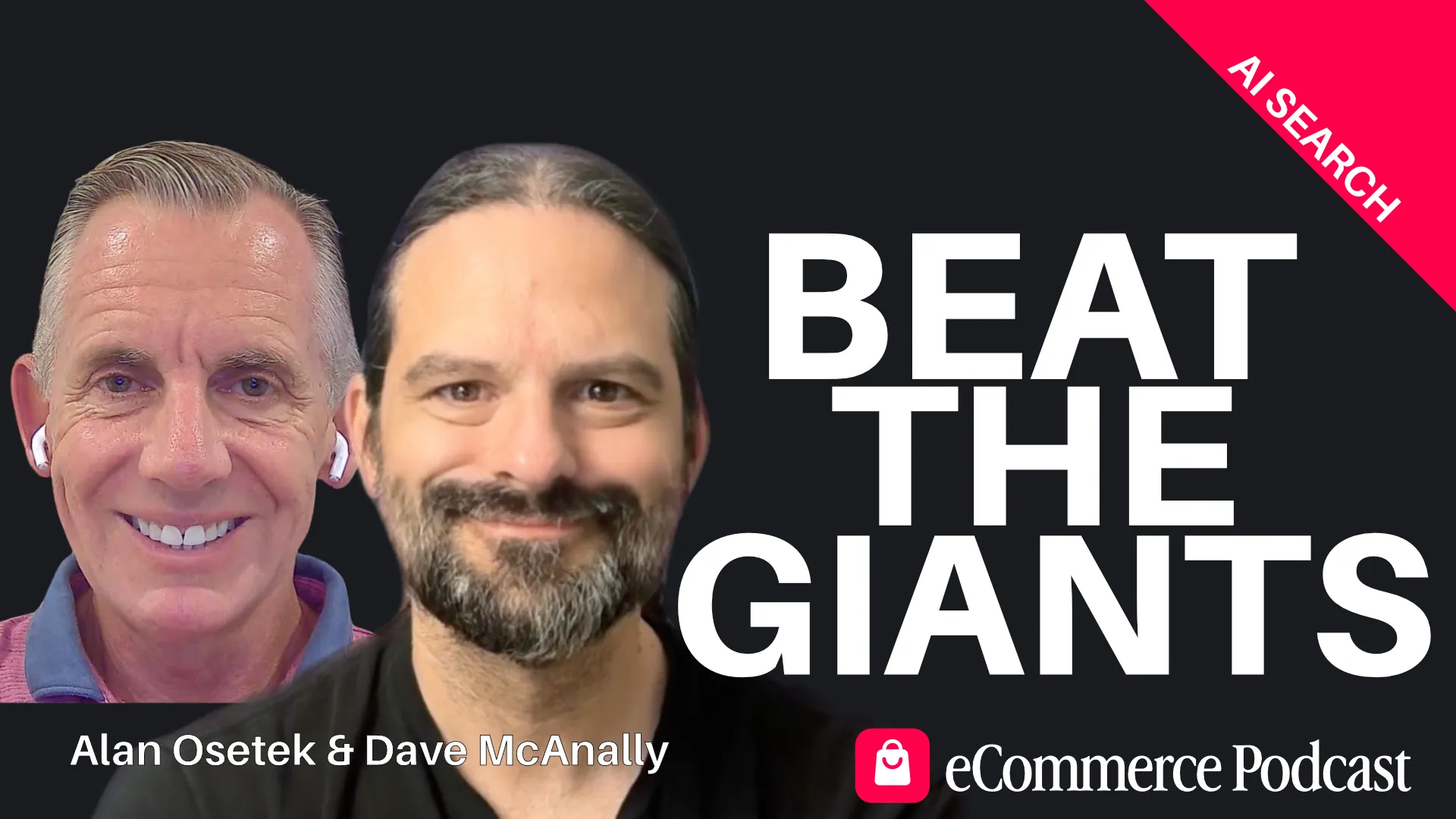
Dave McAnally has spent close to 30 years in SEO, leading practices at major agencies and now heading up content orchestration and SEO at Resolution Media, part of Omnicom Media Group. Alan Osetek has a similar three decades behind him across the global agency holding companies and ad tech, and now advises one of the AI-visibility platforms built for this new era. The two first met working together years ago, and between them they've watched search move from AltaVista to Google to whatever we're calling this now. Their read for smaller brands is wonderfully hopeful because it looks a lot like the early days of search, when the Davids were beating the Goliaths.
When the whole funnel collapses into one prompt
The biggest change AI has brought, Dave reckons, is that it compresses the sales funnel. All the browsing, comparing and shortlisting we used to do across a dozen tabs now happens inside a single conversation.
"If you ask a question like what are the best hiking boots for a rainy season, 97% of the time ChatGPT is going to give you brands," Dave explained. "So you're going from that real high level, just kind of exploring, to a shortlist. And if you're not on that list, that compression is a problem."
It's easy to fall into the trap of thinking only about the sale, the "buy the men's shoes" moment. But if all the research is being condensed into one prompt, the job changes. First you have to understand the questions people are actually asking, then build a strategy to be present in the answer. And oddly, the answer might not come from our own website at all.
The live test that made the point
Rather than take Dave's word for it, I pulled out my phone mid-conversation and asked Perplexity for the best men's hiking boots for rainy days.
It came straight back. For a typical UK walk in wet grass, muddy woodlands and shallow puddles, the Salomon X Ultra 5 GTX was the best all-round choice, or the Lowa Renegade Evo GTX if you prefer a tougher leather boot. Two options. It knew roughly where I lived and what would matter to me. It had done the compressing for me.
Then I clicked through to the sources, and that's where it got genuinely interesting. The first was a US site with a top 10 list. The next was a UK page so detailed it was almost overkill. A verdict score of 87 out of 100, separate scores across different attributes, pros, cons, comparisons, a photo of someone cutting the boot open to show the inside, even waveform charts. Why would a walking boot need waveform charts? Because AI loves data. These people had worked out how to present everything an engine like Perplexity or ChatGPT needs to make its call, all on one page.
None of them, as Dave pointed out, were the manufacturers. They were third parties. Review sites, media sites, affiliate pages. Not a traditional ecommerce store among them.
That matches what Dave found in a study he ran back in June. Compared with a year earlier, ChatGPT now names fewer brands in ecommerce, often just two or three where it used to reel off ten. But it cites roughly three times as many sources to get there. Instead of taking manufacturers at their word, it corroborates against reviews and third parties. For marketers that complicates life, because it means we have to think well beyond our own site.
Why a YouTuber with 6,000 subscribers now answers for Adidas
The clearest example Dave gave was Adidas. This spring, when people asked Google about the returns policy for Adidas shoes, the answer wasn't coming from any of Adidas's own properties. It was largely drawn from a YouTube channel run by a woman with about 6,000 subscribers, plus a Reddit thread and a couple of other bits.
Not nothing, but hardly a big channel. And yet that was the biggest single source shaping how a global brand's returns policy was being explained. As Dave put it, if she had been saying something inaccurate, Adidas would have had no idea their brand reputation was being driven by a creator most of their team had never heard of.
This is the part Alan wanted people to sit up for, because it cuts both ways. "The playing field's levelled a little bit," Dave said. You no longer have to get your shoe reviewed in Runner's World to be recommended by Perplexity. You might just need to build a relationship with a blogger who's actually testing your product.
I've seen a version of this myself. Years before AI, we had a beauty company, and when we looked at where our converting sales traffic came from, one of the biggest sources was a Swedish blogger nobody had predicted. We reached out and offered to make it official. On affiliate commission she'd have earned around £6,000 a month (about $8,000). She turned it down flat. She just liked what we were doing and wanted to help. That one small blogger genuinely shifted the fortunes of the company. So the idea that a "small" source can move the needle isn't new. AI has just made it central.
A short checklist to stop defaulting into AI search
A lot of us have drifted into AI search rather than chosen it. If you're on Shopify, Shopify has done a few helpful things automatically, but so has everyone else on Shopify, so none of it differentiates you. Being more deliberate matters. Here's what Dave and Alan suggested we actually do.
Add a proper FAQ to product and category pages. Mirror the "People also ask" questions you see on Google. "AI search isn't answering the one question you ask," Dave explained. "It's anticipating the next four or five." A good FAQ, written around how people really use the thing, makes it easy for an engine to answer those follow-ups from your content rather than someone else's.
Use schema markup, and don't drop the FAQ schema. Schema is the markup language that tells a crawler what things are, so a price of £9.99 reads as a price and not just a number. There's debate about how much it still matters, but Dave's steer is clear. Google has said it no longer reads FAQ schema, but ChatGPT still does, and OpenAI's agents are "all over sites right now". The goal is to roll out the red carpet for the agent.
Take video seriously. YouTube is the second most cited source for Gemini, trading places with Reddit. Unboxing videos and how-to tutorials are hugely influential in what AI recommends. If video isn't part of your sales strategy, Dave suggested this is the year to change that.
Build relationships with the niche sources AI cites. Find out who's actually being quoted for your products. If you're lucky enough to have a PR function, this is now part of its job, and that includes small bloggers, not just big publishers. Alan noted that some brands are even pointing paid media budgets at the smaller niche sites getting a lot of pull from the engines. Do that across 20, 30, 50 sites and the incremental volume adds up.
How to know it's working, and how much to spend
The measurement side is catching up fast. In Google Analytics 4 there's now a source medium called AI Assistant, launched in May, which captures the likes of Perplexity and OpenAI (the AI-overview breakout is coming, and is already visible in Search Console). Filter your ecommerce reports by it and you can build a trend line rather than guess.
There's a second reason to watch it. Both Dave and I have noticed the same thing. Visitors who arrive from an AI conversation tend to convert at higher rates. They've already been through the comparing and the corroborating, so they land closer to ready to buy than someone coming in cold.
On budget, Alan's advice was to treat it like any ROI question. Get someone to assess what share of your ecommerce sales comes from AI search today, what it could be in 3, 6 and 12 months, and where your opportunity to grab market share sits. Then make someone own the number. It isn't so different from how we used to brief an SEO agency.
And the scale of the shift is why this is a Q4 conversation. Last year Google largely left ecommerce alone, with AI overviews on about 9% of ecommerce queries. This year it's heading for around 25%. That's one in four product searches carrying AI in the results, right as the holiday season lands.
The paid door is open, and it's cheap for now
OpenAI has started an advertising programme that puts your product into those "what's a good hiking boot" moments. Alan mentioned it had already passed around $1bn in revenue in roughly six months, which tells you how quickly it's scaling.
Dave has tested it on a golf accessory brand. Conversions came in about in line with organic, the controls are still limited, and it's early days on the experience. But the cost is the interesting bit. "It's more like Bing than Google in terms of cost per interaction," he said. In other words, cheap to experiment with right now. As with the early days of Google Ads, that window of a level playing field doesn't stay open forever. It's never going to be this cheap again.
Find the questions you can own
For all the talk of Google being overthrown, Dave's take was measured. Rumours of its death are greatly exaggerated. It still holds around 90% of search, Gemini is strong, and it has the Apple and Siri deal. Clicks may be down about 20%, but the traffic that does come through is more qualified. OpenAI is catching up, but it's playing against 20-odd years of Google's accumulated knowledge of the web.
So where does that leave a smaller brand? Exactly where Alan started. Find the niche questions people are asking the AI engines where you can genuinely own or dominate the answer. The 6,000-subscriber channel answering for Adidas is proof those pockets exist. There are niches you haven't explored yet that will let you show up alongside the giants, just as the smaller players did in the early days of SEO.
Dave's closing steer was to drop the marketing fluff. When you're effectively marketing to an AI agent, emotion and brand speak don't do much work. Lead your product descriptions with the real pain points your product solves, and get into video.
And for the big brands? Alan had a two-word instruction. "Defend your turf." Make sure the smaller players aren't quietly taking incremental market share off you through the engines.
Whichever side of that you're on, the honest question is the same. If someone asked an AI engine about your category today, would your brand be one of the names it hands back, or would it be answering with somebody else's?
Full Episode Transcript
Read the complete, unedited conversation between Matt and Dave McAnally & Alan Osetek from Resolution Media (Omnicom) & Brandlight. This transcript provides the full context and details discussed in the episode.
Full Episode Transcript
Read the complete, unedited conversation between Matt and Dave McAnally & Alan Osetek from Resolution Media (Omnicom) & Brandlight. This transcript provides the full context and details discussed in the episode.
# Transcript — Alan Osetek & Dave McAnally (Brandlight)
*eCommerce Podcast · recorded for 2026-09-24 publish · 50.8 min · 3 speakers*
> Speaker map: A→Matt Edmundson (host), B→Dave McAnally, C→Alan Osetek. ASR heard Dave's surname as "Connolly" — corrected to McAnally.
**[00:04] Matt Edmundson:** So welcome to the eCommerce Podcast. My name is Matt Edmundson, and it's great to be with you on this very sunny day from the new recording studio. So if you're keen-eyed amongst us, you will notice that I'm in a very different studio to where I normally am, which is fun. I wish I could show you the setup we've got here. It's unbelievable. But it's still a work in progress. You can't see all the wires and the cables and everything. And it's, it's But it's we're getting there. So anyway, welcome to the show. We talk about all things e-commerce. If this is your first time with us, a very, very warm welcome to you. Like you, I run my own e-commerce business, and in fact, this studio is in our warehouse. So behind these walls, behind the office walls, we have people busy picking and packing orders, which is wonderful. So it means we're busy, which is always a wonderful thing. So. I do this show, I've done it for however many years now, just to talk to people, either founders or experts in ecommerce, and just pull out their stories, their expertise to help me and you run our ecommerce businesses better. So a very warm welcome to you. and if you haven't yet subscribed, make sure you do. Make sure you do all the like, follow, and all the— what help— however you digest the podcast, then do come and join us. And of course, if you're part of our SAM network, which is our, our AI system. You can now just talk to AI about the podcast. Guys, I don't know if you— we'll get around to introductions in a second, but I don't know if you've ever actually used AI to now listen to podcasts. Have you got that far yet?
**[01:46] Dave McAnally:** No, I'm, I mean, I, I've used them to, help me with transcriptions and kind of cut to the— cut to like important parts, but I haven't used them to directly listen to one yet. That sounds, That's very forward thinking of you, Matt.
**[02:02] Matt Edmundson:** Yeah, something like that. I, I, we're testing it at the moment. It's quite, it's quite fascinating.
**[02:09] Alan Osetek:** Anyway, I'm in the same boat. And that I'll have to use, I'll have to listen to the Sam AI podcast. I'll have to like check it out. I have not tried that yet.
**[02:16] Matt Edmundson:** It's just, well, it's just fascinating using AI to listen to a podcast and to help you digest it. one day I'll talk about how we do that. but maybe not today. and again, another first. So not only in the first studio, but actually, no, this is the second. I was saying this is the second time where we have had more than one guest on the show where we're talking to 2 people simultaneously. so guys, why don't you introduce yourself? Give us a quick sort of elevator pitch. Warm welcome, by the way, to the, the, the eCommerce Podcast. We were talking that we did the initial pre-call for this like months ago, and it's taken us a while to make diaries all connect. but it's great to have you guys.
**[02:55] Alan Osetek:** Just give us a brief intro to who you are and what you do?
**[02:59] Dave McAnally:** Yeah, I'll go first. My name is Dave McAnally. I'm— I kind of came to this world. I've been in the SEO space for— Alan, it's gonna sound crazy to say this, we're coming up on 30 years here. And I've seen a lot of changes. And, you know, what I'm excited to talk to you today about, Matt, is just some of the impacts of AI, AI search on ecommerce. I've spent a lot of time You know, I led agencies, big agencies, SEO practices for, you know, about 15 years. And then I've spent about the last 6 years, you know, consulting with companies.
**[03:37] Matt Edmundson:** Yeah.
**[03:38] Dave McAnally:** A lot of them Shopify brands. You know, that's, that's a platform that's really, really kind of made it easy for people to get involved and bring, bring, you know, companies to life, but also some mass ecommerce programs on, you know, bigger, bigger platforms. But, you know, through all that, I guess what I've really been focused on is making sure that, you know, those things are crawlable and accessible and those products can be discovered. And it's— I'm excited to talk to you about some of the things that, you know, especially with AI search, like what, what I think that's going to do in Q4 this year that are things that a lot of people, we've just never dealt with before.
**[04:21] Matt Edmundson:** Yeah, looking forward to it. And Alan, give us a brief lowdown on you, good sir.
**[04:26] Alan Osetek:** Yeah, similar to Dave, we've been around in the space forever. You know, I've worked for multiple of the global ad agency holding companies. In fact, that's how Dave and I know each other. We first met where we worked together at one of the holding companies. You know, Dave put a number on it. I wouldn't— almost 30 years. I wouldn't say 30 years, but we, you know, we both started before, before Google when there was AltaVista, all these other search engines that seemed to—
**[04:55] Matt Edmundson:** I remember them well. I remember showing our age right now.
**[05:00] Alan Osetek:** Yeah, exactly. And they obviously all consolidated around Google and a little bit maybe, you know, Yahoo and Bing. And now we're in the the AI search age.
**[05:10] Dave McAnally:** And—
**[05:10] Matt Edmundson:** Yeah.
**[05:10] Alan Osetek:** But in the last couple years, you know, after having worked at a variety of, I've started a few ad tech companies and agencies, worked at some of the global holdcos. More recently in the last 3 years, I specifically consult in the retail media ecommerce space, working with CEOs of retail media ad tech companies. So I'm very much in this space and I advise one of the leading SEO AI Platforms that started a couple years ago. There's probably, you know, there's kind of a couple, 2 or 3 of the companies that were historically in the SEO space that have moved into the AI SEO space. And then there was, there's probably a good 9 different heavily VC-funded, you know, tech players who are in this space now as well that have entered in the last couple years with funding anywhere from $25 million. The largest one is $100 million of funding. So they—
**[06:00] Matt Edmundson:** Oh, wow.
**[06:01] Alan Osetek:** The VCs are not, there's no secret in this space where VCs, you know, going from search to social to programmatic to retail media and this new AI search space, the VCs did not hesitate to throw money at some players to, 'cause it's such a massive growing industry.
**[06:18] Matt Edmundson:** It is, and it feels a little bit like the Wild West at the moment. Like we're still trying to figure it out, right? But we all also feel like, We've heard that there's gold in them there hills. And so we're trying our best to like go, why, what do I need to do? Because we've seen these kind of things before, haven't we? We come in, it's like the early adopters, the guys that figure it out, tend to do really well as a result, you know. And so I can see why they're throwing hundreds of millions into trying to figure it out.
**[06:48] Dave McAnally:** Right.
**[06:49] Matt Edmundson:** And sort of the AI search thing. So let me ask you guys, A question that I love to ask all our guests, and Dave, you can go first. And I'm curious to also hear what you have to say, Alan. Obviously, you both are in this space and you both have insight and you're both playing and you're talking to people in this space. Thinking about our audience, the guys, you know, doing ecommerce, what's the biggest single mistake that we're making when it comes to this space? Why are we making it? And I guess, how do we solve it? So no small question then, Dave. Yeah.
**[07:28] Dave McAnally:** Well, I'll kind of put it in the dimension of thinking about AI. And one of the things that, you know, particularly with ecommerce, I think it's really easy to fall into the trap of just thinking about the sale. You know, like, and I look at the world through search and, you know, it's the buy the men's shoes, buy, you know, a woman's dress and you want to get people, you know, on the site right away. And, you know, I think one of the things AI has done and, you know, it's still, you know, right now, you know, it's still early days, but this stuff grows so exponentially. So I think it's important as we're— Yeah, it does. You know, we're talking here in early September. It's entirely possible metrics could be, you know, 200-300-fold by come holiday season. So yeah, one of the things that I'm— I find myself talking to a lot of companies about is what AI is doing is kind of compressing the sales funnel, which, you know, what I mean by that is Right now, and kind of like Alan, I work with a couple platforms that are measuring this stuff. But I just did a study with one, one of the bigger players. And, you know, if you ask ChatGPT a question like, you know, what are the best hiking boots for a rainy, rainy season? And I don't know if any listeners sell hiking boots. 97% of the time, if you ask a question like that, ChatGPT is going to give you brands. So you're going from that real high level, just kind of exploring, learning about a product to a shortlist. And if you're not on that list, you know, and this applies just to ecommerce, this applies to B2B, applies to healthcare. But that compression is going to take us from, you know, somebody who asks a question like that isn't going to Isn't going to ask that question of, you know, buying men's hiking boots that do blah, blah, blah. Like all that research is being compressed into a prompt conversation. So what you need to do as an ecommerce provider is, you know, first and foremost, you need to understand those questions people are asking and you need to build a strategy for it. And I think where the— to get around to your question, Matt, I think one of the bigger mistakes people make in that regard is, you know, and this is true whether it's Google or ChatGPT or Perplexity, your website may not be kind of where that answer comes from.
**[10:10] Matt Edmundson:** Yeah.
**[10:11] Dave McAnally:** And one of the things I'm seeing is real advantageous for ecommerce providers is taking advantage of things like YouTube. YouTube is the 2nd biggest source for Gemini.
**[10:21] Matt Edmundson:** Yeah.
**[10:22] Dave McAnally:** Right now for where it gets answers. So all those unboxing videos, how-to tutorials, things like that, if you're not thinking about that as a real kind of a lever to pull in your ecommerce strategy, I think that's a big mistake. Because those are the things when people ask those high-level questions and your brand's going to get shortlisted.
**[10:41] Matt Edmundson:** Yeah.
**[10:41] Dave McAnally:** That more than your website, that's going to be where they're going. And so, you know, there is You know, whether you use a technology or you're just kind of doing the research manually, you need to find out what those, you know, cited sources are when those questions are answered and treat those kinds of things as like, almost kind of like the shopping list for people. Yeah, do— or AI will be recommending the brands earlier. That's a lot different than search, you know, where it's like, well, it is links and you kind of go through it now. Yeah.
**[11:16] Matt Edmundson:** Well, I, as As we're talking, I'm on my phone.
**[11:20] Dave McAnally:** Oh boy.
**[11:20] Matt Edmundson:** I'm on Perplexity. And I said, what are the best men's hiking boots for rainy days? which I think was—
**[11:27] Alan Osetek:** Oh, I did.
**[11:27] Dave McAnally:** Yeah.
**[11:28] Matt Edmundson:** Yeah. And so immediately it says, well, for a typical UK walk in a rainy day, wet grass, muddy woodlands, fells, and shallow puddles. It's very descriptive, isn't it? I mean, I'm there. I'm, I'm there. The, the Salomon X Ultra 5 Mild GTX is the best all-round men's choice. Light enough for regular day hikes, properly waterproof, supportive, and grippy on mixed ground. If you prefer a tougher leather boot, try the Lowa Renegade Evo GTX. And so it's interesting, like you say, it's, it's, it's, it's narrowed down my question to 2 choices. And it's given me those, I mean, it's given me a very long reason as to why we have those 2 choices if I can be bothered to read it.
**[12:17] Dave McAnally:** Well, yeah. And you know what's interesting about that is it's, you know, whether you're kind of a startup, because everyone, you know, product marketing is one of those things where if you don't have a product marketing department, somebody, whether it's the founder or whatever, somebody's doing this in some regard. Yeah, yeah, yeah. realise it or not. But what you just described there is, I mean, we're talking about things that are differentiators for those products. So—
**[12:45] Matt Edmundson:** Yeah.
**[12:45] Dave McAnally:** For like massive ecommerce brands, these are things that, you know, I find myself talking to, you know, teams about making sure that the product marketing really kind of understands this stuff. Like what is AI? How is it discerning kind of what is best. And that needs to be part of— it almost kind of needs to be part of the product strategy.
**[13:08] Matt Edmundson:** Yeah.
**[13:09] Dave McAnally:** Now, you bring that down to like, you know, somebody who's, you know, just selling products on Shopify, you know, you can still kind of replicate that, you know, that engine in your business. And I think it, you know, it becomes part and parcel to understanding what makes your product unique. And When you're doing things like writing descriptions, even as fundamental things as that, you know, you can use one of the kind of life hacks is, you know, if you go to Google and look at like those people also ask things like those little—
**[13:45] Matt Edmundson:** Yeah, yeah, yeah, yeah.
**[13:47] Dave McAnally:** Those are good indicators into, 'cause, you know, especially with Gemini, those are good indicators into what those follow-up questions AI anticipates. So make sure you're factoring that into how you're going to write your product descriptions, how you're going to organise your categories. That's a really good one, especially if you're like on Shopify, as you're categorising your products. Those are good hints to, you know, how AI is going to think about your space.
**[14:12] Matt Edmundson:** Yeah.
**[14:13] Dave McAnally:** But yeah, you raised a really good point there. You know, that thing took us from a really generic question to it knew where you lived, it knew kind of what are the attributes about those products that are going to matter to a guy in the UK on I can't remember the colorful language he used to describe the puddles, but, you know, that kind of stuff is—
**[14:31] Matt Edmundson:** Yeah, yeah, it's fascinating.
**[14:33] Alan Osetek:** Yeah, I want to take the discussion into a, —
**[14:36] Dave McAnally:** Oh, sorry, Alan.
**[14:37] Alan Osetek:** I said I want to take a discussion into same discussion, but just one, but just a different, direction a little bit. Going back to Matt's original question, I just want to make sure, you know, people in the audience, they're doing something, right? Because Dave and I know 100% a year ago when we were talking to a lot of ecommerce brands, no one was doing anything. It was 1% of the marketplace traffic or potential.
**[15:00] Matt Edmundson:** Yeah.
**[15:00] Alan Osetek:** And even today, like more recently, Dave and I have got on the phone with a few people and they're really not doing anything. So, Yeah. Greek first take would be this, like first assess what the potential is, right? So do, you know, people like Dave and others, you could find people to say like, okay, Depending on what my product is, what is the opportunity? Do an assessment of where you stand with the AI search results and say, what's the pocket of opportunity that I'm missing today? But also assuming things keep going the AI search direction in the next 6 months, what's the opportunity cost of me not doing it?
**[15:38] Matt Edmundson:** Yeah.
**[15:39] Alan Osetek:** Because using as an example, putting our age out there again, in the early days of search, There were brands that were, you know, Davids were beating the Goliaths, so to speak, and they were doing it on search because in the early days it wasn't just all about money. And I don't think it's all about money yet. So you can find like, and we can get into the details, I'm sure Dave can rip off a top 10 list right now of things you could be doing right now as a smaller player going up against a bigger player. But when you use that boot example, you know, I didn't know the brands that were listed there, but I bet one of those brands, there was probably 2 or 3 of the brands were the big, you know, known brands. And I bet one of them was a niche brand that probably is, I would guess, is probably a leader in AI search in terms of really taking advantage of it and they're showing up with the bigger players. So like, I think, you know, to use another analogy, a few years ago when TikTok first took off, you know, some innovative ecommerce brands, you know, went all in on TikTok and they won because that was their strategy and they won because of it. I'm not saying it has to be your marketing strategy or your business strategy, but I would at least, I would make sure I would do the audit or assessment of what the opportunity is right now for your specific ecommerce brand.
**[16:54] Matt Edmundson:** Yeah, that's a fair point. I think a lot of people have, what's the phrase I want to get? Just sort of defaulted into AI search, right? So if you're on Shopify, Shopify's done a few things to try and help you.
**[17:09] Dave McAnally:** Yes.
**[17:09] Matt Edmundson:** But then of course everybody who's on Shopify have now got access to the same things. So how's it differentiating you? it's the same thing when AI writes product recommendations that you— in Shopify that you then use on your system. Well, it's using the same system to write the same product recommendations for a whole bunch of the similar brands, right? So how do you stand out? I think it's a really interesting question, but I, I, I, I, I do think that most people are sort of defaulting their way into AI search. So how do we How do we be a bit more proactive in this space? Like, what are some of the really obvious things that we can do instantly, regardless of the size that we are, that are gonna, you know, like a little checklist, Dave, of things that we just need to make sure we're doing?
**[17:54] Dave McAnally:** Well, one of the things, and you mentioned shop and, you know, you use Perplexity. So Perplexity has that Shop Like a Pro program, and that's I do. Last I knew, Shopify does automatically opt you into that. So like people can buy products straight in Perplexity. If you have a Shopify store, there's a partnership with that. So yeah, that's a good example of what you're talking about, where some of the things— but to be proactive, I really, I think there's 2 things that really move the needle for people. Number one, whether it's your category pages or your product pages. And this is like, you know, there's no real secret sauce here, but just a frequently asked questions thing on those product pages that just kind of mirrors some of those people also ask.
**[18:44] Alan Osetek:** Yeah.
**[18:45] Dave McAnally:** That makes it really easy for those AI agents to kind of answer those follow-ups because AI search, you know, the way I've always described is they're not answering the one question you ask. They're anticipating the next 4 or 5 that you might ask. So it's condensing everything, getting you answers really quick. If you signal that in your content versus like just a generic description that uses some of the stuff that, you know, the marketing speak language, that is going to make it easier for them to, you know, kind of corroborate what your product does with like what people are reviewing it or saying. So just a really good frequently asked questions that's oriented around how people are going to use the thing. Because you notice that Perplexity shoe example, you could really see how— and it's true, ChatGPT or Gemini or, you know, whatever, they are really oriented around how that user would use the thing. So a frequently asked questions thing is just making sure you have that on there is one of them.
**[19:49] Matt Edmundson:** Yeah.
**[19:50] Dave McAnally:** I also recommend people— this gets a little more technical. Shopify does bake a lot of this in, but You know, you're marking up using schema markup. There's a lot of debate right now in the community about kind of how much of value this is. But schema, for listeners who aren't aware, is a markup language. It's been around for a while, but it basically gives crawlers, or in this case, AI agents, kind of identifies what things are, you know. Out of the— right out of the gate, if you have $9.99 on a site, a crawler may not be smart enough to understand, okay, that's the price of this product. Yeah.
**[20:29] Matt Edmundson:** Products.
**[20:30] Alan Osetek:** Yeah.
**[20:30] Dave McAnally:** So this language was designed to, you know, help engines kind of understand that. And you saw it being used by like results getting kind of richer with the picture of the product. And, you know, you might see a price under. In the world of AI, you know, those training agents, you know, Google not so much, but some of the ones like ChatGPT and Perplexity where, you know, they don't have 25 years, you know, almost 30 years of, crawler advancements fused in. those things can function as like hints to help those AI agents understand what you're, you know, the attributes about your product. Google recently, there is one specifically for frequently asked questions. I recommend you use that. Google did say they don't read it anymore, but ChatGPT still does. And ChatGPT's Training agents are— the last stat I read is like those represent about a third of the AI agents out there.
**[21:28] Matt Edmundson:** Yeah.
**[21:28] Dave McAnally:** OpenAI is like all over sites right now.
**[21:31] Alan Osetek:** Yeah.
**[21:32] Dave McAnally:** And that's a good hint for it. You just— your goal in that technical side is to make it kind of roll out the red carpet for that agent, so to speak.
**[21:41] Matt Edmundson:** Yeah.
**[21:41] Dave McAnally:** This is a good way to do it. But definitely the really thinking about the use cases in how you describe your products, how people are going to use it. Because that's what the AI is going to grab onto.
**[21:53] Matt Edmundson:** well, it's interesting you say that because the— I've clicked through on Perplexity to its sources. So why? Why? Because Perplexity is good at telling you why, you know, it gives you the sources of its information. the first site is a US site, bearing in mind I'm in the UK. and it's a site with, you know, the top 10 hiking boots.
**[22:17] Dave McAnally:** Yeah.
**[22:18] Matt Edmundson:** Type thing and some detailed descriptions on there. And then I come to a UK site and it's really fascinating the information that's on that page because it's a very detailed product page, right? It's got like a verdict, like we give this shoe a score of 87 out of 100 and it's given it different scores across different things. It's got pros, it's got cons, it's got comparisons, it's got the guy cutting the shoe open to have a look inside. It's got like waveform charts, like you can't see these, but like, why would you have waveform charts for walking boots? But it's AI loves data, right? And it's, I think they, these guys have figured out a way to present information where, like you say, like the likes of ChatGPT or Perplexity are going to look at that and go, this is brilliant for us because it's got everything that we need. it's got all the comparisons, it's got all the try this, try that, don't do this, this is not who the shoe's for.
**[23:21] Dave McAnally:** It's on one page. Well, you raise a good point there that, you know, I'm assuming those sites you looked at weren't necessarily ones that the manufacturers of those shoes would have created. They're third parties.
**[23:34] Matt Edmundson:** Yeah, all third-party sites. I don't even know if any— clicking through them, I don't know if any of them are what I would call a traditional e-com site versus, you know, like the, the sort of the media sites which like do the reviews and click through with an affiliate link type thing.
**[23:51] Dave McAnally:** Yeah. And there's, you know, if you think about it, it kind of makes sense. When one of the studies I did, and I did this in e-commerce back in June, if you compare what ChatGPT is doing like this summer versus last summer, They're naming less brands in ecommerce on average. Like, I think you got— you're using Perplexity, but, you know, imagine it's ChatGPT. I think you got 2, you got 2 shoes. In ChatGPT, they would have kind of given you like 10.
**[24:25] Matt Edmundson:** Yeah.
**[24:26] Dave McAnally:** Although give you like 2 or 3. But what's different is they're citing about 3 times as many sources in terms of how they get to that answer.
**[24:36] Alan Osetek:** Yeah.
**[24:36] Dave McAnally:** So instead of just kind of taking it from the, those manufacturers, take them at their word, they are looking to those review sites and third parties and corroborating what's being said. And so for marketers, you know, there's no easy way to say it, that does complicate things a little bit because it's not, you know, to really kind of paint that picture, it's not as simple as You got to kind of think beyond your site. Everything I'm saying is important. You know, you want to make sure what you're describing resonates with, you know, what third parties are going to say. But this does mean, like, for example, you had a top 10 site there. You need to identify who those are. And, you know, if you're lucky enough to have a PR department, you know, you're building relationships with those people because Alan brought up the point that, you know, it's kind of the playing field's leveled a little bit.
**[25:27] Alan Osetek:** Yeah.
**[25:28] Dave McAnally:** And that means that you're not necessarily having to get your shoe reviewed in Runner's World to be recommended by Perplexity. But you may need to build a relationship with a blogger or, you know, some of these sites and make sure that, you know, they're testing your shoe.
**[25:44] Alan Osetek:** Yeah.
**[25:45] Dave McAnally:** I'll give you an example this spring. And I'll name the name of the brand because it's, you know, you guys could look it up. Adidas, one of the most common ways people— one of the most common behaviours that they have a unique return policy. And Single Bit, when people ask Google about, you know, what is the return policy for the shoes, this is true this spring, I haven't done this search, you know, recently. But what we were seeing was that it wasn't where they were getting most of their answer, how they were answering that. Came from a YouTube channel with a woman who had about 6,000 subscribers. So, you know, it wasn't nothing, but it wasn't a, you know, huge—
**[26:30] Matt Edmundson:** Yeah, it wasn't a big channel.
**[26:31] Dave McAnally:** Yeah. And that was driving the entire brand. That was basically, if you look at where it was being cited in the answer, it was the biggest way for Adidas to, you know, she was describing kind of what you got to do if you want to return shoes online and things like that. And it was that site. Now Adidas, You know, wasn't even mentioned in that brand. You know, like none of their own properties were even part of that answer. Yeah, it was this, this influencer from this girl. There's a Reddit thread and a few other things. So to Alan's point, that's a big, that's a pretty big sea change in how you might think about how Adidas might be thinking about, you know, their brand reputation or you know, how products are sold. So what I would do in their case is, you know, if that girl was saying something that wasn't accurate, which I don't believe she was, but their PR needs to be looking at some of those smaller players and how well they're represented. You know, Alan mentioned, you know, he works with a platform that, you know, there's technologies now that identify all this stuff, you know, and then they can take your brand and say, hey, here's the biggest influencers.
**[27:44] Matt Edmundson:** Yeah.
**[27:45] Dave McAnally:** And to your point, Matt, essentially what the platform does— Oh, sorry, what's that?
**[27:51] Alan Osetek:** Yeah, I was just— essentially what the platform does is like instead of keywords, it's looking at questions or queries, right? And it's, you know, for any one brand or product, it's looking at the potential thousands of queries that someone could be putting into the AI search engines, and then it's finding some of the higher volume queries And in those queries, it's doing exactly what you did, Matt. It's dissecting, well, where, what are the sources from those queries? Where's the AI engine? And what you're finding in Dave's example is a perfect example is what you're finding is they're not all necessarily the big publishers or the big blog, you know what I mean? You're gonna like, so sometimes, you know, whether, you know, you're finding these smaller, you know, YouTube channels like that person you mentioned and your PR agent. And so what companies are doing, quite honestly, And this is like an advantage that maybe it'll go away at some point, but you go, you can, you know, your PR agency can actually go and see if you can participate or like some of the brands are taking their advertising or their media budgets and they're doing paid media budgets towards some of these smaller niche brands that are getting a lot of juice from the search engines. So, but it's very, very granular. Like, you know, you have to, you know, you do that with like, 20, 30, 50, 100 sites that increases the overall volume you're getting on your ecommerce brand. And that's where like the devil's in the details where, you know, you can use another platform or a consultant or a combination of both to get that incremental lift as a smaller brand.
**[29:16] Matt Edmundson:** Yeah.
**[29:17] Dave McAnally:** Yeah.
**[29:18] Matt Edmundson:** No, see, I remember years ago, I mean, obviously before AI, just when, but going back to sort of how this all worked, We, we had a beauty company and we looked at the source of traffic and one of the biggest sources of sales traffic, so not just traffic to the site, but traffic that converted to sales came from a Swedish blogger, a Swedish blogger, right? I mean, no one predicted this. And so we reached out to that Swedish blogger and said, listen, would you like to, you know, make this kind of like official? And they were like, no, no, it's fine. I'm like, are you sure? Because on affiliate commission, you'd make about 6 grand a month, right? And she's like, no, no, it's totally fine. I just, I just like you guys and what you're doing. If I can help, then it's great. We were like, stone the crows. It was incredible, really. Just a small Swedish blogger. And it changed in some respects the fortunes of, of the company that we had. And so I'm a big fan of going after these smaller source— smaller in inverted commas, do you know what I mean? These sort of smaller, fans or people that are blogging or writing about things. Because yeah, you just— how do you— but how do you find, like, for AI, how do you find out where ChatGPT or Perplexity is going? Is that a laborious manual process?
**[30:42] Dave McAnally:** So there—
**[30:43] Matt Edmundson:** is there something you can put into ChatGPT to tell you? I'm kind of curious, how do we do that?
**[30:48] Dave McAnally:** Well, you saw in Perplexity there, I think you must have looked at the cited sources and it showed you where it's getting that. Yeah, that same dynamic exists across Gemini, ChatGPT, you know, Perplexity, whichever. There are platforms and there's a whole cottage industry of technologies, some, you know, like that have been around for a while and some like what Alan was describing that have kind of come up. And they do kind of aggregate and streamline that process. So rather than having to do it manually like you just did, you know, you could see all those prompts and, hey, here's what's being cited, here's how often they're— here's our questions they're answering. you know, are they saying good things or bad things about your product? Because sentiment, you know, the AI is a little more 3-dimensional than search because now you have It's like, it's, well, the AI has an opinion about brands.
**[31:44] Matt Edmundson:** Yeah, yeah.
**[31:45] Dave McAnally:** Triangulating where those things are coming from. The technology will do that. So, you know, I, and the good news is that industry is getting to the point to where there's kind of a something for everybody. $99 a month things that will kind of just give you the data on up to like full service. operating models for teams type stuff that, you know, is more enterprise grade. But that's probably something that's probably going to be part of a tech stack ecommerce brands will need to think more about. I think, you know, before we got— just when we joined, I think one of the things that'll be very different this quarter is— or Q4, you know, AI overviews, which is probably the most common way people interact With AI.
**[32:34] Matt Edmundson:** Yeah.
**[32:35] Dave McAnally:** You know, Google's 90% of the share. Last year, Google really left ecommerce alone with those. It was about 9% of ecommerce queries had that AI overview and those shopping carousels and things like that. This year, it's going to be about 25%. So 1 in 4 ecommerce searches are going to have that AI in there. So, you know, I think what does that mean for marketers? That's where You know, kind of regardless if you're a big— I know not everyone is a big— the holiday season is huge for them. But if it is for you, this is probably something you want to explore, you know, make technology makers to see this stuff. Because probably as you can imagine, Matt, if you went to every single little prompt and looked at the sources, it would be laborious. So there are technologies that simplify that. And there's— they're getting more and more to where there's something that scales for every provider or every, every kind of size of business.
**[33:31] Matt Edmundson:** Yeah.
**[33:33] Alan Osetek:** Yeah.
**[33:33] Matt Edmundson:** Have you got anything to throw in here, Alan?
**[33:35] Alan Osetek:** Yeah, I think, I would just add, it's, it's definitely working, as Dave mentioned. Like, I think as a strategy, you need to decide, you know, is your PR agency going to do this? Are you going to do it internally? Are you going to use technology? And then just as I mentioned earlier, the overall assessment of You know, how much of your budget and resources are gonna go towards AI search? So, you know, if you haven't done that assessment, I think it's important because it's not only is it not going away, it seems like search is, SEO specifically is morphing into this industry. So I think it's a good time to get ahead of it. And—
**[34:15] Matt Edmundson:** Well, how much budget do you think we should have? Because this will be one of the questions people ask. It's like, well, I'm listening to you guys talk. If I, you know, I'm just sort of getting my head around Meta ads and Google. Now I've got to think about AI search. What sort of budget? I mean, I appreciate I'm asking how long's a piece of string in many ways, but how would you determine, maybe is a better question, how would you determine what a good budget amount to throw in here is?
**[34:40] Alan Osetek:** I mean, you could do it straight from an ROI assessment. I would first get an assessment of like what, you know, find someone like Dave or someone else internally who has the capability of doing this and find You know, basically get assessment, okay, in the next year, what percentage of my ecommerce sales come from, you know, come from AI search today and what do I expect it to be a year from now? And like, what, like, you know, someone do an audit or an assessment of like, what's my opportunity to grab more market share in the AI search engines? And, you know, do a 3, 6, 12-month opportunity analysis, see how much, you know, someone's willing to say that they can, you know, grab from a market share or revenue standpoint and then, you know, put there, you know, and then make them own it. You know, it's not much different than what you used to do with an SEO consultant or, you know, an SEO agency.
**[35:30] Matt Edmundson:** Yeah, yeah, yeah. You know, that's what I suppose the tricky question though is, how do we know how much search is gonna come from AI in 12 months' time, right? I, it feels a little bit like, You know, throwing a dart at a dartboard and it's just going to stick somewhere. And that's probably a right answer because we've got some ideas and it's getting clearer, but it's still— I mean, David, I mean, you're, you know, you're probably James Bond in this kind of thing with all these secrets, tech and stuff. But it's kind of like, how did— how would we know, right, that actually we can look at our site and we can go, well, listen, I've had 10 sales this month from AI search. In 3 to 6 months' time, that's going to be X amount of sales. How could I predict that with any kind of re— I mean, I don't know if I could predict that with any kind of reasonable success, could I?
**[36:22] Dave McAnally:** Well, you can build a trend line. And one of the ways— so one of the cool things Google did with GA4, Google Analytics, is you have a source medium that will show— you used you know, you used to be able to filter all your, your, your charts and stuff in there by, like organic or direct. Yeah, you know, they now have one called AI Assistant, and they launched that in May. That includes Perplexity, OpenAI. it doesn't break out the AI overviews yet. that's coming though, and you can see that in Search Console, but For what we're talking about, one of the things I like to do is so things like your, you know, you can go into your ecommerce, you know, component of GA4, and you can filter by that and you can see, you know, the trend of what that growth looks like.
**[37:20] Matt Edmundson:** Yeah.
**[37:21] Dave McAnally:** That's one way you could forecast it. And that's probably the most common thing. The other thing I like to look at too is because I think this is What really kind of tells the story, and I've seen this, you know, you mentioned your Perplexity example, you know, this thing went beyond just kind of recommending a shoe for the sake of, hey, here's a brand. It really told you, you know, corroborating from all these sources, if you're going to be doing this kind of hiking, you want this because it does this and this and this one over here. What that's translating to, and I've seen this across a lot of different sites, is when people do convert directly from ecommerce, the conversion rates are a lot higher.
**[38:05] Matt Edmundson:** Yeah, yeah, yeah, that we've noticed.
**[38:09] Dave McAnally:** The engagement rates, people are coming to this, you know, you come from an experience like that versus, you know, kind of cold off the street. Yeah, yeah, you do get a more, you know, person ready to buy now. I guess since we're talking about investment here, I would say assess that, get a sense of what the conversions are. OpenAI has now started an advertising program where you can start to show your ads. And it's pretty cool how it does it because it's, you know, kind of around the product, you know, putting a product marketing hat on. When people are asking those kind of, what's a good hiking boot type of things?
**[38:49] Matt Edmundson:** Yeah, yeah, yeah.
**[38:49] Dave McAnally:** You can get your product in there.
**[38:52] Alan Osetek:** Right.
**[38:52] Dave McAnally:** Assuming that it kind of satisfies all the elements of it, you can kind of, you know, you can have at least have an ad show up. So I would say if you want to test that kind of thing, get a sense of what the conversion rates organically are right now, how much you could expect, and, you know, start small and go from there.
**[39:15] Matt Edmundson:** Yeah.
**[39:17] Dave McAnally:** The, you'll at least get a sense of kind of what the traffic looks like from that AI filter.
**[39:22] Alan Osetek:** Yeah, I think I said, yeah, I read yesterday, I think OpenAI had just hit $1 billion in the ad revenue for that product right there. So it's scaling quickly. So actually, yeah, it is another topic of like, you know, kind of like in the early days of, SEO, you know, it's basically finding your mixture of, or using paid search in this case, or using AI search, paid search.
**[39:45] Matt Edmundson:** Yeah.
**[39:46] Alan Osetek:** To maybe start to inform some of your other organic strategies too.
**[39:51] Matt Edmundson:** Yeah. That's an interesting thing.
**[39:53] Alan Osetek:** I think it popped up like 6 months ago and it's already at a billion dollars though.
**[39:58] Matt Edmundson:** So it's crazy, isn't it, how quickly it's growing?
**[40:01] Alan Osetek:** Yeah.
**[40:02] Matt Edmundson:** Have you guys tested ads on OpenAI's platform?
**[40:08] Dave McAnally:** Yeah, I've done it for a golf like golf accessory brand site.
**[40:13] Matt Edmundson:** How did you find it?
**[40:14] Dave McAnally:** The conversions are about in line with what you see organically. I think the, you know, the UX, it's still kind of, you know, it's early days. You're a little limited in kind of how you control what prompts things appear.
**[40:32] Matt Edmundson:** Yeah.
**[40:32] Dave McAnally:** But the cost, you know, it's not It's, it's more kind of my experience, at least, it's more kind of like Bing than it is Google in terms of the cost per interaction and stuff like that. So it's, it's, it's a pretty cheap thing to experiment with right now.
**[40:50] Alan Osetek:** Yeah.
**[40:51] Matt Edmundson:** You know, I just have—
**[40:52] Dave McAnally:** yeah. I don't know, Matt, I guess for your audience, look up because it's available in the US.
**[41:00] Matt Edmundson:** I don't know if you I think there are limitations to OpenAI's ad platform. That's, that's what we've discovered playing around. So I think it'll get rolled out as these things always do. And you just have to keep checking and testing. But I think if you're in the States, definitely, you should be, you should definitely be testing that. Because it's never going to be this cheap. I wouldn't have thought.
**[41:27] Alan Osetek:** Yeah.
**[41:28] Dave McAnally:** Well, going back to the early days of Google, what a level playing field that was in terms of, you know, what a cost per click would cost versus, you know, a big CPM buy on TV.
**[41:37] Matt Edmundson:** Yeah, yeah, yeah. I remember when Google cost per click were cheap, and now you have to mortgage your house every time you get one. But that's, you know, it's a different story. It's interesting though, isn't it? Because I, you know, Google is obviously pivoting with its AI overviews and with Gemini I think organic search is down because we're now using AI. So Google seems to be losing that space a little bit, trying to get it in the AI platform. OpenAI seems to have done a good job with it. I don't know how well Anthropic's doing with it. I wonder if they're going more after the coders than— I don't know. It's kind of, it's an interesting field, isn't it? Sort of, like I say, the Wild West a little bit. Who do you see emerging as some key winners here?
**[42:28] Dave McAnally:** Well, you know, I do say I think rumors of Google's death are greatly exaggerated. They've had a very—
**[42:34] Matt Edmundson:** It's gonna take a long time to kill Google.
**[42:37] Dave McAnally:** Well, you know, it's still 90% of the search market share. Google's AI share with things like Gemini, the deal they cut with Apple to power, you know, Siri. I think some of the moves they made with Gemini, You remember there was, the code red that OpenAI had in December because Gemini was so good. I don't think I would rule them. I, I think Google is doing actually really well in this space. You have to remember too, OpenAI is having a, you know, the, the training, the training agents that they've got are essentially having to play catch-up to—
**[43:17] Alan Osetek:** Yeah, yeah.
**[43:17] Dave McAnally:** Google's been building over You know, 20-some years. So Google has got a lot more inherent knowledge to build off of. I could tell you just from a technical standpoint, Google, you know, you know, those agents tend to be able to handle a lot more of the complexities of the web better than OpenAI does. yeah, you know, JavaScript and things like that. And that matters because that's going to be more access. That means that Google is going to be able to get to data quicker, you know, and so forth. AI overviews, they were— I think it turned out to be the right move. They did roll those out. They scaled them really quickly, believe it or not, in healthcare.
**[43:56] Matt Edmundson:** Yeah.
**[43:57] Dave McAnally:** Healthcare and insurance, which I wouldn't have thought. And they rolled them out slower in ecommerce and more transactional things like travel and restaurants, like restaurant searches, local things. So I guess to go to your point, Matt, I don't I still look at Google as still going to be the king. They, they, yeah, yeah. I think they made a lot of really smart moves. They were deliberate. They didn't, they kind of took some wait-and-see moments. I think Apple still kind of remains to be seen. I see that they're aging out there on some of the log files I look at. I don't, I don't know kind of what they're gonna do. But you know, yeah.
**[44:36] Alan Osetek:** Definitely.
**[44:38] Dave McAnally:** some proprietary, you know, activity going on. Yeah, I think your point about Claude, I think their user base is definitely more B2B. for e-commerce providers, you know, what kind of role that's going to play kind of remains to be seen. but I do think, you know, the, the, you know, definitely Google and OpenAI are kind of the two leading right now. But I do think—
**[45:03] Matt Edmundson:** Yeah.
**[45:04] Dave McAnally:** You know, a year ago, it, you know, it seemed like there was all this talk of Google was, you know, finally going to get overthrown. And you're right, clicks are down about 20%. But, you know, they're answering a lot of questions, they're sending a lot more qualified visitors. Yeah. So they're, they've improved the traffic, they've improved the quality of the traffic that people are getting.
**[45:28] Alan Osetek:** Yeah.
**[45:30] Dave McAnally:** It remains to be seen how their monetization strategy is going to change on that. but yeah.
**[45:35] Matt Edmundson:** Oh, they'll find a way. We know they'll find a way. That, that we can rest assured on. Yeah, I don't have to worry about Google making money.
**[45:42] Dave McAnally:** I guess that's a long-winded way of me saying I still think Google's doing—
**[45:48] Alan Osetek:** yeah, the only, the only tricky part, and this is more of a question than an answer, is, you know, when You know, a long time ago when you switched from using Bing or Yahoo to Google, it was basically just opening up a browser and just typing in Google as opposed to Bing.
**[46:02] Dave McAnally:** Yeah.
**[46:04] Alan Osetek:** As opposed to now, like, you know, I actually, just because I started in this direction, I'm more of a ChatGPT user myself for a long time.
**[46:11] Matt Edmundson:** Yeah.
**[46:11] Alan Osetek:** And the switching costs are a little bit higher than they were just from jumping from one search engine to another. Having said that, Google had, as Matt said, Google figured out how to get tentacles around me eventually and move me with ChatGPT. If I had to buy one of the stocks, I think, well, Google, I mean, you've seen it this year, Google stock has gone up a lot.
**[46:32] Matt Edmundson:** Yeah, yeah, you're definitely buying Google. I think if anyone's gonna collapse first, it'll be OpenAI. That's my personal prediction. But I, you know, what do I know? I'm not a stock market expert.
**[46:41] Alan Osetek:** The market, Matt, the market's moving this morning as we're recording this, right?
**[46:46] Matt Edmundson:** Yeah, yeah. It's Yeah, it's gonna be one of those. Guys, listen, I'm aware of time. It seems to have flown by. And Dave, I know you shoot off. Is just in closing, any final thoughts from you two before I close out the show? And also just let people know how they reach you, how they connect with you if they've got some questions and all that sort of stuff. What's the best way to do that?
**[47:10] Dave McAnally:** Well, for me, find me on LinkedIn. Just Dave McInally, my name. That's probably the best place to connect with me.
**[47:22] Alan Osetek:** The—
**[47:23] Dave McAnally:** but I would say my final thought for ecommerce providers is really, you know, think about the product marketing questions, the pain points your stuff solves, and really drive your descriptions with that. I think if anything, OpenAI is really making product marketing and mission critical. The mark— no offense to the brand marketers, and but market speak and fluff and all that kind of stuff when you're marketing to an AI agent doesn't really have the— we're not really marketing on people's emotions when they're buying. Yeah. So that's really critical. Don't ignore video. Unboxing videos this holiday season. I saw those hugely influential in how AI you know, recommended products. if you're not doing that kind of stuff, this might be the year to think about getting into that.
**[48:16] Matt Edmundson:** Yeah.
**[48:17] Dave McAnally:** You know, on YouTube, because that, like I said, that's the second most cited source on Google. Bounces back and forth between Reddit and, YouTube. So, those are the two things I recommend people think about, is the product, really getting into the pain points and the product marketing, and what, what does your thing do that solves, you know, and orient your descriptions, and then You know, video is absolutely part of, you know, what your sales strategy needs to be.
**[48:44] Matt Edmundson:** Fantastic. Alan?
**[48:47] Alan Osetek:** Yeah, same as Dave. You find me on LinkedIn. glad to connect. and I would say for the, the small to mid-sized ecommerce brands, find those niche questions that people are asking on the AI engines where you can, you can own or dominate those, questions. using as an example is David mentioned earlier the 6,000 unique visitor YouTube site that is one of the sources for one of the main questions for that product. So there are plenty of those out there. There's niches that you're not finding or not exploring right now that will enable you to beat the smaller guys, just like in the early days of SEO where some of the smaller players could dominate. And then for the larger ecommerce brands, just the opposite. Defend your turf, make sure you're defending your turf. And, not allowing the small to mid-sized players, you know, steal some incremental, sales or market share. yeah, using the AI engines.
**[49:39] Matt Edmundson:** I like that. Defend your turf.
**[49:42] Dave McAnally:** Yes. it is what it is, you know.
**[49:47] Matt Edmundson:** it is what it is.
**[49:47] Dave McAnally:** Playing field's gotten level and—
**[49:49] Alan Osetek:** Yeah.
**[49:51] Matt Edmundson:** But these things are just always interesting opportunities, aren't they? And you, you either, you either embrace it now or you Ride it out for six months and go. Let's see where the dust settles. Depends on your personality. I'm the kind of guy that goes, right? Let's just go and have a go and see what happens. But Dave Allen, thank you so much for joining us, man. Really appreciate it.
**[50:10] Alan Osetek:** Thank you much.
**[50:12] Dave McAnally:** Thanks a lot. Take care, Matt.
**[50:14] Matt Edmundson:** Well, listen, you too, Dave. Thank you for joining us. And of course, if you've been listening to the show, make sure you like and subscribe and do all of that good stuff because we've got some more. More great conversations coming up, and I don't want you to miss any fun— any of them. But that's it this week from me. That's it from Dave. That's it from Alan. Thank you so much for joining us wherever you are in the world. Have a great week. I'll see you next time.
**[50:34] Dave McAnally:** Bye for now.
Meet your expert
Dave McAnally & Alan Osetek
Dave McAnally & Alan Osetek
Resolution Media (Omnicom) & Brandlight