How to Stop Chargebacks From Destroying Your Profit Margins
Payments veteran Jeff Foster reveals why fighting chargebacks often costs more than accepting them, and how the threshold for "acceptable" disputes has dropped from 3.5% to under 1%. With 25% of chargebacks hitting transactions already refunded and friendly fraud becoming behavioural rather than criminal, he shares the pragmatic approach that protects profit margins: make refunds frictionless, overcommunicate with customers, and accept that preventing every dispute is more expensive than handling them efficiently.
What if 99.5% customer satisfaction could still threaten your entire business? That's the reality facing eCommerce merchants today, where Visa and MasterCard have tightened chargeback thresholds to the breaking point. Jeff Foster, a payments veteran with nearly 30 years in the industry, has seen merchants go from profitable to panicked overnight. His company, Quick Refund, sits at the intersection of banks, merchants, and consumers, and he's got some counterintuitive advice that might just save your profit margins.
Jeff's credentials run deep. He's been in payments since 1998, helped process the first CVV transaction ever, and the first Verified by Visa transaction through his gateway. After selling his payment gateway to a British company and working in fraud prevention, he now runs acquiring portfolios for thousands of merchants. When he spotted a gap in how refunds and chargebacks were handled, he built Quick Refund to fill it. The insight that drives everything? Sometimes the smartest business decision is giving money back faster than you think you should.
Customer Disputes
Before diving into solutions, we need to understand a fundamental shift in how disputes work. Jeff challenges the conventional wisdom that fighting chargebacks protects your business.
"Imagine your bank calling you up and threatening to shut your business down because only 98% of your customers were perfectly happy," Jeff explains. "Imagine if a politician had to deal with those kinds of stats. Every elected official would be gone their first week."
Yet that's precisely the threshold eCommerce merchants face. If 2% of your customers file chargebacks, you're in serious trouble. The threshold used to be 3.5%. Then it dropped to 1%. Now it's heading towards 0.5%. The goalposts keep moving, and merchants are scrambling to keep up.
The Chargeback Cascade
The real danger isn't the initial dispute. It's what happens next.
Consider this scenario: You're selling a product for $25. A customer disputes the charge. Here's how quickly the costs multiply:
- The original refund – $25 gone
- Chargeback processing fee – $25-35
- Additional fines if volume increases – $8-10 per transaction
- Monthly penalty fees if thresholds are breached – potentially $20,000-30,000
"Imagine somebody who's selling something that costs $25 having $75 in fees and fines on each of their transactions," Jeff notes. "Now a $250,000 problem is a million-pound problem."
And it gets worse. The more chargebacks you accumulate, the more scrutiny you face from Visa, MasterCard, and your acquiring bank. Cross certain thresholds, and you're not just paying fines. You're losing your ability to process cards entirely.
Friendly Fraud Isn't What You Think
There's a phrase Jeff used that sounds almost pleasant: friendly fraud. It's anything but.
Unlike organised criminal fraud rings, friendly fraud is largely behavioural. Someone buys something, receives it, and then decides to get their money back through the bank rather than the merchant. Jeff's data shows that the vast majority isn't even premeditated.
"It's something that maybe is a little more expensive than you should have bought in the first place. A bill comes in that you weren't expecting. Things are a little tight. And you say, you know what? I'm just gonna call my bank and tell them I didn't get it."
The pandemic accelerated this behaviour significantly. People discovered how easy it had become. Banks have built dispute buttons into their apps, right next to every transaction. Two taps and the money's coming back. No paperwork. No questions. No consequences for the consumer.
For merchants, there's virtually nothing you can do to predict it. All the fraud prevention in the world won't flag a customer who decides three weeks later that they'd rather have the money back.
Why Banks Don't Care About Merchants
Here's where the economics get brutal.
A premium card issuer that Jeff spoke to laid it out plainly: "We know when Matt calls up and says he doesn't like this $200 thing, he's probably perfectly fine with it. But we don't care. Matt's spending $17,000 a month. We're getting premium interchange on all that money. He's rolling about half into the next month with high interest rates. We just want Matt to be happy. We don't care if he wants to steal something worth $200 every other month. It's definitely not my problem. It's your problem."
This isn't cynicism. It's mathematics. There's far more money in the issuing business than the processing business. Card issuers make their fortune keeping cardholders happy. Merchants are simply the cost of doing business.
The Shoplifting Paradox
Jeff shares an analogy that perfectly captures the merchant's dilemma.
One of his clients owned 150 hypermarkets in urban areas, including 40-50 in New York City. Shoplifting was inevitable. Their solution? Station security guards at the front. Not to physically stop anyone (in the US, touching a shoplifter can trigger a lawsuit), but as a deterrent.
The result? Insurance rates increased so much that if shoplifting had doubled, it still wouldn't have been as expensive as paying one person to stand at the entrance.
"Nobody wants to say, 'Yeah, okay, just go ahead and take the stuff,'" Jeff acknowledges. "But at the end of the day, those are the pragmatic decisions that we have to make. Particularly at volume."
The same principle applies to chargebacks. Fighting them feels right. Morally, ethically, you want to stand your ground. But the economics often make us surrender to the smarter choice.
The Refund Economics You're Getting Wrong
A refund through your processor isn't actually a refund. It's a forced deposit in the same amount back to the original payment method.
The bank then has to match these up. And often, they don't.
"Something like 25% of all chargebacks are transactions that have actually already been refunded," Jeff reveals. "But the bank didn't match them up."
For example, a customer buys a subscription and can't figure out the software, and requests a refund. You process it promptly. But forced deposits can take days, sometimes a week. The customer checks their bank app, doesn't see the credit, gets frustrated, and disputes it anyway.
Now you've got two refunds going out. Plus fees. Plus fines. Plus, a black mark on your record with Visa and MasterCard.
The Pragmatic Path Forward
So what actually works? Jeff's advice might sting, but the maths don't lie.
Accept the inevitable. If you're doing $10 million in sales, budget for $250,000-300,000 in disputes. It's not about whether it happens. It's about minimising the penalty you pay on top of it.
Make refunds frictionless. The easier it is for customers to get money back through you, the less likely they are to go through the bank. When they go through you, there are no chargeback fees, no fines, no black marks on your record.
Speed matters more than policy. A customer who gets a refund in 24 hours rarely escalates. A customer who waits a week while you "review their case" goes straight to their bank.
Keep your ratios clean. Getting from 2% chargebacks to 1% doesn't just save you money on fees. It keeps Visa, MasterCard, and your acquiring bank from looking at your business with suspicion. You become a cleaner, safer merchant in their eyes.
What You Can Actually Control
Jeff's parting advice focuses on the 25-30% of disputes that are entirely preventable.
"The number of disputes, refunds, and things that we see on a daily basis that are based on a lack of communication from the merchant is something that every single merchant can easily solve in its entirety."
His framework is simple:
- 1Get your products out fast. Whether it's a digital download or a physical shipment, speed reduces anxiety.
- 2Overcommunicate throughout the process. Order confirmation. Shipping notification. Delivery confirmation. Follow-up to check satisfaction.
- 3Make yourself easy to reach. Customers who can't find you will find their bank instead.
- 4Follow up after delivery. A quick check-in catches problems before they become disputes.
These aren't revolutionary tactics. They're basics done brilliantly. But they eliminate the confusion and frustration that drive a significant chunk of friendly fraud.
The 78-Year Lesson
When people ask Jeff why a simple solution like Quick Refund didn't exist before, he has a favourite response: "It took 78 years for the postal service to turn the stamp into a sticker."
Sometimes the obvious solution takes forever to arrive. The payment industry has been so busy with complex fraud-prevention tools and dispute-management systems that nobody has built the simple thing: a way to make refunds fast, clean, and chargeback-free.
The merchants who thrive won't be the ones who fight hardest against chargebacks. They'll be the ones who build systems that make disputes unnecessary in the first place, and who handle the inevitable ones with pragmatic efficiency rather than righteous frustration.
Your Move
So, how much of your energy is going into fighting chargebacks versus preventing them? How much money are you spending on moral victories that cost more than surrendering would?
The world isn't fair. Banks favour cardholders. Thresholds keep tightening. Friendly fraud isn't going away. But within those constraints, there's a path to protecting your margins. It just requires letting go of some battles to win the war.
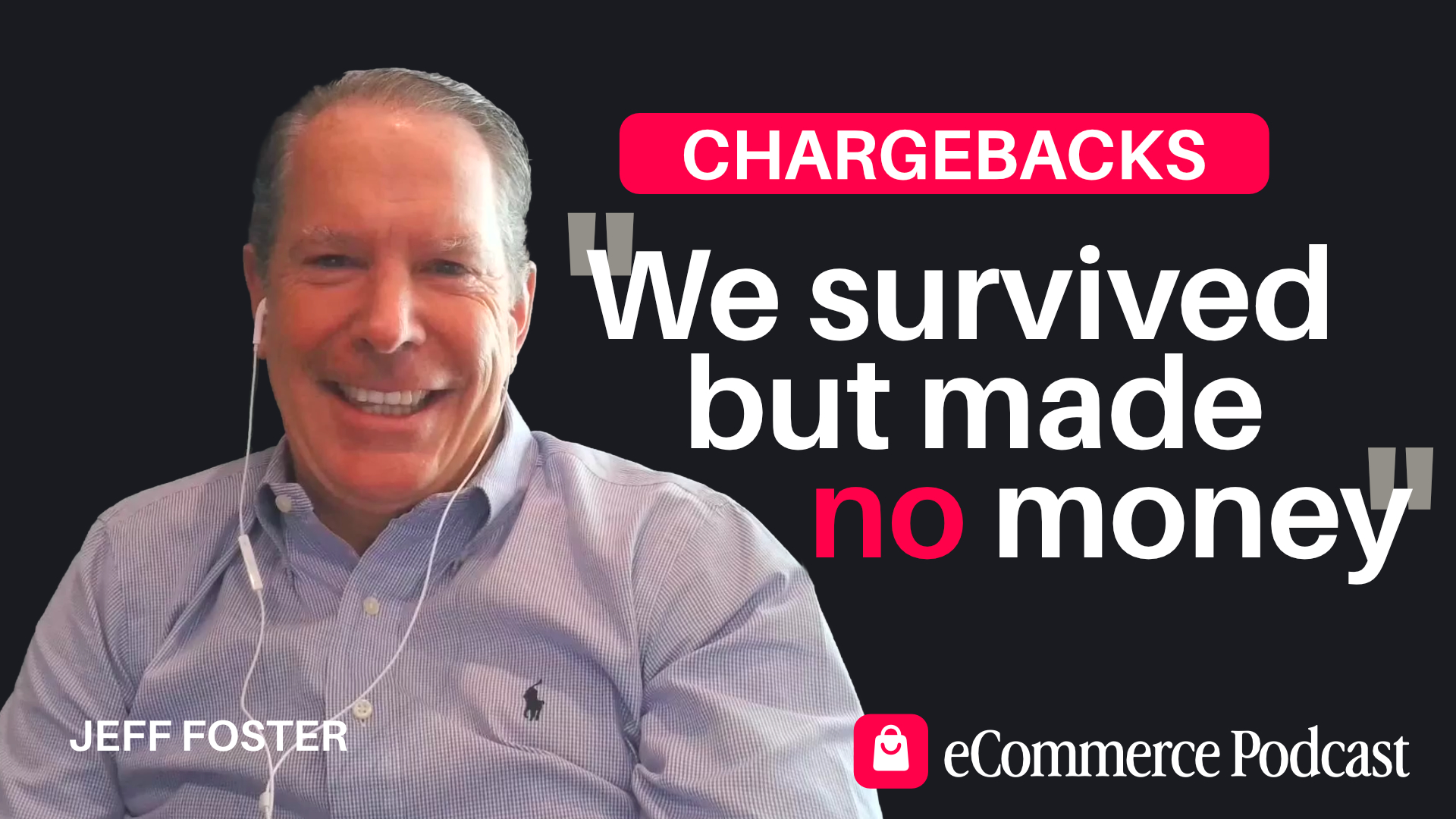
As Jeff puts it: "We survived, but we're not making any money anymore." That's the trap. The goal isn't just survival. It's profitability. And sometimes that means giving the money back before they even have to ask.
Full Episode Transcript
Read the complete, unedited conversation between Matt and Jeff Foster from Quick Refund. This transcript provides the full context and details discussed in the episode.
Full Episode Transcript
Read the complete, unedited conversation between Matt and Jeff Foster from Quick Refund. This transcript provides the full context and details discussed in the episode.
# How to Stop Chargebacks From Destroying Your Profit Margins
## [00:00:00] Welcome to the eCommerce Podcast
Well, hello and welcome to the eCommerce Podcast. My name is Matt Edmundson, and it is great to be with you on what can only be described as a very cold day at the time of recording. Uh, it is a little bit chilly, I'm not gonna lie, uh, but it's good to be with you. I hope you are doing well. I hope, uh, life and business is good.
## [00:00:26] Introduction to the Show and Cohorts
If you are new to the show, uh, we, we, the, the, you know what. The title kind of explains what we talk about. We talk about e-commerce, all things to do e-commerce. Uh, it's a show we've been doing since 2019. Can you believe it? This is our seventh year doing the show. Um, and so very warm, welcome to you if this is your first time with us, and of course, many people listen to the show time and time again, and it's great to have back if you're.
Very, very warm. Welcome to you guys as well. Uh, just love the fact you keep coming back. Genuinely enables me to keep having these great conversations, which we're gonna be having today, again, with people like Jeff. So, thank you for sticking around. If you wanna know more about the show, more what we get up to.
Um, there is a website. You can see all the past episodes on that archive. You can search by topic. I mean it's, it's just singing that website at the moment. Go to eCommerce Podcast net. Go check that out. And of course, if you haven't done so already, check out Cohorts, um, which is our monthly call. It's a, it's a group that we have with a bunch of e-commerce entrepreneurs from around the world.
We all get together different calls, different time zones. It's all good fun, all international. We all run e-commerce businesses and we all talk about e-commerce, talk about the challenges that we're facing, uh, and we just all help each other out. And it's a beautiful thing and it's totally free. And if you would like to find out more about that, go to the website.
Just click on the Cohort link. It kind of explains it in a bit more detail. Um, but yeah, come join us in Cohort. It will be great to see you there. Now that's enough from me. Rabbiting on.
## [00:01:56] Guest Introduction: Jeff from Sunny Florida
Jeff. Welcome to the show, man. How are we doing today? Uh, fantastic. Thank you. Uh, thanks Matt. Thanks for having me. I appreciate it.
Oh, that's great. Great to have you. Uh, all the way from sunny Florida. Is it sunny? Actually, yes. I just, it sunny. It is sunny. I, I won't, don't, won't even tell you the temperature. Uh, I wouldn't understand anyway, but I, I, I took the garbage out in shorts and a t-shirt. Uh.
Yeah, I, I would say I did the same thing, but I genuinely did. Um, so it was great to have you, uh, Jeff, for those, um, that might not know, just explain a little bit about who you are, what you do, what you get up to, and why you are on the show.
## [00:02:35] Discussing Quick Refund: A New Product
So we're on the show today to talk about a new, uh, product that we developed, uh, over the course of last year.
It's last year now. Interesting. Uh, first time I've said that, um, called Quick refund. Uh, we, we sort of, I, I identified a gap in the market, you know, in the e-commerce market. Uh, there's been a pretty significant tightening, uh, you know, on, on, on all sides in terms of, you know, refunds and chargebacks and stuff like that.
And we sort of stumbled into something, uh, that, that seems to be working out very well. Um, it's, it's, you know, sort of a, a, a new trusted third party that, you know, sits in between, uh, the banks and the merchants and the, and the consumers. And, uh, we've been at it now for, well, we, we've been at it for over a year, but we went live in the fall and, and, uh, we're doing, we're doing well.
We're excited about it and we're excited to talk about it. Fantastic, fantastic.
## [00:03:36] Challenges in eCommerce Payments and Refunds
And of course, this is something that affects everyone in e-commerce because we all take money, at least I think that's the general rule of an e-commerce business is you take money for a product or a service. So we. We're gonna be all of these things, so, great.
Uh, great to have you, Jeff. I think these are the kind of topics that we don't really talk about, uh, is my experience. Everyone likes to talk about email marketing or, you know, whatever the latest trend is. Um, but if you, I mean, you know, with chargebacks, refunds, payment processing, all that sort of stuff, with e-commerce, if you could wave a magic wand and solve it.
One key problem that you see customers facing time again and again and again. What would that problem be? Um, and why? I, I, I think the issue, uh, generally is that there's no, there's no central repository for information. You know, the issuers have their information, the processors have theirs, the merchants have theirs, and, uh, you know, the consumers have, uh, you know, their confirmation emails or, or whatever it is.
But I think a lot of the issues and the problems that we're trying to solve are based upon the fact that everybody is really working from a different. Database, so to speak. Right. Um, it's, it, it, it's not that interests aren't aligned. I think that interests are aligned largely. Um, it's that everybody is, you know, sort of backed into their own corner and, and sees these issues from their own perspective.
And when that happens, you know, there's a lot of finger pointing and, and you know, a lot of blaming and, you know, and, and because there are multiple ways that you can resolve these things, um, it just becomes over complicated and like a lot of things, I mean, I've been doing this for almost 30 years. Um, it seems like a lot of the efforts to try to clean things up.
Um, at least in the short term, tend to make them more complex and more difficult. And I think that's a situation that we're in now, and I think those are the kinds of problems that we're trying to solve.
## [00:05:42] The Evolution of Payment Systems
It's interesting listening to you talk about this because what you, what I've noticed I think over the years in e-commerce is, um, we, we sort of go down a path.
We find a whole bunch of problems and then somebody somewhere fixes that problem. Right. And then you move on and, and you, you get to the next problem. And so, um, but perhaps the most obvious one was shipping, you know, and, and the ability to ship quickly. Um, in the uk ESP especially, I mean, I know you know, the uk, but in the UK there was only one, there was a royal male, you know, there was a few other bits and bobs, but nothing significant.
You had the Royal Mail, and now, um, 10 years later, one of the things that you can say eCommerce has done. Everything now ships quicker and easier. Mm-hmm. And there's a system in place that just makes that whole thing, usually not all the time, but usually work with payments. It, it kind of feels like the systems that we were using, perhaps in 2005, they're not too dissimilar to what you have now.
You, you, you have an internet merchant account. There seems to be. Now a few key players that have emerged. Maybe you've the obvious one being Stripe, you know.
I, other than things like Apple Pay, maybe, um, Google Pay, I don't know if there's been any major innovation that I can point to. Am I, am I remembering the history well here or am I missing something? No, I think you've got it right. And I think that there, you know, for, for that entire time period, I mean, I, I've been in it since 1998 and I will tell you like since 1998.
Uh, you know, people have been trying to come up with, uh, with a replacement, uh, to the credit card, you know, for online transactions. Uh, I think the stable coin is now, you know, sort of the big mover, at least in terms of, you know, overall publicity and things like that. Crypto sort of had its chance. Uh, you know, there were a lot of people that were trying to, trying to do that.
It's difficult to get much traction with a, with a currency that less than 1% of the people in the world have any of Yeah. Um, but yeah, I mean, there is, you know, the, the thing about payments is, is that there has been, uh, it is, you're, you're exactly right. It's largely the same now. Is it always has been. I mean, we were in the payment back in two.
You know, we passed the first CVV, uh, transaction ever in the history of the world. Right. Uh, we did the, we did the first verified by visa, uh, transaction ever and, you know, through our gateway. Yeah, yeah, yeah. Um, we had, you know, we sort of piled up, I think 11 or 12 different firsts in just a couple of years because, you know, because there were so many issues that were identified as soon as we started trying to accept payments on the internet.
Um. But then really around 2000 6, 7, 8, uh, things sort of stabilized from, you know, a technology standpoint. There's, there's been no new CVV, there's been no new, you know, verified by Visa. No. Uh, new sort of, you know, fraud prevention or security based, you know, platforms. We're all just dealing with the same stuff.
Um, I think the issuers have gotten a lot more sophisticated, right? That the issuers understand a lot more about our patterns as individuals. Yeah. And so rather than, you know, the, the merchants being burdened with, you know, sort of figuring out where the potential problems are, uh, the issuers are now doing that on behalf of their card holders as opposed to the merchants and doing it on behalf of themselves.
Yeah. Um, but it's, uh, but, but you know, disputes are, are, are largely the same now as they have been since I got into the business, you know, almost 30 years ago. Yeah. Um, you, you have two choices. You can either call the merchant and ask for your money back, or you can call the bank and tell them to tell the merchant to give you your money back.
Yeah. Or just get it back from the bank and then, you know, the, uh, the bank. Takes it from the merchant, which is essentially what's it, what, what, what a chargeback is. Yeah. Um, it's interesting, isn't it, that there's been no real innovation. I mean, I, I, I, I do like Apple Pay. From a consumer point of view, that's easy.
Um, I don't know, actually thinking it through whether. Because it's Apple paying. You've had to use face id, whether that means it's much harder to get the chargeback for fraud on the other end or not. Um, but I, I, I think it's an industry like that that almost feels like it's rife for something quite interesting to come along and, and, and solve a lot of the problems around chargebacks and fraud because.
And whilst, you know, credit cards work on the halt, for most people, most of the time it's still, there's still quite a big chunk of profits which disappear thanks to them. Right? So Apple Pay is a good example, um, of, of a, a way, and I use Apple Pay constantly. Um, it's just the easiest, whether you're on your desktop or your laptop or your phone, you, you know, you hit that button.
You, you, I put the fingerprint thing on my, on my keyboard, or I double click the side of my phone and it's finished. Let's just assume for, for an example, you, you bought something on Apple Pay. It doesn't matter what it's, let's just say it's a bottle of diet pills or something along those lines. And, um, you know, they either don't arrive or they show up and you take 'em for a week and they make you sick.
Whatever it is, you decide you want your money back. And let's just say for example, that you've got three or four different cards that are, that are, uh, on your Apple Pay. Um, and you can't remember which one you used. So there's two things that you, well, there's one thing that you know for sure you're not unhappy with the product and you want your money back, but then there's this whole, you know, sort of complex issue that you have.
Am I calling Apple, not, not calling physically, but am I going on to Apple Pay and trying to figure out how to dispute it from there? Do I dive down into my card? Whichever one it is that I used, assuming that I can figure that out and on Apple Pay specifically, there's no central, you know, I was told, I talked earlier about, you know, working from the same set of information.
There's, there's no list of your transactions on Apple Pay. You have to go into each individual card to find out, uh, you know, what you've done on that card. Mm-hmm. Or do you call the merchant. And if you call the merchant, how do you tell 'em that you paid? Yeah. Um, and so you're faced with a situation where you don't even really know what to do.
You'll know that you want your money back, but you don't really have a clear path, uh, you know, to getting your refund. Um, so sometimes we solve problems, uh, on the front end, like how do I make it easier for Matt to buy? Uh, you, you know, some, some diet pills or, or whatever it is. Um, but I add a bunch of complexity on what happens if Matt is unhappy.
So, yeah, it's, it, it, it, what we're dealing with right now I think is more complex just because of those kinds of things. PayPal's the same thing, you know, they were the first ones. Then with PayPal, you've got, you know, they've got a PayPal credit, you know, which is a line of credit within PayPal that doesn't even link to a card.
Now what do I do? I still owe PayPal the money. Yeah, yeah, yeah. It's interest because, and there's a multiple of these now coming out, like in the UK we've got Carney, you know, the buy before interest free payments thing or whatever it is, and it's never interest free. Um, but I, you know, that, that aside, but it's, it's one of those where.
I can see the problem and I mean, I, you know, I can see from my own data, um, the problem, and I suppose as a merchant, the easiest and best thing I can do, and correct me if I'm wrong here, Jeff, is to make sure it's easy for customers to come and get refunds. So the system that we have are customer emails or callers, and we need to give 'em a refund.
They don't even need to remember the card that it was on because the payment provider has remembered the, the card. Sends it back to it, then it's all fairly straightforward. They're not complaining to the bank. I'm not getting into trouble anywhere else, and I've got somebody who's satisfied with the customer service, right?
Mm-hmm. They're kind of like, well, this is good customer service. Mm-hmm. So that strikes me maybe as the best way to deal with these things. Um, but it would be, it would be interesting to, to also think about, you know, the amount of times we would've had orders and. Two weeks later, the, the, the bank says, oh, that was a fraudulent transaction, and, and clause the money back.
And you're like, well, hang on a minute. We, we did the base checks. Why? What, why are we being penalized for this? Um, mm-hmm. I loved what I, I was reading through your information, Jeff, actually, we obviously, like I, I do with, I guess I just wanna know what I'm talking about.
## [00:15:08] Friendly Fraud: A Growing Concern
Um, there was this really interesting phrase that you use called friendly fraud.
Mm-hmm. Um, and how this has become a behavioral issue, not just a criminal one. I'm really curious, what do you mean by friendly fraud? So, I guess fre the first, the, the first differentiation for friendly fraud is that it's not, you know, systemic or criminal fraud, right? It's not a ring of people that are, uh, you know, sort of, uh, traipsing the, you know, the global eCommerce world, uh, trying to, you know, steal things, you know, in order to sell them or, you know, or something along those lines.
It is simply, um. A lot of this really increased significantly during the pandemic. Um, I got something, I'm perfectly happy with it, but I know I can call my bank and, uh, tell them a different story and they will give me my money back and take it from the merchant. Um, we, we, we, we've, there have been, you know, literally hundreds of surveys and, and you know, we have access to a lot of data around this.
The vast majority of friendly fraud is not even what we would call intentional. You know, it's not something that when you, you're buying the item, you necessarily are deciding at that moment that I'm gonna get my money back for this anyway. Um, it's something that maybe is a little more expensive than you should have bought in the first place.
You know, a bill comes in that you weren't expecting. Your things are a little tight, maybe. I mean, this is one of 10,000 scenarios. And you say, you know what? I'm just gonna call my bank and tell 'em I didn't get it. And, you know, and they'll gimme my money back and it'll be fine. Um, there's nothing that you can do.
I was in the fraud prevention business. Uh, you know, it was, you know, part of my career. I started out in the payment gateway business and I sold that company to a British company. Uh, that was in the, was one of the, uh, initial leaders of e-commerce fraud. Really, there's very little that we could have done then, or that you can do now to, to determine that friendly fraud, you know, is now or eventually gonna happen.
It's just something that is largely behavioral and there's nothing, you can only really deal with it on the back end. Um, you know, when somebody has made the decision that they want their money back, whatcha gonna do about it. The issue that merchants have, uh, with, with friendly fraud is not that, oh, well, geez, I, I, I don't wanna give them their money back because unfortunately the, the cards are stacked against them.
The issuers will refund their money if you call your, your issuer, they've made it very easy. In most cases, when I say your, um. When I say, when I say call, I mean there's a dispute button, you know, next to almost every transaction. Like I go onto your Amex app, there's literally, yeah. You know, every single transaction, just a little button that you hit, okay, gimme my money back.
So they've made it very easy on consumers. Um, and so as a merchant, uh, one of the things that you have to figure is, okay, well. I've got X percent of friendly fraud that I'm gonna be dealing with as a business. How do I wanna deal with it? Do I wanna, do I wanna just give them the money back and limit the expense and the exposure and the, you know, the, the time that we consume on these things.
Or do I want to go the other way and, you know, fight and deal with the bank and, and all the rest of that stuff. And, and the issue generally for our customers comes down to the economics. Hmm. Um, you know, you wind up making about the same number of refunds anyway. Uh, the expense of having to deal with the bank and the charge chargeback and the, and, and, and all of the rest of that stuff can be 6, 7, 8 times as much.
As, you know, using a system like ours, which I say a system like ours, I mean, we, we have really the only one right now. Um, but uh, just say, okay, well look, it's, it's 1% of my transactions. These people are gonna get their money back one way or the other. Let's just give 'em the money back. It's interesting, isn't it?
It. Friendly fraud. So it, it sounds so soft and palatable, um, right. Um, but it, it's, it's also quite distasteful, isn't it? And I, I, I get it. I, I, I understand it from, from both. And this is where I think actually your idea of having a shared set of data would be really interesting, because if I could, when I took your credit card details, when I took your order.
If there was a system where I could somehow go and check and say, well, Jeff, actually, no, he's a good guy. He's got a, a bias score of 98%. Like Jeff, I'm sending this out to you tomorrow, but Esella over here, and I'm sorry if your name's Estella by the way, you'd start to pick, let's pick a random name. Uh, but uh, if you are, if you are a stellar over here and actually you.
Actually there, there's a, there's a little check on your name because you do quite a lot of these chargebacks. A lot of these disputes, you've only got a score of like 30. I'm like, Hmm, I don't think I'm gonna send these to you. Uh, Estella, I think I, I, I think I'd rather not actually take the risk. Um, I can see why a central repository of data that I as a merchant could access and that everybody could access, I think would be a really interesting thing.
Um. I appreciate that, just by suggesting that there will be hoards of people up in arms, around privacy and, you know, all that sort of stuff. Um, but I, I'd like you, I go, well, we're just gonna have x amount percent refunds every year. And so we just have to account for that in our costings. It just, it is what it is.
It's not brilliant. It's not, and there are some people who genuinely need a refund and there are some people who are taking the mick and you, you can't distinguish them. You go, you're right. The economics are just so bad. I just, why, why would I want to find them on this?
## [00:21:13] The Economics of Refunds and Chargebacks
I, I, I think if you wake up, you know, so we're on, we're in January 5th, right?
I mean, really probably the first business day of the year. And I'm an e-commerce merchant and I'm gonna do, you know, $10 million in sales this year. I know that, uh, that I'm gonna have, you know, 250 or $300,000 in, in, in what I would call disputes, right? Mm-hmm. Like friendly fraud, uh, you know, chargebacks, whatever it is.
Uh, the, the question is, um, how, how much of a penalty do I wanna pay on top of that $250,000? And how can that penalty exacerbate itself, right? Because if, if the, if the percentage is too high, you know, I wind up getting all of these additional fees and fines and, uh, you know, it, it tumbles pretty quickly, uh, into something that becomes unmanageable.
The, the acquiring banks and the sponsor banks out there have got a very low tolerance threshold at this point. Mm-hmm. And so you could literally get yourself into a situation where, I mean, we were, we were actually joking around about this last night. Uh, one of my partners and I, I mean, imagine your bank calling you up and threatening to shut your business down because only 98% of your customers were perfectly happy.
With what they bought. Right. I mean, imagine if a politician had to deal with those kinds of stats. Yeah. You know, nobody, every elected official would be gone their first week. Well, yeah. That there'd be no government, but Yeah, I hear what you're saying. Right, right. So, so, but those are the actual thresholds.
I mean, if you've got 2% chargebacks as a merchant, you're in big trouble. Not, not only is it costing you a Fortune 25, 35 55. Dollars per transaction. And imagine somebody who's selling something that costs $25. Yeah. You know, having $75 in, in fees and fines, you know, on each of their transactions. Now a $250,000 problem is a million dollar problem.
Yeah. And you know, you've got a, you've got a sponsor bank potentially pointing a gun at your head. Yeah. Um, and it is, we're, we're largely in a sort of blame the merchant. It's always been a little bit blame the merchant. Yeah. Right. Like if somebody, if, but, but you know, I, I'm 58 years old and, and I was, you know, I, I was around at the very beginning of e-commerce and, and um, and I remember very vividly how difficult it used to be to charge something back.
You know, I mean, if you called up your bank and said, Hey, you know, these guys didn't deliver this, or I'm unhappy with it, or there's some big problem. They would send you this reef of papers and like every other paper would basically say you're gonna be arrested immediately if any of this doesn't turn out to be true.
Yes. You know, you fi like you really, I mean, you, you felt like you were taking your life in your hands a little bit and it was gonna take a month to resolve and all the rest of that. None of that exists anymore. Like I said, they, everybody's built a little dispute button and you answer a couple of questions, they give you your money back and they sort it out with the merchant and they go back to the merchant and say, well, you must be running a terrible business if people are unhappy.
Yeah. And that's just, that's just how the world has turned. Um, you know, one of the systemic issues that we have, I think, um, is that there's a lot more money in the issuing business than there is in the processing business. Yeah. And so, you know, the, the issuers all have a much, much greater economic opportunity keeping their, their cardholders happy.
Uh, than, than the processors or the, or the merchants have, you know, on a, on a one by one transaction basis.
## [00:25:02] The Customer is Always Right
Yeah. I mean, you can see why they favor the, the customer. Yeah. That's where their money is, right. Yeah, I mean, I, I had it explained to me by a very large merchant. We were at a, there's a show in the US called Money 2020, which is sort of the, you know, the mecca for, you know, payments and FinTech and stuff.
Mm-hmm. Uh, and, and uh, that was in October. And I, I was talking to a guy who runs a very, very large, you know, sort of premium issu. Portfolio for one of the major card brands in the US and he said, listen, Jeff, we, we know what's going on. You know, we, we know when, when Matt calls up and says, you know, he doesn't like this $200 thing or whatever, he's probably perfectly fine with it, but we don't care.
You know, Matt's spending $17,000 a month. We're getting e premium interchange on all that money. Yeah. Uh, he's rolling about half of that into the next month. And, and, and we're getting, you know, almost leg breaking interest rates, uh, you know, from him, uh, on that. And, you know, we, we just want Matt to be happy.
We don't give us, we don't, we, we don't care if he wants to steal something worth 200 bucks every other month. Yeah, that's sure thing. It's fine with us. Yeah, that's right. Yeah. Deal with, because it's definitely not my problem. Says the bank. Right. It's not my problem. It's your problem. Yeah, but the bank is gonna say, Matt, you called the right people.
You have no problems. Yeah, exactly. And I get that. I get you're sorted. Yeah. It's just a danger of free market economics, isn't it? In many ways that, you know, the, the bank's gonna go where the money's going. Um, and the go. No one's, no one's crying out for the merchants. It's not like the government's gonna go and introduce new law to protect the merchants.
I think all that's gonna happen is the merchants are gonna do what we do now. We're gonna go, well there's this percentage. We're gonna have to put prices up so the consumer ends up paying more anyway. Um. Thanks to people that maybe abuse the system slightly. It's one of those, isn't it?
## [00:26:52] Merchant Frustrations and Solutions
I, I've talked to a lot of people about this and everybody you speak to, and Jeff, maybe you, this is, it's interesting with the business that you are in, because I can imagine that every customer that you have on the, on, you know, using your software solution is probably using it.
'cause they're really angry with at least one of their customers doing something illegal and getting away with it. And there's nothing that they can do. They can almost, they almost feel powers, right? Um. What's your counsel to people that, that feel that way? Just suck it up and get on with it. Y you know, I, I, we joke around about having to have it like a staff psychiatrist, uh, you know, to, you know, in our customer service department, um, because it really is terribly frustrating for, for these merchants, right?
Because at the end of the day, we only only have one, one thing to say, just give 'em their damn money back. Right? Yeah. I mean, they're gonna get it anyway. Yeah. And I know it's painful. It's sort of like, I mean, if, if, if you removed all of the emotion from the legal system, how many lawyers would lose their job tomorrow?
Right. I mean, there, there are so many people out there spending, you know, four or five, $700 an hour on lawyers to fight something that they probably won't win anyway, just because they wanna feel like they're right and they wanna feel like, you know, I'd say it's not right. It's not, it's not moral and ethical for me to give up.
At the end of the day, there's just a, there's just a practical, uh, view OO of all of this. And like I said, you have $250,000 in people that are gonna want their money back, legitimately or not. Um, do you want that $250,000 to cost you an extra 50,000 in fees or do you want it to be 800,000? But like, how much of your sort of moral and ethical balance comes into.
Um, sustaining your profit margins? Um, I don't know.
## [00:28:47] Visa and MasterCard Regulations
I mean, if I, I, I assume there's a lot of people that run e-commerce businesses that are, that are listening to this and, and so they're all very familiar with, uh, you know, the Visa monitoring program and, you know, the Visa and MasterCard in 2025 significantly tightened, uh, you know, and, and lowered thresholds for almost every.
Um, and, and change some of the rules significantly. And, and there's sort of additional fees and fine now that are, uh, in place. And we, you know, I, I mean the, the sponsor banks that we work with directly have, have removed thousands from their customer, you know, because, because they were acting exactly the way that they were, uh.
Prior, but when they, when you lower the threshold, uh, and you change the rules, then sometimes the rules say, well, it was perfectly fine for you to do this before. It's like changing the speed limit on a highway, right? So it used to be 70 and we changed it to 55 and there's a bunch of people that don't realize it's 55, but you can still get pulled over and get a ticket for going 75.
Yeah. Um. So frankly, we we're in this business right now because we're also in the acquiring business. We've got large portfolios of merchants, some of whom are in, you know, what Visa, MasterCard would call high risk businesses, uh, you know, nutrition supplements, uh, you know, e-gaming, um, you know, all sorts of stuff like that.
And. We needed a solution for them because they were under pressure y you know, they were coming to us and saying, I look, I can't get below 1%. I can't do it. There's too, there's too many people that are stealing from me. You know, there's too much confusion in the market. Like, if, if you're telling me I'm gonna lose my business unless I lower it, you know, below this, I don't, you know, we don't know what we're gonna do.
And, um.
## [00:30:53] The Quick Refund Solution
One of our, one of our partners actually came to us with the, with the original product, the original Quick refund product that they had built in response to the Federal Trade Commissions, uh, click to Cancel law, which took several years to pass, which wound up getting, you know, sort of, uh, crushed, um, you know, in lawsuits just before it was supposed to launch.
But the idea was. We talked about this a little, you know, uh, at the start, if it's super easy to pay for something, it should also be super easy to cancel it or, or get your money back. And, and so the original Quick Refund product was built in response to that because, you know, the FTC said all these merchants are gonna need a solution that makes it just as easy to get your money back as it was to pay that lawsuit went away.
Um, and in the middle of all of this, uh, visa, MasterCard significantly tightened. Uh, you know, the, the thresholds by which you're judged as a merchant and changed some of the rules and started, you know, finding them for things that they didn't previously. I mean, I don't want to get too technical, but it, it's become a significant problem.
And, you know, when I was, when I was first introduced to it, because I didn't think of it, um, I thought, Hmm, making refunds easier. Well, why didn't somebody, what isn't somebody already doing that? I mean. It seems so simple. Right. Um, but nobody did. Right? Nobody did. And when you said earlier, you said what, you know, obviously the smartest and easiest thing is to just, you know, sort of let the processor deal with it, right?
Just refund it back to the original card and everybody moves on. That's actually not what happens in most of the cases with refunds. Most refunds are a forced deposit in the same amount back to either the original payment method or another one, and then the bank has to sort of match those up. It's not, you're not, you're not actually doing anything.
You're not affecting a refund based on the original transaction. You're producing a new one. In, in the same amount, you know, in the opposite direction. Um, but I think something like 25% of all chargebacks are transactions that have actually already been refunded, believe it or not. Okay? But the bank didn't match 'em up, right?
So, you know, you, so, you know, you get, you get something in the mail. So let's just say that, make it easy. So there's no shipping or anything. You, uh, you need to do a presentation. Uh, and you, you, you've seen this, uh, AI tool on Instagram that makes it look like, well, I'm just gonna throw my logo and a couple of declarative sentences in and I'm gonna get this thing that looks like a 50,000 television commercial.
So you buy it or you subscribe to it, you can't figure it out. It's not intuitive. You don't know what to do with it. Um, and you know you want your money back. Well, it's, it's. It's not that. It's, so maybe it's been a couple of weeks and the company goes, yeah, great. 1995. Here's your money back, Matt. They just put, do a force deposit onto your, your card.
Um, but a forced deposit sometimes takes days. Sometimes it can take a week. Depends on where the co you know, where the company is. You randomly checking your bank app. You go, I don't see this 1995. I'm not calling those guys back again. I'm gonna call my bank. So you call the bank or you, or you dispute it online.
These transactions are two weeks apart. The forced deposit and the original transaction, they don't catch it. They also process a refund on top of that. Maybe give the merchant their money back again and a $25 fine or a 35 fine. And if there's enough of those, there could be another fine for $8 or $10.
And if there's enough of those, they could wind up with 20, $30,000 a month. And just some arbitrary amount that they decide to charge the merchant because there's too many So it, you know, it, it, it tumbles pretty quickly. Yeah, and it's at a very, very low threshold. You know, when I got into this business, the threshold for chargebacks was 3.5%.
Then they changed it to one and everybody figured it out. Now it's freaked out. Now it's going down to half a percent. Yeah, I mean, imagine your bank of accusing you of being a failure because only 99.5% of your customers are happy. It's like the dad who says to his son. When his son comes and says, dad, I got 99 point half percent on my test.
Well done. Instead of saying, well done, he said, well, what happened to the other half? Yeah, that's Yeah. What, what did you get wrong? Yeah, yeah, yeah. I just wanna punch you in the face right now, dad. It's one of those, isn't it?
## [00:35:36] Challenges in E-commerce
And I, I, it feels like as an e-commerce operator that we're kind of at the mercy of all of this.
It's not like we can just all sort of band together and change the outcome. We just kind of have to deal with it. Well, that's right. And then, you know, so you've got, uh, you've got, you know, visa and MasterCard. You've got, uh, the sponsor banks on both, you know, the acquiring and the issuing side, you know, the processors and acquirers, the merchants.
And then you've got all of these third parties, right? So you've got front end fraud prevention vendors that are gonna try to tell you as a merchant what's good and what isn't good, you know, before you accept the transaction in the first place. That was the business that I was in when I was, you know, working in the uk.
And then there are a whole bunch of companies that help you to sort of manage the chargebacks that will, will provide you with alerts, you know, um, if you hit the dispute button, for example, on your bank app. And the first question is always, you know, have you contacted the merchant because they won't give you your money back if you haven't at least attempted or claimed to have attempted, uh, to get to, to contact the merchant.
And you say that, no, I haven't. And they say, we'll, get in touch with the merchant. And you know, again, this is all digital. Well, that results in a bunch of these companies sending the merchant an alert, Hey, Matt's upset, he hasn't charged anything back. Guess what that alert's gonna be $35. Right. So even if they, even if they jump on the phone with you and resolve it, it still cost 'em 35 bucks.
Yeah. Just because they went to the bank first. Yeah. So it's to, to your point. Exactly. I mean, I, I, these, these merchants are all, and we're in that business, you know, we've got large, you know, portfolios of, of merchants who we process for, and they are definitely feeling like they're in a much smaller box now, uh, than they, than they were.
And I think the, the biggest problem for everybody eventually is gonna be in that they're, they're, they're in a lot less profitable box. Mm-hmm. So when. When regulations or, or, um, you know, the Visa, MasterCard thresholds, you know, change or tighten, um, when, uh, banks and acquirers start to get more aggressive about, uh, you know, cleaning these things up and with fees and fines and, and sometimes, uh, you know, just eliminating the merchant accounts altogether, everybody gets into this survival mode, right?
And it's sort of like, well, you know, as long as I survive, I am fine. Um, and I think everybody's largely been in that, you know, sort of like they're on a raft in the middle of the ocean. Yeah. Um, but I think, you know, by the time we hit, uh, you know, spring, summer of this year, there's gonna be a lot of people that sort of put their head up and say, well, yeah, we survived, but we're not making any money anymore.
Right. These, you know, all of these, uh, you know, tightened restrictions and everything else are costing us a fortune. Yeah, with the same number of disputes as we had before. And so that's, you know, that's, again, I think that's part of how we, we're not, we're not solving the problem, right? I mean, we're not, we're not gonna tell you the merchant, well, you've got $250,000 in friendly fraud or any other kind of fraud, and we're gonna prevent it.
We're telling you that we're gonna limit your exposure based on what that is. We're just, we're gonna facilitate, uh, you know, an easy refund. And it's gonna cost you less money. And all of these, you know, sort of black marks that you get on your record with Visa and MasterCard and the banks and so forth, disappear because you've resolved it on your own.
Nobody else is involved. So if we can take care of if, if, if the problem is you're at 2% and you need to get to 1% and we get you there. Um, not only is, are your costs lowered, uh, obviously by, by a bunch, but the thresholds by which your business is judged by Visa, MasterCard, the sponsor, banks, and so forth, is also much cleaner.
Yeah. Uh, and so you, you're making more money, but you also money, you know, to, to those third parties look like, you know, a much, you know, cleaner, better business. Yeah. Um. So it's a real, you know, you get into the weeds on this stuff and it's, it, it's easy to get despondent. I mean, we, you know, I deal with merchants all the time that are like, I just can't, like, this is insane.
Um, but, you know, sometimes there's an easier solution than you think there was going to be. Um, you know, we're, we're, we, we own the product and we're as surprised as anybody that, that it, that it didn't exist in the first place. Yeah. The, the, the analogy that I started using, right? Because everybody was like, well, doesn't that, isn't that already around somewhere?
I mean, it seems like it would, you know, that that would already exist. It seems like an obvious thing that somebody would've, would, would've done a million years ago. And I say maybe this is more of a US thing, but I mean, it took 78 years for the postal service to turn the stamp into a sticker. You know, we spent, we,
okay. That's a stat I'm gonna use. Uh, I'm, I'm gonna quote you there, Jeff. I'm not gonna lie. I love that. Well, no, but I, and listening to you to ride it, it sounds to me like the smart play here is for merchants to go, you know, what? We are gonna get royally shafted with chargebacks, right? It is what it is.
It's inevitable. Um, we can lower the amount of chargebacks from refunds by being smart and the refunds and chargebacks that we have, we can do those well to again, lower the charges. So the smart play is not necessarily to go to your, uh, local counselor or senator or wherever you're in the world and complains smart place to go.
How do I minimize loss? Yeah, that's right. How do I, how do I make the I, I acknowledge there's gonna be loss. I don't think it's fair. It doesn't matter whether it's fair, there's gonna be some loss. How do you minimize it and how do you move on? And that sounds like the smart play, doesn't it? When it comes to dealing with customers that use credit cards to buy from your website.
I, I, I have a, a to that point exactly, and it's not an e-commerce issue, but it, I think it's a good analogy. So one of, one of our clients, uh, also owns slash owned, uh, 150 odd, uh, sort of hyper markets, uh, you, you would call 'em in the uk, uh, in, in, in urban areas. And in, in the US in particular, they owned, uh, I think 40 or 50 in the, in New York City.
And, uh, they ended up shutting them down because there was, you know, there's always gonna be shoplifting, you know, people are always gonna, you know, grab, grab some stuff and go. Um, and. Their original solution was to put security guards, you know, to just prevent it, not necessarily to stop anybody, because believe it or not, here in the US you can't stop anybody.
You know, you put your hands on somebody who's just stolen a candy bar and you got a, you know, multi, you know, 20, $30,000 lawsuit on your hand, but just as a prevention, right? I'm just gonna have a guy standing there who's gonna make it seem like it's not a good idea. Yeah, the, the insurance rates increased so much, uh, in each of these stores in New York that if the shoplifting had doubled, it still wouldn't have been as expensive as preventing it with one guy standing at the front.
And I think that's sort of, uh, symbolic of what we're looking at, right? I mean, nobody, nobody wants to say, yeah, okay. Just go ahead and take the stuff. Um, you, you know, we'll make it easy on you just so it's easier on us, but at the end of the day, those are the pragmatic decisions that we have to make. You know, particularly at volume.
Scale makes total sense. I love this idea of, I suppose, of understanding it, of e-commerce, shoplifting, uh, I think is a really interesting idea. Um, very good.
## [00:43:58] Final Thoughts and Contact Information
Jeff, listen, I'm aware of time, um, and I, I thoroughly enjoying the conversation, but, but how do people reach you? How do they connect with you if they want to do that, what's the best way to find that more?
So, our website is, uh, www get quick refund.com. Uh, there's a bunch of information on there. There's a, you know, there's a contact us, uh, form, uh, that you, you can, you can fill out. Um, you can also email, uh, info@quickrefund.ai. And those are two completely different domains. We actually. I got the, I got the AI domain 'cause I thought it was really cool.
We built the platform on it and then my IT guy said, you can't run email off this thing, Jeff. We're actually running the platform here, so we, we got a different one for the, uh, for the website. Um, so yeah, so info@quickrefund.ai. Uh, anybody can reach us there and if you would like to just learn more about quick refund, you can go to get quick refund.
Of course, link to that in the show notes as well. And you can click those links. And of course, if you sign up to the newsletter, they'll be in your email inbox. Uh, but of course, whatever podcast player you are listening to this on, or whatever you are, you are on YouTube or whatever, just scroll down.
It'll all be in the description as well. Sure, in there. Um, but Jeff, thank you man for coming on this show. Genuinely loved the conversation. Learned a lot. It's my pleasure. Take it also seriously, uh, is probably the, you know, don't get so angry, man. Uh, it's, it's probably the, the be the best bit of advice.
Um, one of the things that we do like to do in the last two minutes, Jeff, we like to do this thing called saving the best or less, so those that have stuck around to the end. What is your top tips for someone specifically starting out in eCommerce, who's kind of new to eCommerce, who's listening to you talk, going?
Man alive. I just, I, I, I've still gotta find a good supply for the products. I'm, I'm getting a little bit lost with it all. What's your top tip for them? The mic is yours for the next two minutes, Jeff. So, uh, my top tip for anybody and we deal with all sorts of merchants of digital goods, physical goods and things like that.
Um, the, the most important thing and, and what prevents us, uh, frankly, from ever having to get involved is around fulfillment. And customer service. You know, whether you're providing somebody with a, you know, with a, a downloadable digital good, or you're shipping them, uh, you know, a, a, a sweater, uh, or, or, uh, you know, a pair of shoes or something like that.
Uh, getting, uh, your product to your customer as quickly as possible and over communicating with them through that process. The number of, of disputes, refunds and things that we see on a daily basis that are based on a lack of communication, uh, from the merchant is something that every single merchant can easily solve in its entirety.
Uh, you know, it's, it's just in that specific case, there's all sorts of stuff that we can't control, and that's, that's the world that I live in, you know, most of the time. But what you can control, literally down to the last item, it just takes, you know, discipline and organization is, you know, fulfillment and customer service.
Get your goods out, uh, overcommunicate with your clients, follow up, uh, to make sure they got what they got and that they're happy with it and so forth. And because the number of, of disputes and refunds and chargebacks and things that I've seen through my entire career, I'd say there's a large, large percentage, you know, maybe 25, 30% that are based on confusion or frustration or lack of communication.
And those, if you can just solve those problems, you know, forget about. Refund versus chargeback or anything else. Mm-hmm. If you can just, you know, make sure that your, your stuff arrives on time and if it doesn't, just communicate about it. Mm-hmm. And I think a, that, that will eliminate a huge percentage of what we have to deal with on the back end.
Fantastic. Love that. And I just, it, it, it puts the power back in your hands, doesn't it? This is what I can control. This is what I can do. Um, don't try and shaft your customer 'cause you'll always come off worse it seems. But. Go out there, do a good job over deliver, and you'll find these things go, you know, further and further down.
Jeff loved it man. Thank you so much for coming on this show. It's been an absolute treat, my friend. It's my pleasure. Thank you for having me. Wow. There you go. Another fabulous episode of the eCommerce Podcast. All wrapped up and handed to you on the metaphorical silver plate. Uh, of course, uh, but thank you for joining us this week.
Make sure you come back next week because we've got more great conversations lined up and I don't want me to miss any of them, so make sure you do all the like and subscribe thing. Um, uh, but that's it from me. That's it from Jeff. Thank you so much for joining us wherever you are in the world. I'll see you next time.
Bye for now.
Meet your expert
Jeff Foster
Jeff Foster
Quick Refund
Even more episodes...
The Creative Engine That Stops Your Meta Ads Burning Out