Two Years, 100 Newsletters, and Not a Single Sale Yet
Gabriel Lindh has spent two years and a hundred weekly newsletters building Nordic Dudes, an anti-chafing swim shorts brand, and still hasn't sold a pair. He and Matt Edmundson unpack the pre-launch playbook: validating demand with paid pre-orders before spending a penny, building an audience while the product is still in development, launching at good enough rather than chasing perfect, and the small packaging decisions that turn a purchase into a moment. An honest look at doing the early, unglamorous work of starting an ecommerce business properly.
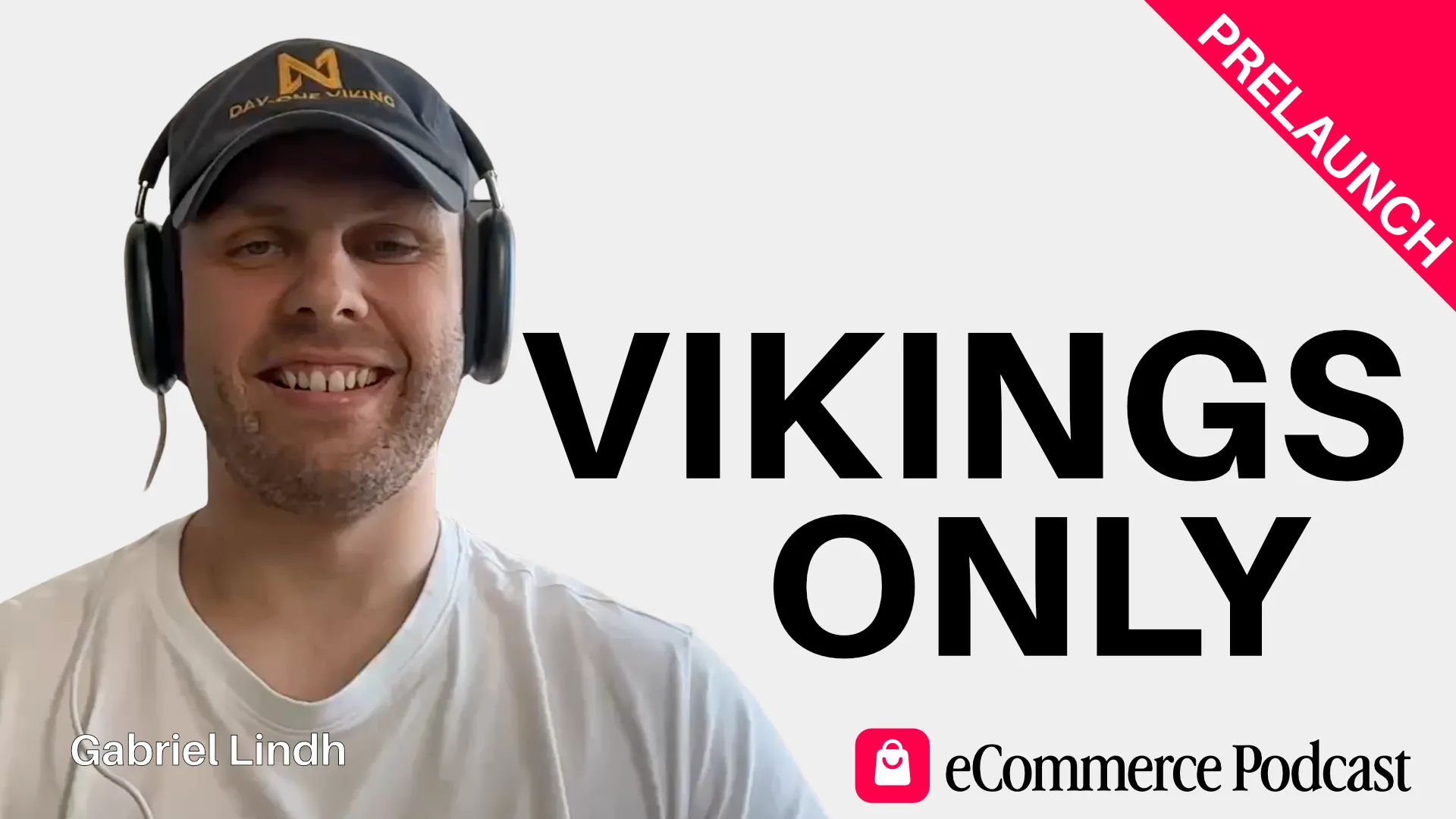
Gabriel Lindh has written The Weekly Pillagenewsletter every single week for over 2 years (with is a 100+ newsletters at my last count). In all that time he has not sold a single pair of the swim shorts he is desparately wanting to sell. Why? Well, the finished product does not exist yet. The order for the first production run went in the day of this recording.
Nordic Dudes makes anti-chafing swim shorts for "guys, or Vikings, with bigger legs", a Swedish brand with a sense of humour and an ice-hockey family behind it. Gabriel runs it with his brother alongside a day job, with no real e-commerce background beyond a couple of years of dropshipping and about $400 in sales. What he does have is a method any early-stage founder can copy, and honest lessons about how long the whole thing actually takes.
The idea that took two years to get off the ground
The problem found Gabriel on holiday in Australia, on the 40-minute walk from Coogee Beach to Bondi. It was January, summer down there, around 38 degrees. He had swum in mesh-liner swim shorts, the kind that dry hard and crusty, and by the time he reached Bondi the chafing had scratched his skin raw. Getting into the water to cool off made it worse as the salt water hit the cuts. The idea planted itself there.
Then nothing happened for a couple of years. Gabriel was 23 or so, his brother four and a half years younger and still wanting to finish university. It was only when they talked it through properly that they gave each other the nerve to start. A good idea will wait for you, and it often needs a second person to make it feel real.
Get people to pay before you build anything
Before there was a name, a design, or a product, Gabriel tested whether anyone actually wanted his product (very Tim Ferriss).
He and his brother built a list of 60 to 70 people they thought might be interested. Friends, friends of friends, and players from the brother's ice-hockey team. Then they reached out one by one, by text and by phone, explained the plan, and asked a simple question. Would you buy this?
Most people said no. But 20 to 30 said yes, and they pre-ordered and paid up front through Swish, the Swedish payment app. Gabriel was upfront about the terms. They did not know how long it would take, it could be a year or two, and buyers could have their money back any time they wanted. They all agreed anyway.
A few things make this worth copying.
- Real money, not a poll. A thumbs-up costs nothing. A payment, even a refundable one, is a genuine signal. People voted with their wallets before a product existed.
- No fixed launch date promised. Removing the deadline removed the pressure and kept the pre-order honest. It was a bet on the idea, not a purchase with a delivery expectation.
- A rough bar, agreed in advance. They never set a hard minimum. As Gabriel put it, if we get 2, that is not going to cut it, but if we get 20 or 30, that is definitely enough. They landed in the "enough" zone and gave themselves permission to continue.
Gabriel is careful not to oversell what the test proved. The list was made of people who knew them and wanted to help, so it is not a perfect read on the real market. It does not prove a million-dollar idea. But it proved there was enough interest to keep going, and that is all a validation test needs to do.
Matt has run the same play across several businesses, usually setting a threshold that would tell him the idea was good. He never once hit that threshold, and he built every one of those businesses anyway, out of what he calls blind entrepreneurial optimism. He does not regret a single one, including the failures. Validation is useful, but it is not a permission slip you have to earn before you are allowed to start.
It takes longer than you think, and it is harder
Gabriel thought the design-and-manufacture process would take four to six months. It has taken more than two years. He calls it the most difficult thing he has ever done.
The path was messy in the way real building is messy. The first manufacturer got a text message with no tech pack, no designs, nothing, and sent back a sample that was, in Gabriel's words, absolutely horrendous. No stretch, a complete waste of time and money. That failure taught them what a tech pack even was. They found a designer on Fiverr who had worked with real brands, paid properly for a good one, and used her manufacturer contacts to start again. From there it was sample, feedback, revised tech pack, new sample, through three or four manufacturers before they found the one they have now.
His advice for surviving that grind is the same advice he gives for starting at all, take it one step at a time. The to-do list is endless and most of it never gets done. So the question is not "what are all the things I have to do?" It is "what is the single most important thing I can do right now to get a little closer?"
Build the audience while the product is still in planning
Here is the part that makes Nordic Dudes unusual. The audience-building did not start after the product was ready. It ran in parallel with the entire build.
The Weekly Pillage newsletter has gone out every week for around 100 weeks, sharing the journey, the wins, the setbacks, the horrendous first samples. The point, in Gabriel's words, is momentum. By the time they launch, they want an audience that already knows them and trusts them, so the product lands with people who are pleased to see it rather than strangers asking "who are these guys?"
Two weeks before recording they added a weekly blog on top of the Thursday email. The one honest gap is social media. Gabriel admits they are lagging on Instagram, partly because they feel they need product content and do not have much yet. Matt's nudge here was direct. Get a move on with Instagram, because it is the biggest open opportunity, and with a humour-led brand you do not need finished stock to start being funny about chafing.
Launch at an eight, then let customers finish it
Gabriel's plan for the product itself is not to make it perfect. It is to make it good, launch, and improve it with real customer feedback. He wants the first run to be at a level where buyers think "I like these", flaws and all, then use their comments (even the rude ones) to make the next run better.
That instinct has a name Matt shared on the show, the theory of eights. Chase a 10 out of 10 every time and you will exhaust yourself and quite possibly never ship. Aim to consistently hit an 8 out of 10, and you get something into the world that people are happy with, plus room to iterate. And at an 8, customers will not call the product "good enough". They will just call it good. The "enough" is a founder's anxiety, not the customer's verdict.
The packaging decision that cost pennies and changed everything
Nordic Dudes very nearly shipped in a premium box. They studied how Apple does unboxing, ordered box samples, tested the weight. Then Gabriel's mum suggested a bag, and the whole thinking flipped.
They settled on a reusable cotton fabric bag with the logo on it, shipped inside a simple plastic bag to protect it. The reasoning is smart on three counts. A box gets opened and thrown away, whereas a fabric bag gets kept and used to carry swim shorts, a towel and a water bottle to the beach. A box can be crushed in transit, and a broken premium box tanks the whole experience, but a bag is mouldable and does not break. And there is a quiet sustainability angle they have not even started to talk about yet.
Matt's counterpoint was about surprise. His example was the beauty company where every competitor shipped in a padded Jiffy bag, so they moved to a proper box, added a flap so it felt like opening something, tissue paper, a nice smell, and then, instead of bubble wrap, popcorn. When they added up the cost, the box was the same price, the tissue a penny or two a sheet, the popcorn maybe two or three pence a parcel. Under ten pence to turn a delivery into a gift-opening moment.
What happened next is the point. Social media posts that used to be complaints became posts about the popcorn. Customers emailed daily to say how much they loved it, to the point the team had to ask people not to eat it. Matt credits that one decision with pushing retention well above his industry's averages. He also pointed to ThruDark, a UK clothing brand whose roll-top bags customers keep and reuse for years. Same principle as Gabriel's bag. Give people something they want to keep.
Pack the first orders yourself
The first production run is 200 pairs. Shipping, to start, will be done by hand, mostly by Gabriel's brother in Sweden, out of the address where the business is registered. Third-party logistics can wait until the volume genuinely demands it.
Matt's take is that packing your own first orders is a feature, not a chore. You learn the product. You start to see the customer. And you care more than any warehouse ever will about how that parcel arrives, which is exactly where the packaging magic gets invented. He told the story of the first time his own e-commerce business went a bit mad, filling his car with parcels instead of the usual two or three, paying the postman in cash for stamps. Outsourcing that too early robs a founder of the moment, and Gabriel admitted, live on the show, that he had not thought about the memory of those first orders until Matt raised it.
Where to start this week
If you are early in your own build, Gabriel and Matt leave you with a short, practical list.
- 1Validate with money before you spend any. Build a list of people who might want what you are making, ask them plainly, and let the willing ones pre-pay (refundable) to prove real demand.
- 2Start the audience now, not at launch. A weekly email that shares the journey builds trust while the product is still being made. Pick one channel and be relentlessly consistent, the way The Weekly Pillage has been for 100 weeks.
- 3Aim for an eight. Ship something good, then let customer feedback shape the next version. Perfect never launches.
- 4Make the unboxing memorable for pennies. A kept bag, a small surprise in the parcel, a moment of delight. It costs almost nothing and it changes how people talk about you.
- 5Do the small, unglamorous jobs yourself at the start. Pack the first orders. Prioritise the single most important next thing, and let the endless to-do list wait.
Two years of work and not a single sale yet. Put like that it sounds like a warning. Look closer and it is the opposite. He has an audience that already trusts him, a product tested by the people who will buy it, and a craft learned one step at a time before the first order ever ships. Are you waiting for the product to be finished before you start building the audience, or could you start both today?
Full Episode Transcript
Read the complete, unedited conversation between Matt and Gabriel Lindh from Nordic Dudes. This transcript provides the full context and details discussed in the episode.
Full Episode Transcript
Read the complete, unedited conversation between Matt and Gabriel Lindh from Nordic Dudes. This transcript provides the full context and details discussed in the episode.
---
episode: 303
guest: Gabriel Lindh
company: Nordic Dudes
recorded: 2026-08-07
publish_date: 2026-09-10
duration_minutes: 52.63
speakers:
A: Matt Edmundson
B: Gabriel Lindh
source: riverside_edit_- gabriel & matt_ecommerce_podcast r.mp4
transcription: AssemblyAI universal-3-5-pro (speaker diarization)
cleanup: ASR proper-noun + British-spelling pass on SAM box, 2026-09-04
---
# Transcript — EP 303: Gabriel Lindh (Nordic Dudes)
> Cleaned from raw AssemblyAI output. Corrections applied: Matt Edmundson (was 'Edmondson'), Coogee Beach (was 'Kuji'), Bondi Beach (was 'Bonda'), ThruDark (was 'ThruDuck'), Gabriel Lindh on YouTube (was 'Gabriel Lind'), British spelling. No sections flagged as unintelligible.
**[00:04] Matt:** So welcome to the eCommerce Podcast. My name is Matt Edmundson and it is great to be with you as always. A very warm welcome to the show. If this is your first time with us, we are going to be talking about all things eCommerce. Yeah, how to set up, run, start your own e-com business, how to make it wildly profitable and all those other amazing things that we want to do. I've been in ecommerce since 2002, which I like to say to people makes me an ecommerce dinosaur. I've been around a fair while. Yes, I have. Since the dawn of ecommerce. And when we last counted, and to be fair, this was quite a few years ago. I don't know what the number is now, but when we last counted, I think we'd done over $75 million in worldwide sales over the years. So yeah, I've seen the ups, I've seen the downs. Failed at business more times than I've succeeded. It's just the successes have far outweighed the failures. And so yeah, we've, we just, I just really enjoy this topic of ecommerce and it's great to be with you talking about it. So if you are new, do make sure you like and subscribe and all of that good stuff. We've got lots of great episodes including today. And if you want to know anything about the show, about what we get up to, past episodes, the notes from today's show, the link to today's guest, Some of the things outside of the podcast that you could get involved with if you like, if you're in ecommerce, like we have, we run cohort groups which are free to attend and awesome. We've got some really funky ecommerce AI. All that stuff is on the website at ecommercepodcast.net, ecommercepodcast.net, where incidentally you can sign up for the ecommerce podcast newsletter. And all we do is once a week just literally send you the notes and the links From the episode. So you've always got those in your inbox. They come to you and they've now started to come actually with a little Claude prompt, well, a little Sam prompt. So if you're using the Slingshot AI system, if you're one of the people using our system, you can always use the prompt as just to get you started with how what we're going to talk about today can impact and help you with your own e-com business. So do check that out, ecommercepodcast.net. And of course, if you're a regular to the show, welcome back. It's great to have you. Thanks for being part of the journey. I just, it's just great. I get to meet so many of you guys when I travel around the world and go to different events. And it's always good to do that. So make sure you reach out to me on social media or about that in just a little bit. But that's enough from me. Let's get today's guest on the show. Gabriel, welcome to the show, man. Whereabouts are you? It's looking very swanky.
**[02:50] Gabriel:** Thank you very much. I appreciate being on the show. And I'm currently in Colombia, so I'm here in a hotel room in Medellín and just enjoying the Colombian weather.
**[03:00] Matt:** Yeah, well, good on you. Why not? Why not? Is this a vacation or is this like a digital nomad thing?
**[03:08] Gabriel:** So I'm currently doing it for my day job that I'm doing while I'm working on my ecommerce business. I'm here for Work.
**[03:17] Matt:** Very good. Well, why don't you tell us a little bit then about your e-com business? This is the reason why we've got you on the show, isn't it? To talk about your e-com business, what you're finding, what you're learning, because I know that quite a few people listening to the show are going to be in the same boat as you. So I'm kind of curious, just tell us, give us the 30-second elevator pitch about what you're up to.
**[03:38] Gabriel:** So Nordic Dudes is an e-commerce business for guys or Vikings with bigger legs. And the whole point of our business is to create swim shorts for men who have bigger legs and who chafe and just don't want to have the sand in between their legs and all that chafing that comes from the normal swim shorts that you wear with a mesh liner. So, we want to solve that problem with solving the chafing and also making it a little bit fun with some jokes along the way.
**[04:11] Matt:** I think humour is by far one of the best ways to sell a product. And if you can use humour, people love it and they really, really connect well with it. I like this. You're making swimwear for Vikings, those that have got bigger legs, which if I'm honest with you, my ears picked up at that. Not that I claim to have massive legs, but they are significant. Um, and so I like to do a lot of squats. My calf muscles are massive. Not that you need to know that for your swimwear, but I appreciate the problem. I remember once, Gabriel, going into, um, I don't know if you've heard of a chain of stores here in the UK called Reiss. And they're like a clothing, they're like a well-known clothing brand here in the UK. And, uh, I had to, I remember once I had to go get some trousers for, I think it was for a wedding. And me and one of my sons went shopping. And I, I was so exasperated after like 3 or 4 hours of not being able to find anything that fits. I walked into Reiss and I said, listen, if you can find me a pair of trousers that fits me, then I will buy every single pair in this shop. And they were like, well, challenge accepted.
**[05:31] Gabriel:** Oh yeah.
**[05:31] Matt:** Uh, and, um, I didn't realise at the time, but Reiss was very much the skinny fit brand. And so I'm like, there's no way they're going around my calves, let alone my thighs. And so I'm very intrigued by why this was a problem that you thought you needed to solve.
**[05:51] Gabriel:** So the way it started was I was on vacation in Australia and we were doing a walk from Coogee Beach to Bondi Beach. And that's about a 40-minute walk maybe. And it's January, so it's summer there, so it was like 38 degrees, 100 degrees Fahrenheit, really hot. And we went for a swim in Coogee Beach, and then we're gonna do this walk. And I was wearing these mesh liner swim shorts that looked really nice, but they, you know, when you swim for a while and then they dry, they get really hard. Yeah, yeah, yeah. Crusty. They were kind of like that. And then they had the mesh liner inside, and we were walking for Mm-hmm. And it hurt, it burnt really badly. And when we got to Bondi Beach, I was like, I can't wait to get into the water and cool off. But then when we got into the water, the— I guess the salt water or something got into the scratched skin and it started burning really bad. So it was pretty much just in and out immediately. And that kind of planted the seed for, for me to be like, I need starting to get into the water more often. Nordic Dudes. And then we didn't do anything. I didn't do anything about it for a couple years. And I spoke with my brother about it and he also had the same problem or similar problems. He has even bigger legs than I have. And so we come from an ice hockey family, so that's why we have the big legs.
**[07:17] Matt:** Yeah.
**[07:18] Gabriel:** And we didn't do anything for a couple years. It kind of just died off a little bit. And then we're like, you know what, should we do something about this? And then he's like, yeah, let's do it. And then we started the process of building Nordic Dudes.
**[07:32] Matt:** Okay, so where are you in that process now?
**[07:35] Gabriel:** So right now we are just about, we are about to make the order for our first production run. So we have found a manufacturer, we have finished designing the swim shorts, and we, I actually sent an email earlier today about sending or sending an email to talk about what the next steps would be to make that first order to get those swim shorts.
**[08:01] Matt:** Fantastic. Well, sign me up. I'll quite happily be one of your first customers. No problem. It's— I empathize with the walking on the beach thing. I— so I won't share all the personal stories. No one really wants to hear that. But It's interesting, isn't it, how you had the idea and then you sat on the idea for a few years before talking to your brother. And it sounds like you kind of gave each other the courage to sort of take the plunge and have a go. Would that be right?
**[08:35] Gabriel:** Yeah, that would be right. It's also me and my brother, we have— it's about 4 and a half years of age difference between us. And when I had this problem was 2017 or 2018. And I was, I don't remember how old I was, maybe 23 or something like that at the time. And he was, you know, 4 years younger. So, he was 19, 18, 19 years old. So, he was maybe not quite as mature yet. And I probably wasn't quite as mature either. And he wanted to go to university. So, that kind of, you know, delayed things a little bit where he wanted to finish his university degree.
**[09:13] Matt:** Right.
**[09:13] Gabriel:** And then after that, He was like, I want to start this business and get going with this.
**[09:19] Matt:** Wow, fantastic. So, uh, you've, you've, you're at the place now where you've just, um, you've placed the order. Explain to me, um, the sort of the process that you guys went through in terms of getting them designed and made, because my guess is, um, there had to be some thought around this. It's not like print on demand where you're just gonna You know, you're going to use predetermined t-shirt sizes, or maybe you do, I don't know. But I'm kind of curious, what was the design phase like, the manufacturing phase, the prototyping, you know, that whole kind of thing? How was that journey?
**[09:56] Gabriel:** More took— it took more time than we thought it would take, and it was way more difficult than we thought it would be. So it's the most difficult thing I've ever done, and I don't have Neither of us have any ecommerce experience except for a couple of years earlier where I did some dropshipping. And I think we did like, I did by myself $400 in sales. That's all the ecommerce experience I have.
**[10:22] Matt:** Sure.
**[10:23] Gabriel:** So we didn't have any idea what to do, how to get out, reach out to manufacturers. So we just researched and then sent a text message to a manufacturer saying, hey, can you make these swim shorts? No tech pack or anything, no designs, nothing, just a text message. And surprisingly, he said, yes, sounds good, paid the tech pack or the sample, and then they sent it to us and they were absolutely horrendous. It was a complete waste of time and money.
**[10:51] Matt:** Yeah, yeah.
**[10:52] Gabriel:** There was no stretch. They were— it was horrible. And we've spoken about it on our newsletter about how bad those shorts were. And that's when we realised, okay, this is not working. What are we going to do now? And that's when we found out, oh, you need a tech pack where it explains the design that you want and the colours and how it's supposed to be sewn and all that. But we didn't know how to make that. So we found on Fiverr a designer who'd worked with a couple of brands and she was quite expensive, but she We wanted to do it properly, so we didn't want to have something that cost tech pack $10, $20. So we paid her a good amount of money to make a tech pack for us and based on our designs and all that. And then she had also some connections with manufacturers, so we got in touch with manufacturers that way. And then they created a little bit, created a sample for us, those manufacturers with that tech pack. And then we just made iterations with every sample.
**[11:57] Matt:** Mm-hmm.
**[11:57] Gabriel:** changes to the tech pack. This is what we want to change. We tried the swim shorts, the sample for a little bit, and then wrote down everything, told her these are the changes we want to make, and then submitted a new tech pack and then just iterated like that. And we went through like 3 or 4 manufacturers until we found the one we have now.
**[12:16] Matt:** So, that process then, how long did that take you?
**[12:23] Gabriel:** It took— we thought we would have it done in 4 to 6 months, but it— we've been on that process now ever since we decided to start until now. It's been more than 2 years, which is longer than I would like to admit. I wish it would have gone faster. We probably could have done it a little bit faster as well, but we're working day jobs and we don't really know what we're doing most of the time. So it's a lot of— you know, jumping off the cliff and then figuring out how to fly along the way.
**[12:53] Matt:** Yeah, yeah, yeah, yeah. I know that feeling well, uh, trust me. Yeah, uh, know that feeling very well. That's really fascinating. So I, I guess one question, uh, that springs to my mind, Gabriel, is why did you not quit partway through? Did you— did— or did you think about doing that? Did you kind of go, this is getting out of hand now?
**[13:11] Gabriel:** I thought about quitting It's probably not, maybe not every week, but every month I think at least once about quitting or doing something else. Or a little, you see something online about some business idea, oh, I made $10,000 in the first month. And your brain's like, oh, maybe I should do that instead because that looks easier. But it's probably not easier.
**[13:36] Matt:** No.
**[13:37] Gabriel:** So I try to stick to what I have because I've already made a little bit of progress and we have subscribers and we, you know, we've made significant amount of progress. So that kind of keeps me in line. And we also tested demand for the swim shorts before we did all this, which also gives me confidence that we have something that people are interested in or that will sell eventually.
**[14:03] Matt:** So how did you do that? So you tested the demand. What do you mean by that?
**[14:09] Gabriel:** So what we did was before we had a name, we had nothing. We just had the idea. And I told my brother we should test something to just make sure that we're not spending all this money and time on something that nobody wants in the end. So we created a list of people who we thought would be interested in a product like this.
**[14:30] Matt:** Mm-hmm.
**[14:31] Gabriel:** And that was friends, friends of friends, people from my brother's ice hockey team and just collect as many, like my friends, just collect as many people we thought would be interested in this. And then we sent them a text message or called them and reached out to them and asked them, hey, would you be interested in something like this? This is the plan. And most people said no, but there were, I think it was between 20 and 30 people that said yes and then pre-ordered. And we, in Sweden, we have an app called Swish, which is kind of, you just, it's a very easy way to transfer money. So they transferred us money for that. And then we said, we don't know how long this is going to take. It could take us, you know, a year or 2. And all of them, just so they're aware of it.
**[15:20] Matt:** Yeah.
**[15:20] Gabriel:** And they said yes to that. And if you ever want your money back, you know, no problem, we'll give it back to you. And that kind of gave us the confidence that, Okay, this is something that people are somewhat interested in. Maybe it doesn't validate that it's a million-dollar, $100 million idea, but there's enough interest for us to at least explore this further.
**[15:43] Matt:** Yeah, yeah. I mean, it's interesting, is that— did you ever read the— I'm just trying to think of the name of the book now. Was it The 4-Hour Workweek with Tim Ferriss that came out? I'm guessing Jeez, when did that book come out? Maybe 15, 20 years ago?
**[15:58] Gabriel:** Yeah.
**[15:58] Matt:** Um, and in that he talked a lot about validating ideas, didn't he? And, um, it, that kind of thing makes sense. It's like, well, okay, let's build it. Let's see who clicks. Let's do this before we go and invest a lot of money. Um, I've done that with a few businesses in the past whereby I was like, right, we'll, we'll validate the idea. And if we reach this point, then we know it's a good idea. And I never once reached that point when I validated the idea, but on every single business, I did it anyway. I don't know if it was blind entrepreneurial optimism that made me do it. Probably would be the answer. And I don't regret a single one, even the ones that failed, I don't regret at all. I thought it was really You know, quite helpful. So I guess, did you meet your minimum requirement for the pre-order or the testing, or was it just a case of, well, if we sell one, we know we can sell two, and if we can sell two, we can sell four kind of a thing?
**[17:09] Gabriel:** So we didn't have a minimum order requirement. It was kind of like this gray area where it's like, okay, if we get 2, then that's probably not going to cut it. But if we get 20 or 30, then that's definitely going to cut it. And then we have this gray area that we never really defined. This is the minimum amount that we want in order to get people or to continue this idea.
**[17:35] Matt:** Yeah.
**[17:36] Gabriel:** So, we just— it was this gray area we never talked about, but we were both happy with, okay, 20 to 30 orders. That's That's enough to continue.
**[17:45] Matt:** And 20 to 30 orders from how big an audience?
**[17:50] Gabriel:** So, I don't remember how many people we had on the list. I think it was maybe 60, 70 people on that list.
**[18:03] Matt:** Okay.
**[18:04] Gabriel:** So, it was significant, but we also wanted to include that, okay, there's people in here who know us, who want to help us out, who might not be a complete accurate representation of our real audience. Like, they just want to, oh, we know who we want to help him. So we wanted to adjust a little bit for that. But we're still happy with the order amount and feel confident that we can make this work.
**[18:32] Matt:** So you've gone and placed the order today, I believe. Congratulations, by the way. It's a big milestone. It's a huge milestone. How long before the goods arrive?
**[18:44] Gabriel:** So the next process now is with the manufacturers to order pre-production samples, which is just— we had the normal samples before, and now it's pre-production samples, which are included, so we don't have to pay anything for that. And this is just to confirm that the final samples are good, and this is how the final product will look like. And we, uh, hopefully we can get— it's all a little bit dependent on— because me and my brother are in 2 different locations, so we need to coordinate all the time. So that's also one of the reasons why things have taken a little bit longer, because me and him need to find the time to talk about any new big step, like, you know, making this order, for example.
**[19:27] Matt:** Yeah.
**[19:27] Gabriel:** We have to talk about this, and, and then we need to talk about the pre-production samples as well. So hopefully we get it all done You know, in the next couple of weeks. But the initial goal was to get all this done so we're ready to sell before this summer so we could take this wave of the summer with the swim shorts. But now it's—we're almost into August, so we're going to miss this unfortunately. But it is what it is.
**[19:51] Matt:** Yeah, but it's always summer somewhere in the world, right? That's the—that's the beautiful thing about summer is it's—if it's winter in the UK, it's summer in New Zealand, right? It just—it's just the way it is. And so. You get 2 bites of the cherry when you think, you know, North and South Hemispheres, which I mean, you would definitely want to, I would have thought, with this product. At least I assume you are thinking worldwide.
**[20:19] Gabriel:** We are. We focus— since we focus a lot on Europe, America, Canada, Australia, and New Zealand are I guess the main focus area. We obviously want to— we're going to— if someone buys in here in Colombia, obviously we're not going to say no. We're going to try and ship it to them. But we've thought about, okay, Australia and New Zealand are the 2 maybe big countries that have summer during Christmas and January or our winter.
**[20:48] Matt:** Yeah.
**[20:48] Gabriel:** And that's where maybe the big potential is for us now coming into fall and Christmas and winter.
**[20:55] Matt:** Yeah, it'd be good to be— it'd be good to test as well, I would have, I would have thought. Yeah. So let me run through a few questions, a quick checklist if I can, Gabriel, just to sort of— we've got to the point where you're just about to order pre-production samples. Where are you up to with the website? Have you set that up? Have you got a platform? Are you still thinking about that? Where, where's your thinking there?
**[21:17] Gabriel:** So with the website, we have the domain nordicdudes.com. It's currently right now landing page that is a sign-up to our weekly newsletter that's called The Weekly Pillage, and there we just share the journey.
**[21:31] Matt:** That's brilliant. I think that, that name itself deserves everyone just to go and sign up to. In fact, let me do it right now. There we go. Join the waitlist. There we go. Uh, almost there, fellow Viking. Uh, sorry, I, I, I, you, you tickled me with the word pillage, so carry on. You've got the landing page.
**[21:53] Gabriel:** Yeah, so we have that where we just share the journey of building the business, things that happen, and just keep our subscribers updated on the progress. And what we also started recently doing is because we're trying to build as much momentum as possible. So by the time we launch, we have this audience that know about us. We've built a little bit of trust with them. So when we present the product to them, they're not going to be like, oh, what is this? I've never heard of these guys. We don't even know who they are. So we created a blog post or a blog now where we post weekly a blog, and then we send a weekly email as well every Thursday. And then we try— we're a little bit bad with social media, but we're trying to post on social media as well, like Instagram. But it's, uh, we want to post product content, and we don't really have much product content to post. So it's— social media is a little bit, uh, we're lagging behind there a little bit. But blog posts we're doing, and, and the email is our big thing that we focus a lot on, right? Newsletter.
**[22:59] Matt:** Okay, so I'm on the blog now. Uh, so you've got comparisons and, and all kinds of stuff going on here. Okay. Yeah. So the, the plan, if I can, uh, put it this way, with your audience building— so you're— it sounds like you've just— you've got a landing page, you're like, let's do some audience building whilst the product's getting done. You're not waiting for the product to arrive, which I think is super I think listening to you talk, I probably would say, if I could put it kindly, you probably should get your finger out where social media is concerned. I don't know if that translates, but basically get a move on with social media because that's your biggest opportunity in many ways, especially Instagram, especially with this type of product. And especially if you've got samples because you can do all kinds of things with that kind of content.
**[23:52] Gabriel:** Yeah.
**[23:54] Matt:** Um, and especially if you like humour, because you can use humour to build the following, um, uh, quite easily, I would have thought, um, uh, with, with social media. But the, I think it's smart, this idea of audience building so that when you get your first order, um, you've, well, you've got your pre-orders, at least you've got those in, but when the product arrives, you can obviously start shipping out some of the other stuff as well. Um, because you don't want stock sat around, especially with clothing, you know, it tends to sort of come and go in fashion really quickly, doesn't it? How have you mitigated for that? You know, the sort of the fact that you have to continually, it feels like to me with clothing, um, you continually have to design and innovate in design, I guess.
**[24:44] Gabriel:** And that's probably true. I, so I guess the main thing that we focus on when it comes to constantly redesigning, like there's, there's a lot of things that we haven't thought about and that we haven't done yet. But when it comes to redesigning, the only thing that we have done to mitigate that is that we want to focus on, because we think brands today are so boring and they don't really focus on the customer. So we, one of the things that we wanted to do was Listen to what the customer has to say with this first production run and see what they think of these now first swim shorts. And then use their feedback, especially from our email list, but also anyone who buys and who's tried them. Use that to improve the product and listen to what people say and then make it better that way instead of just blindly making changes, kind of a little bit like we're doing now because right now we're just building the shorts. Yeah. We like them, but and hopefully our customers like it as well. But then once they have tried it, we can actually use customer feedback to improve our swim shorts. That's the main thing we've done in terms of I guess redesigning, constantly redesigning, so to speak. That answers your question.
**[25:59] Matt:** Yeah, no, it does totally. And and what it makes me think, Gabriel, and correct me if I'm wrong here, is your it feels like. You're going for the slower approach to getting the business up and running because you want to get it. How can I phrase this? You want it. You want maybe the right approach. So you've taken a fair bit of time going back with the samples. You're not. You want to get those mostly right. You then want to get the product out there. You want customer feedback and iteration. All of those things take time. Right. And so it feels like listening to you talk, it's like we want the business to do well, but I don't need to do $10 million tomorrow kind of thing. So it's like, it feels like you're maybe you've set yourself up to run a marathon rather than the 100-metre sprint, if I could put it that way.
**[26:51] Gabriel:** Yeah, we, we, I mean, obviously we wanted to go fast. I wish it went faster, but I feel like that our experience and our skills Stop us a little bit because they're all—it feels like they're always lagging a little bit behind and behind what we actually want to do. But we're also not in in a you know in this race or anything where we feel like oh we have to get this done faster than this person or we have to launch faster than this person. That being said, I think it's important that we don't think that the product is perfect at the time when we launch and we I think. You should, if you, I mean, if you want it to be perfect, you're probably never gonna launch, but just good enough to where we feel, okay, this is not where someone would feel this is not worth it at all, this product, this is absolutely horrible. We want it to be where they're like, okay, this is good enough. I mean, there's, has maybe some flaws, but I like these swim shorts. And that's how we feel right now with our current sample.
**[27:51] Matt:** Yeah, yeah, that's a good, there's something, I don't know if you've ever come across it, There's something called the theory of eights. And, um, it's a, it's a theory that I subscribe to in the sense that take anything that you're trying to do, whether it's go to the gym, build an e-com business, uh, learn a hobby, whatever it is, right? If you try to hit a 10 out of 10 every time you do that, um, you're going to exhaust yourself and you're going to burn out. And the problem is you'll only hit a 10 out of 10 sometimes. Right. And, um, which means sometimes you'll hit a 10 out of 10. Quite often you're going to hit a 6 or a 7 and be disappointed and so on and so forth. So the theory of 8 states that it's much better to consistently hit an 8 out of 10 in something, um, than to try and get a 10 out of 10, uh, every time. And I appreciate it doesn't translate all the time, but I think in, in this kind of situation, it's a, it's a good idea. Is this product an 8 out of 10? Yes. Great. That means we can improve it. We can iterate, which is good. We can do that with customer feedback, which is good. But if it's an 8 out of 10, people will be happy with the product. I don't even think people will say it's good enough. I think they will say it is good, full stop. Right? None of the enough. It's just this. People will think this is a good product.
**[29:19] Gabriel:** Yeah.
**[29:20] Matt:** And so, um, and we all do that, I think, with our favourite brands. And we all know that our favourite brands are going to come up with something next year and go, why didn't you do that? Actually, that's genius. You know, like Apple. Apple are a classic example of that, I think. Um, so I think, I think it's a good strategy. Uh, the, the whole 8 out of 10 idea, I think for you guys sounds like, um, it could It could work quite well because again, you're, you're not racing here. Yes, I appreciate you'd want it to go faster, but it, I think the business philosophy, I suppose, um, the Viking pillaging is, um, is, is maybe not quite there yet. Um, but still, I mean, you guys must be excited. I would have thought, to, to have had this sort of the energy to sustain yourself through maybe the last 2 years. Because you said, I think, I think you said earlier, it was one of the hardest things that you've done. But it's— there must be an excitement and a belief, I suppose, in it.
**[30:27] Gabriel:** Yeah, it's, um, it is the— I mean, I think that hits the nail on the head, um, or it hits it perfectly. It's the 8 out of 10. We want it to be good enough where we're happy with it so we can launch with a good conscience and think that, okay, people are going to think this is good, they like it. And then obviously there's going to be some people who think that there might be some improvements with this, you could change this. But this is, even if it's, they're kind of rude with their comment or their feedback, it's still good feedback that we could use to improve.
**[31:03] Matt:** Hmm.
**[31:03] Gabriel:** And then the next production run where we can make all those changes and then just keep iterating like that and taking a step, one step at a time.
**[31:12] Matt:** Yeah, absolutely. So if I can, I mean, you've mentioned your website is a landing page, which it is. I can, I can see it here. Watch what— how are you going to do the e-commerce site? Have you chosen a platform there?
**[31:23] Gabriel:** So what we've done is it's actually, which is kind of a little bit ironic because we're using it for the wrong thing, but that website is actually on Shopify. We've just removed all the homepage and what we had for the homepage and the product page, but we're designing the product page and everything that you need for the ecommerce on, you know, behind the scenes. So—
**[31:50] Matt:** Yeah.
**[31:51] Gabriel:** We are designing the product page and doing all that behind the scenes while we have that up. We just wanna have something up where people can find us and they can sign up for the newsletter and things like that.
**[32:01] Matt:** Okay, so you've gone with Shopify.
**[32:03] Gabriel:** Yeah.
**[32:05] Matt:** How are you going to do the shipping?
**[32:07] Gabriel:** To begin with, what we're going to do with the shipping is we're going to do it manually. And so we are— and that's mostly going to be my brother because we've set up the business with the address where he lives in Sweden, and he's going to be the one who's going to be Shipping the orders to begin with. And then the plan is, if it goes that far, which we hope it does, where we can't keep up, where it becomes too much work, then we're maybe renting a warehouse space or doing like third-party logistics or something like that to—
**[32:38] Matt:** Yeah.
**[32:38] Gabriel:** Kind of remove that work. But in the beginning, we thought it would be perhaps a waste of money to spend some money on third-party logistics when maybe we don't get that many orders. Yeah, it might be that we sell out immediately. I have no idea. But, um, just in the beginning, we'll just do it in person ourselves.
**[32:59] Matt:** Yeah, no, it sounds very wise. I, I think it does sound very wise. And there's actually— if you— the worst case scenario, like you say, is you sell out in the beginning. How many, how many pairs of shorts is on the initial order, if you don't mind me asking?
**[33:12] Gabriel:** 200.
**[33:13] Matt:** So worst case scenario is you have to pack 200 pairs of shorts. Well, you could probably do that in about 6 or 7 hours without too much drama, I would have thought. Probably less, depending on what else you're putting in the, in the parcel. That's a re— there, there is a joyous moment. There are times when I walk into the warehouse, uh, that we have— I appreciate it's a very different phase, um, Gabriel— but I, I stand there in the warehouse and sometimes, like 3 or 4 times a year, it is just chaos. We have sold like 5 times more For whatever reason than we expected to, and there's pallets and crates and boxes everywhere, and there's more stuff, and everyone's running around like a madman. And I just stand there and I, I look at it and I smile because it reminds me of the very first time I had to go down to the post office. And I'd not gone down with two or three parcels like I normally did, you know, selling two or three parcels a day with our first e-com business. I'd filled my car with all of these. these parcels and it's like, guys, it's just gone mental. And it was wonderful. Um, I mean, it was, it was a lot of work, but it was wonderful. And the joy and the excitement with that, I still, I never forget those days of, you know, I don't forget the days actually, the first time I had to stand in the queue to post the first parcels, you know, and I had to pay with cash to the, to the postman to get the, the stamps and all that sort of thing. It was just— It's quite magical and it's quite lovely. Um, and third-party logistics are great, you know, and I, I can't deny that they're not helpful, but sometimes those things do rob you of the magic of, of some of these smaller things, you know.
**[35:00] Gabriel:** And I haven't even thought about that, the, the experience and the, the memory of going and shipping those first orders yourself. Now that I think about it, is that, oh, that when we have that, that's going to be probably something like you have, like something you're going to remember. And, and I haven't even thought about that until this moment.
**[35:20] Matt:** Yeah, no, it will be. And if you— if I could be as bold maybe as to give you— I, I— you may have thought about this already, but if I could give you a piece of advice, um, founders picking and packing their first orders, I think, is critical. One, you understand the product, right? You, you start to see the customers, but you are going to care more than anybody else about how that parcel is shipped, right? And one of the ways that I think you can differentiate yourself quite rapidly is how you ship that product. So for example, if I gave the same shorts to somebody at Amazon, And they ship them, it's going to come in a really dull brown bag or a brown box or possibly a gray plastic bag. And it's like, one of the ways you can really make that stand out, one of the ways that you can really differentiate it is do that differently. Don't do it like Amazon. Tell a story with the packaging and create an experience so that when your customers get them, they're like, That's, that's incredible. Do you know what I mean? It creates that sort of magical moment. And I think when founders pack the boxes, you get really good at understanding how to create those magical moments. Whereas if you outsource it to a 3PL, they could care less about that. And that's unfair. I appreciate to a bunch of 3PLs, they're going to be writing me going, we care a lot. I appreciate, do you see what I mean?
**[36:52] Gabriel:** Yeah.
**[36:53] Matt:** I think there's something quite Amazing about that. Um, have you thought about the— how you're going to pack the orders? Is it just a case of we're just going to throw them in the bag, or have you got— you're going to box them? Are you going to tissue paper them? Are you going to throw in a, I don't know, a Viking helmet? What? Yeah, I don't know.
**[37:13] Gabriel:** So what, in terms of packaging, we were looking— that's also something we looked at because we wanted to create a premium packaging experience or unboxing experience. And we've bought samples or tested samples from boxes, and we've gotten boxes home, and then I put the swim shorts or the samples in there and then test how heavy it is. And we tried with a box, we've tried with bags. And one thing we looked at was how Apple packages their products because I think they have a really beautiful unboxing experience and it's a really nice premium unboxing experience. But with boxes, we thought that they take more space and it's probably a little bit more expensive. So what we did was we then, we were almost deciding that, we almost decided that we're going to do boxes, but then my mom said that maybe you could do like some premium bag. And then I was like, I haven't even thought about that. And then we looked at bags and now we've decided that we're gonna do a bag and we're gonna do a fabric bag. So it's a bag with the logo on it and it's a fabric bag that you can use for other stuff. So it's not just like, you can't, you don't throw it away because if you have a box, you can open it and throw it away immediately.
**[38:37] Matt:** Yeah.
**[38:37] Gabriel:** Don't keep it. But with a bag, they can use it to, put their swim shorts in it, their towel, and their water when they go to the beach, for example.
**[38:44] Matt:** Yeah.
**[38:45] Gabriel:** And we're gonna ship that, those swim shorts in that bag, and then we're just gonna have probably a plastic bag around it just to protect it. And then when they open it up, it's going to be that fabric bag, which is made out of cotton, and then the swim shorts inside. That's how we decided we're gonna do, I guess, the premium. We obviously wanna work on that in like, listen to feedback from customers in order to improve that. But that's where we started off. Yeah, love that.
**[39:14] Matt:** I think it's a good idea. I— and you can definitely test it. I mean, I'm a big fan of the ThruDark brand, right? They're a clothing brand here in the UK. They're not cheap. Um, and it used to be when you ordered stuff from them, they sent the products, uh, in this sort of black, um, polyester bag, which was one of these sort of Um, uh, I don't quite know how to describe them, but they're sort of roll-top bags. I've still got those. I still use them. They're all over the place. We were camping at the weekend. Some tent pegs are in a ThruDark sort of roll-top bag. And that kind of thing is, is really good. What I, I've not seen them for a while. I don't know if ThruDark have stopped doing it to try and cut costs, but I think if you're spending a good chunk of money on clothing, or you want something more than the clothes just to turn up in a grey plastic bag and then have the clothes inside in a clear plastic bag. There's got to be something more to the story, I think. So the fact that you're doing that, I think, is great. I think it's really great.
**[40:18] Gabriel:** It also, it also, I think, adds value because it's a reusable bag that you can use for other stuff. So it adds a little bit of value. And I haven't thought about it up until now, but you could also make the argument that it's more environmentally friendly because it's a It's a fabric bag, but we, we haven't made that. Like, we haven't mentioned anything like that. No one knows that they're going to come in fabric bags. So yeah, that's something that I'm telling now the first time, and then the people who order from us are going to find out when they open.
**[40:46] Matt:** Yeah, yeah. Delight and surprise. I think that's such a good way. No, I think it's a good way of doing it. I do. And I think if it grows, you know, let's say you're doing, you know, 1,000 shorts a week, and I hope you do, you know, I, I would Again, do things that delight and surprise, like, okay, well, these are summer shorts, so I'm going to go to a manufacturer of SPF, for example, and I'm going to have Nordic Dudes, um, white-labeled SPF, uh, or chafe cream or whatever, do you know what I mean? And just, I'm gonna throw some of those in the bag, and you're just like, all these little things, all these bits, and, um, they, they cost pennies to do. Like, I remember with our beauty company We went from every, all our competitors put their products in a Jiffy bag, which are these sort of padded envelopes. And we're like, well, let's do one better. Let's put everything in a box. And so we did. We got these boxes and then we're like, let's make the box feel good. You know, we put some nice sort of text on the inside. Great. And then we were like, actually, when we surveyed our customers, we realised quite quickly what they were buying wasn't skincare. They were buying a gift for themselves, like a treat. Do you see what I mean? And so we're like, let's make this thing like a mad gift. And so we added another flap to the cardboard box. So it felt like you were opening something. And then there was tissue paper that you had to sort of, and there was a nice smell. And then the packaging material, because we wanted to do something that was a bit different to the plastic bubbles, that was a bit more fun. We used popcorn and we, and the customers loved it. And we had popcorn machines like all over the warehouse, just Constantly making popcorn. It was great if you wanted a low-calorie snack, right? I think it's just like popcorn smell everywhere. And the whole thing, when we added up the extra cost, I think the boxes were the same price. The tissue paper cost like 1 or 2 pence a sheet. And the popcorn cost maybe an extra 2 or 3 pence per parcel. So you're talking like less than 10 pence or 10 cents to upgrade the packaging to a gift opening experience. What happened was, all of a sudden, it went from people using social media just to complain about something. All the social media posts became about the popcorn. Everybody loved the popcorn. All the— we got emails every day from people going, this is amazing. You're using popcorn. It's really tasty. And we're like, we had to start sending out notes saying, please don't eat this. This is not produced in a food-safe environment. This is just a biodegradable packaging material that's a bit of fun. And it just was great. And I would say that was one of the key things that we did, which massively changed our retention ratio on our business to way above industry averages. No one else was doing popcorn. In fact, if I'd have thought about it at the time, I'd have renamed the company Popcorn Beauty or something like that. I see. Because there's something about that that is magical.
**[43:52] Gabriel:** I think that's really creative. I love it. I've never heard of anything like that, but I think that you deserve those above industry average conversion rates and all that because I think that's great. I love it.
**[44:05] Matt:** Well, yeah, kudos to the team for making it happen. I'm just a crazy guy that sits there and goes, let's try popcorn. But it's the guys in the warehouse going, I'm going to slap you silly because of all your crazy ideas. But I think the more you can create a remarkable opening experience, the more you're going to create a loyal customer base, right? Yeah. So have a great product and have a great opening experience, and you, and you'll do really well.
**[44:30] Gabriel:** That's another thing we thought about as well with the packaging, was that if it's a box, there's the risk that it's going to get squished with the weight or how they handle it. But with a bag, you don't really have that same problem because it's mouldable, so to speak. So it changes based on, you know, how, you know, you understand what I mean.
**[44:51] Matt:** Yeah, I do. Totally.
**[44:53] Gabriel:** You don't break the box, so to speak, because if you have a really premium box but it's broken when it arrives, then that completely tanks the experience. So that was one of the other reasons why we chose a bag over the box.
**[45:05] Matt:** Yeah. Interesting. Interesting. So can I be as bold as to ask, when do you think you'll launch?
**[45:13] Gabriel:** The whole idea is as soon as we get the shorts, but that doesn't really say much. But hopefully we have it by this fall. So September or October is where I hope that we actually have a website up and you can actually buy the shorts online on our website.
**[45:36] Matt:** Okay. Very good.
**[45:38] Gabriel:** But I've been on previous podcasts where they've asked that and then something happened and then we were really close with a different manufacturer to pretty much ready to make the order and then they just stopped responding and they were not interested anymore. And then we had to restart with a new manufacturer. So you never really know. It's unpredictable and it's frustrating and that's why it's one of the reasons why it's taken longer than we thought. So, but September, October is what I hope that we're going to launch.
**[46:06] Matt:** Fantastic. What's one bit of advice you wished you'd have known at the start? So if someone's listening to this show, they're starting their own e-com business, they're doing the same thing as you, they're researching, they're sampling whatever industry they're in. What's, what's one bit of advice you wish someone had told you at the start that would have been really helpful?
**[46:31] Gabriel:** The 2 main things that I think I wish I would have known is it takes longer than you think, and it's more— probably going to be more difficult than what you think. Those are the 2 main things that I wish I would have known. And then the solution I have to that, or my little solution, is to take it one step at a time.
**[46:53] Matt:** Mm-hmm.
**[46:54] Gabriel:** And because it's easy to start thinking about all the things you have to do, because our to-do list is endless, and it gets longer and longer and longer. And then most of the things we never even do. You just have to prioritize the things that are most important. So it can be very overwhelming sometimes thinking about all the things you have to do, and instead just focus on, okay, what's the most important thing that I can do right now to get a little bit closer to where I want to go?
**[47:18] Matt:** Such good advice. Such good advice. And one final question for you, Gabriel. Have you What's been your strategy in building your email list, this sort of list which you've been, you know, trying to get emails, which I think is a very smart thing, by the way. I'm curious how you've grown it.
**[47:37] Gabriel:** So it started off with, first we added all the pre-orders, the people that pre-ordered from us. We asked them as well, can we put you on the email list? And everyone said yes who pre-ordered. And then we've done a little bit of different things. So we've done We've done a little bit of Facebook ads, but that turned out— we again didn't really know what we were doing, so that cost a little bit of money, but we got a significant amount of subscribers from that. And then we've done manual as well, where we reach out to people or talk— I've talked with people on— because I'm wearing a hat that is our logo.
**[48:14] Matt:** Yeah.
**[48:15] Gabriel:** And when— if someone asks me about it, I used to tell, oh, it's my business and this is where if you're interested, you can sign up here. So we have gotten a couple of subscribers that way. And now we are starting to get a little bit of subscribers from also the blog. We've gotten like 2 or 3 subscribers from that, I think. We just started 2 weeks ago, so it's not— we hope it gets a little bit better, but we're trying to find free ways to get people to sign up because the Facebook ads was—
**[48:45] Matt:** Yeah.
**[48:46] Gabriel:** You know, a little bit too expensive and it just adds more money to an already expensive thing that takes a lot of time and money.
**[48:54] Matt:** Yeah, that's a fair comment. That's a fair comment. I think as much free traffic as is humanly possible is a good idea. So yeah, the more you can do that and the emails will be more and more valuable when they— so that's really great. That's really, really great. Gabriel, listen, I'm aware of the time, and time—I said to you at the start when we start chatting away, time just disappears, right? Yeah, it just—it just goes. At least it does in my head. I'm like, hang on, we've just started. I've got forty thousand on my piece of paper. I've got a lot more questions. But time, alas, is against us. If people—I know you've mentioned it earlier, but let's just mention it again. Where do people go to find out about Nordic dudes, about what you're doing? Maybe see the blog, sign up to the newsletter, and. God willing, also order some of your fabulous shorts. Where do we do that?
**[49:46] Gabriel:** So to sign up, it will be on nordicdudes.com. That's where also our email list and newsletter, and that's our big thing. That's where we put our most effort into is sending a weekly email. And we haven't missed an email in, I think, 100 weeks at this point, which is pretty crazy. It's been difficult sometimes. And then we— you can also read our blog posts. We have 3 blog posts, I think, now up. We started 2 weeks ago, and those are the main things. And then we also have Instagram, and I also do a personal brand where I share a little bit of what I learn and the things that I do with Nordic Dudes on YouTube as well. So I make videos on YouTube a little bit about what I learned and the things that have worked for me and, and things like that. So Nordic Dudes Instagram, and if you want to follow me personally, I do YouTube videos with Gabriel Lindh on YouTube.
**[50:44] Matt:** Fantastic. We will of course put all of those links in the show notes, which will be on your podcast app, uh, on the YouTube channel, uh, in the description, in the newsletter if you subscribe to the newsletter, or on the website ecommercepodcast.net if you're happening to be passing by there. Uh, but Gabriel, Gabriel, listen, uh, firstly, thank you for coming on the show, and secondly, may I wish you all the best with this venture. And I will be watching with great anticipation, uh, for you. And yeah, I just hope you have a really successful journey, man. It sounds awesome.
**[51:21] Gabriel:** Thank you very much. It was great being on here, and I really appreciate your, your support.
**[51:26] Matt:** Fantastic. Well, there you go, ladies and gentlemen, uh, that is That's the conclusion of today's episode of the eCommerce Podcast. If you're listening to the show and you are a founder yourself, or like Gabriel, you're maybe just starting out your ecommerce journey, we would love to talk to you and maybe also get you on the show if you're brave enough to come and share the story. It wasn't that bad, was it, Gabriel? We were okay.
**[51:49] Gabriel:** It was great. I loved it.
**[51:50] Matt:** Great. We're not that scary. It's okay. So yeah, come on to the show, share your story, because everybody listens to these stories with founders and just, they always get the highest engagement because we're just, we're all in the same boat in many ways. And so, uh, come and do that. Let us know if you're in an e-com business, uh, and would like to come on the show. Just go to ecommercepodcast.net, click the Be a Guest link, and connect with us that way. Be great to hear from you. Uh, but that's it from me. Thank you so much for joining us. Have a phenomenal week wherever you are. But from Gabriel and myself, uh, that's it. We'll speak to you soon. Bye for now.
Meet your founder
Gabriel Lindh
Gabriel Lindh
Nordic Dudes