300 Episodes In, and I Still Got This Wrong
After seven years and 300 episodes, Matt's most useful lesson isn't a tactic. It's that "will it move the needle?" says yes to everything worth writing down, which is why notebooks fill up and nothing ships. This episode is the honest report on a 90-day Instagram experiment he committed to on air and didn't deliver, and the framework he should have applied to it. Two questions, a drop-delegate-systematise diagnostic for when an idea fails, and the one-thing rule for what survives. Plus the podcast conversation that took mobile conversion up over 400%, and what 300 episodes have actually been worth.
Three hundred episodes. Seven years. And I still don't quite know how that happened.
We started the eCommerce Podcast back in June 2019, and if you'd told me then that we'd still be doing it seven years later, I think I'd have laughed at you. I might have been grateful. But I wouldn't have believed you.
So this one's a bit different. No guest. Just me, going through the lessons that 300 episodes have actually taught me, and being honest about the fact that the biggest one is a bit embarrassing.
There's a fitting bit of timing to it, too. We're moving house in a week, after 22 years in this one. Which means episode 300 is the last episode I'll ever record in this studio. You'll see a few more come out of here that we recorded earlier, but this is the last one made in the room. Seemed like a decent place to take stock.
I made a promise on this show, and I didn't keep it
Back in episode 289 (seven episodes and about eleven weeks ago) I told you I was running a 90-day experiment on Instagram.
The setup was a proper argument. On one side, Davie Fogarty, the Oodie guy, doing something like $200 million a year, who reckons founders under $10 million shouldn't bother with personal brand at all because the opportunity cost is enormous and that time is better spent testing ad creative. On the other side, Alex Hormozi and Daniel Priestley, saying the exact opposite. Put out a shedload of content, because AI is going to eat the businesses of founders who don't show up on camera.
Very successful people. Completely contradictory advice. So I said, right, let's settle it. Ninety days, Instagram against a paid-ads benchmark, and I'll publish the numbers either way.
Here's where we actually are.
The ads benchmark never got run. Not that it underperformed, it never happened. So I can't give you the comparison I promised, and I can only apologise for that. We got a few reels out, but nowhere near what I said we'd do.
Now, I could explain all that away. I'm very good at explaining things away. We are genuinely moving house, and that is genuinely a lot. But it's easy to turn a reason into a list of excuses if you're not careful, and I don't want to do that. So here's the honest version.
I gave myself a hard cap of two to three hours a week for this. I never got anywhere near it. Not once. So whatever went wrong, it wasn't a time problem, I had the time and I didn't spend it. And I don't think it was discipline either, because I'm reasonably disciplined about most things in business.
What it actually was is something I'd now call origination cost.
The expensive bit was never the filming. Filming's fine. I've got three studios and more iPhones than I know what to do with. I can record a podcast without much drama. The expensive bit was deciding what to say, and then getting in front of a camera cold and doing it. Every reel started from a blank page. That's the cost I completely failed to budget for.
One did work, mind. A reel about building an AI assistant for our ecommerce business, where the angle was slightly contrarian. Everyone's trying to build Jarvis, and I'm a bit old school, so I wanted to build KITT. From Knight Rider. That one did eight or nine thousand views, which for my personal channel at that stage was way beyond anything I expected.
And I didn't script it. I had a beat sheet, hook written word for word, landing written word for word, prompts in the middle that I ad-libbed around. So it sounded like me, rather than me doing an impression of a script. Which I never want to do.
So I've learned things. Beat sheets beat scripts. Batch recording works. I've actually got a stack of reels recorded that we just haven't edited or scheduled yet, which is a team-and-AI problem we're now solving.
But that's not the embarrassing part.
I broke my own coaching question, in public
I've got two questions I ask people when I'm coaching them. Two. I've been asking them for years, of probably a thousand founders.
Question one. Will this move the needle between where I am and where I want to be? Yes or no. If it's a no, we stop there.
Question two. Can I be a consistent 8 out of 10 at doing this?
I broke the second one. On my own podcast. Having asked half the ecommerce industry some version of the same thing.
And what got me there is something I call entrepreneurial optimism, that blind confidence we all have that we can just do the thing, let's crack on, it'll be fine. My team knows this about me only too well. It's both a feature and a bug at the same time.
Here's what's been bugging me since. I've spent seven years sat here interviewing some of the smartest people in ecommerce. People who've built things I'll never build. I take pages of notes on every single one. I hold them up to the camera on the YouTube videos.
And I still couldn't get myself in front of a camera three times a week for a sixty-second reel.
So what's going on there? Because that isn't an information problem. I've got a searchable archive of 300 conversations with experts. If knowing things was the bottleneck, I'd have fixed this before I started.
The bottleneck was never knowledge. And I suspect that's true for you too.
Your notebook isn't full of bad ideas. That's the problem.
I take a lot of notes. Every episode, every conference, every book, every coaching call. I learned the habit early and I'm grateful for it, it's a genuine gold mine. There have been plenty of times the business wasn't doing what it should and I've gone back through those notebooks and found the thing.
But I've noticed something else about them. All those notes can create overwhelm rather than clarity. Because when you've got 200 good ideas written down, the honest feeling on opening the notebook isn't excitement. It's a sort of low-level dread. A list of things you know you're never going to get round to.
For years I read that as a discipline failure. Come on, Matt. All these brilliant ideas from all these brilliant people. Sort yourself out.
That's not it.
The problem isn't that the ideas are bad. It's that every single one of them is good. Which sounds like an oxymoron, but stay with me. Every idea in that notebook would move the needle. Of course it would, that's the only reason I wrote it down. Question one is the filter my brain runs while I'm taking notes. Is this good? Will it move the needle? Yes? Into the notebook.
So the notebook isn't a list of options. It's a list of 200 things that all passed the only test I had.
Which means the test filtered nothing. It's a library of good intentions.
And I don't think I'm alone in this. Having done a fair bit of coaching, we've all got the metaphorical notebook. And we all feel vaguely guilty about most of what's in it.
Why 8 out of 10, and why "consistent" is the word that matters
That's where question two earns its place. It's the one that makes you say no, which, if you're anything like me, you find genuinely hard when the idea is good. But it's also the one that turns a list of 200 into a list of three.
So why 8, and not 10?
Partly because it fits the Pareto principle rather neatly. But mostly because I've stopped chasing excellence. I've come to realise I'm much better at chasing good, or very good. Ten out of ten is perfectionism wearing a business suit. If I ask whether I can be a 10 at something, the answer is almost always no, and on the rare occasion it's yes, I'm usually not willing to pay what it costs to get there. Chase a 10 and you never start anything. And if you do hit a 10 and get excited and tell the team to keep going at that level, you'll burn yourself out and them with you.
Eight out of ten is very good. It produces real results, and (more to the point) I can sustain it, and the team can sustain it, on a Thursday afternoon when everyone's tired and there are fires everywhere.
Because the real key here, after 300 episodes, is consistency. Not can I be an 8 out of 10 at this. Can I be a consistent 8 out of 10 at this?
Hitting an 8 once is easy. That's a good afternoon's work. Can you do it in week nine, when the novelty's gone and nobody's clapping?
I'll be straight with you, there have been at least three or four times over seven years where I thought, right, I'm going to stop doing the eCommerce Podcast. We didn't. We stayed consistent. And that turned out to matter more than anything clever.
Here's the maths most of us get backwards. A brilliant idea you can only do at 4 out of 10, sporadically, when you feel like it, is worth close to nothing. Arguably less than nothing, because of the opportunity cost, it eats the time and attention that something else could have had. It'll slowly improve your guilt score, but that's a KPI not worth measuring.
A fairly boring idea, say a podcast about ecommerce (the BBC aren't ringing me about a TV adaptation), done at 8 out of 10 every single week for a year, compounds. That's a business.
And that's exactly where Instagram went wrong. Three reels a week sails through question one; everyone agrees it moves the needle, even the bloke arguing against it. But I never honestly asked question two. Can Matt be a consistent 8 out of 10 at originating three reels a week, from scratch, on camera, on top of running the businesses, on top of moving house, on top of the season we're in as a company? The answer was always no.
And I just never asked.
When It Fails, Find Out Why
Now here's the part that stops all this becoming a very sophisticated way of doing nothing.
When something fails question two, there's one more question.
Does it fail because of me, or because of the task?
Those are completely different problems, and only one of them is a dead end.
If it's the task (genuinely not worth doing, or it needs resources we haven't got, or it only works in a market we're not in) drop it. Cross it out and feel good about saying no. That's the filter doing its job.
If it's me (because it needs my face, my hours, my particular brain) then hang on. Ask which bits genuinely need me, and which bits I've only assumed need me.
With the reels, what actually requires me? The thirty seconds where my face is on camera. That's it. Choosing the idea, shaping the beat sheet, editing, publishing, scheduling, none of that has to be me. I want input on it, sure, but a team that knows me well can carry all of it with a bit of training. And I didn't do that. I kept the whole thing on my own desk, which in hindsight was daft given what we do for a living.
So the fix isn't "try harder at Instagram, Matthew." The fix is to make the only Matt-shaped step as cheap and as batched as possible, and hand everything either side of it to somebody else, the team, someone on Fiverr if it's just you, or increasingly AI.
Drop it. Delegate it. Systematise it. Three exits, and only one of them is a no.
What it looks like when it actually works
Episode 280, March this year. Adam Pearce from Blend Commerce. We'd got chatting on LinkedIn and I wanted him back on, partly because he's a genuinely generous guy and partly because mobile conversion was exactly what our team was wrestling with at the time. So I grilled him about it.
He talked about the first three thumb scrolls on a mobile page. You get about three before somebody buys or leaves, and almost all of us are wasting them. We certainly were. Across his client base he was seeing 30 to 50% conversion lifts from changes to those first three scrolls.
Question one? Obviously yes, and urgently.
Question two? No. I can't be a consistent 8 out of 10 at mobile conversion optimisation. I'm not a CRO specialist, I'm not going to become one, and I haven't got the time. Had the plan been "Matt learns mobile UX and audits the site monthly and writes the developer tickets," it would never have started.
So, me, or the task? Clearly me. The task was one of the highest-yielding things available to us. I was the constraint.
So we changed who does the doing.
I took the conversation with Adam, did the research, sat and thought about it properly, and then we built a tool with Claude Code, an AI skill that goes through our sites, audits the mobile experience, finds the problems, and tells the developers how to fix them. That changed everything, because now the task was brilliant and it wasn't dependent on me. It can run those audits all day long.
Out of that came a three-phase implementation plan. Real jobs, real team, real sequence. We've completed two of the three phases.
Mobile conversion is up by over 400%. On a site turning over millions.
And if you're sat there thinking that's fine for you, Matt, I don't turn over millions, the value here is in the doing, not the scale. It doesn't matter whether your site does a grand or a million. The mechanism was a decision, not a budget.
One conversation. One episode. I genuinely can't put a number on it. Which does make you wonder what seven years of them is worth.
Capacity Is Not the Same as Appetite
There's a way to abuse all of this, so let me put a guardrail on it.
Sometimes the resistance you feel to an idea isn't a signal that it fails question two. Sometimes it's a signal that it's exactly the thing you need to do and you just don't fancy it. I've been in that boat far too often.
Back in episode 35 (October 2020) I was talking to Chloe Thomas, who runs eCommerce MasterPlan and is an absolute legend. We were talking Black Friday, and she said, if you haven't started, get a move on, you're running out of time. This was in the summer.
Outwardly, "yeah, totally agree, great point, Chloe." Inwardly, that's true for a lot of people, but we're fine. We've done this before. We know what we're doing.
You can see where this is going. We did not have loads of time. We were not fine. We didn't know what we were doing. And every single year since, we've been early with our Black Friday campaigns, because Chloe was right and I didn't want her to be.
The longer I've been in ecommerce, the more I think I know. And when you do a podcast and speak at conferences and people start calling you an expert, you can start believing the hype. A lot of my questions on this show are really me being sceptical out loud, which makes for a better interview, I think, but it does mean I've had to eat my words more than once.
So, question two is about capacity, not appetite. Can I sustain this, rather than do I fancy it. If the honest answer is "I could absolutely do this at 8 out of 10 every week, I just don't want to," that's not a fail. That's a Tuesday afternoon.
What AI actually changed
One more piece, and it's the big step change of the last few years.
The distance between having an interesting idea and having a decision you can act on is enormous. To answer question two honestly I need to know what's on my plate, what's on the team's plate, what we tried eighteen months ago, what the research says, how people are using the site, what our competitors did, where the cash flow is, what resource we've got. That's a lot of thinking, and finding the space for it isn't easy. Always profitable, mind. Some of the best ideas I've ever had came from being up a mountain or in the ocean, which is never taught at business school.
We built SAM (our Slingshot AI Mentor) to close that gap. It sits on top of Claude, with an ecom layer on it, and set up properly it knows where the business actually is, the resources, the live projects, the constraints.
So I can say, here's what Adam said about mobile conversion. Given where we are, given what's already running, given what we tried last year, does this make sense for us now? And if it does, what's the one thing?
Those conversations run anywhere from fifteen minutes to two or three hours of genuinely pushing back and challenging. Which is a lot better than the alternative.
But use it grounded. It's not magic and it's not all-knowing, and I'm wary of the hype. It doesn't do the thing for you. It doesn't get me in front of a camera. It just closes the gap between deciding and not deciding, and that gap turns out to be where most good ideas go to die.
And Then Pick One
Last piece. Once you've got the handful of ideas that passed both questions, don't do all of them. That's entrepreneurial optimism sneaking back in through the side door.
Ask the one thing question. What's the single thing I can do that won't create overwhelm for me or the team, and that moves the needle most?
One. Not five.
We get dramatically more done when we work that way. And honestly, that's the most valuable lesson in 300 episodes and however many hundred interviews. Everything else we've built has functioned on top of it.
How this whole thing started
Since it's 300, let me answer the question I get asked most.
A friend of mine (my best friend Tony) told me I had a great face for radio. It still makes me laugh. What a legend. And that was more or less the strategy.
We already had the kit. Back in 2012 we ran a podcast for one of our ecommerce companies, a beauty business, because we needed to do something in marketing that was different and didn't cost much, and podcasts were new then. That podcast made the business hundreds of thousands of pounds in ways I never would have predicted. So I knew podcasts did something, even if I couldn't tell you what.
I was doing a lot of ecommerce coaching at the time, travelling to New Zealand, Australia, all over, this being pre-COVID, so starting an ecommerce podcast made a rough kind of sense. It elevates you in people's eyes a bit. Like writing a book. The book might not be any good, but "published author" carries a certain kudos.
The first season was basically me talking. One or two guests, but mostly me. And by the end of season one I was bored of my own voice, genuinely. So we started interviewing properly, learned a huge amount in the first two seasons about what makes a conversation work, and never looked back.
To this day I don't script an episode and I don't script my questions. Whatever's in my head, aimed at whoever's listening. I like not knowing where it'll go.
And here's the bit that still amuses me. I went through the analytics preparing for this episode, and the most popular episode of all 300 is still episode one. The one where I had no idea what I was doing and just sat down with a microphone. Seven years of getting better at the craft, and the most listened-to thing is the one I made before I'd learned anything. Very humbling and very freeing at the same time.
What 300 episodes have actually been worth
We never did sponsorship. Never chased it. That was never going to be how this show paid for itself, and measured that way it's a bit of a failure.
But every week for seven years I've had an hour with someone who knows something I don't. I've never tracked the financial value of that and I wouldn't know how, but it's millions. Just look at the Adam Pearce conversation and multiply.
And then there's the bit I never saw coming, which is the relationships.
Jared Mitchell came on in episode 74. He and his family have stayed at my house here in the UK; my daughter and I have been over to his on the West Coast. Proper friends, all because of the show. And he's not the only one, not by a long way.
Chris George came on in episode 130 to talk about subscriptions, and that ended with me at SubSummit recording live. Doors I could not have opened any other way, and the business has benefited enormously from that one conversation.
None of it was the plan. There wasn't a plan. There was Tony, telling me I had a face for radio.
Should you start one?
Yes. Categorically. With one condition, and by now you know what it is.
Only do it if you can be consistent at it. Don't worry about the download numbers, I barely check mine, because on their own they don't mean much. I look at whether we're growing, whether new listeners arrive each week, whether repeat downloads are healthy. That's it. What I actually care about is whether the show delivers value and whether I'm having great conversations with interesting people.
Focus on those and amazing things happen in ways you can't forecast at the start. That's my story, anyway.
This podcast was nowhere near the best idea I had in 2019. I had two eight-by-four whiteboards in the office that year, crammed edge to edge with better ones. I couldn't tell you what most of them were now.
It's just the one I've been able to do at a consistent 8 out of 10 for seven years, week after week. And that is the entire reason it worked.
Your turn
Go and find your list. The notebook, the doc, the Slack channel, wherever your note graveyard is. Run it through:
- Does it move the needle?
- Can I consistently do this at 8 out of 10?
- If it fails number two, is that me, or the task? Drop, delegate, or systematise.
- Of what survives, what's the one thing?
I reckon most of you will end up with two or three things. And I reckon that'll feel like an enormous relief.
Get the filter
I've put the whole thing on a page, deliberately, because a twelve-page workbook about avoiding overwhelm would be a bit ironic even for me.
The 8/10 Filter has the two questions with a scoring guide, the Drop / Delegate / Systematise diagnostic, the One Thing Selector, and a few AI prompts you can paste straight into Claude or SAM to grill an idea against your actual business rather than the fantasy version of your week.
Free at ecommercepodcast.net, click the resources link.
And if you'd like to say your one thing out loud to a room of other ecommerce founders, which makes it far more likely to happen, come and join Cohort. Free, low-key, monthly calls and a WhatsApp group. No strings.
P.S. Three hundred episodes in, thank you for being here for them. Genuinely. There's no version of this show that works without you at the other end of it. And if you want to watch me try to take my own advice, I'm the one on Instagram slowly getting better at talking to a camera. Bear with me while we move house; things pick up again in September.
Free resource
The 8/10 Filter
The 8/10 Filter
Your list isn't full of bad ideas. That's the problem. Every item on it passed the same test, which is "will this move the needle?", and that question says yes to everything worth writing down. The 8/10 Filter adds the question that actually decides, which is whether you can be a consistent 8 out of 10 at something in week nine, when the novelty has gone and nobody is clapping. Four steps on two printable pages, plus the Drop, Delegate or Systematise diagnostic for when an idea fails, the One Thing Selector for what survives, and three AI prompts to paste into Claude or SAM. One of them is an honesty check to run before you commit to anything publicly, which is the mistake Matt made on this podcast in May. Fifteen minutes with your ten oldest ideas and you'll cross most of them out.
Get your free download
Full Episode Transcript
Read the complete, unedited conversation between Matt and Matt Edmundson from Aurion Digital. This transcript provides the full context and details discussed in the episode.
Full Episode Transcript
Read the complete, unedited conversation between Matt and Matt Edmundson from Aurion Digital. This transcript provides the full context and details discussed in the episode.
---
episode: 300
title: "300 Episodes In, and I Still Got This Wrong"
type: solo
recorded: 2026-08-12
publish-date: 2026-08-13
duration: "51:46 (52:21 with outro)"
source: "01 Main Mic.m4a — AssemblyAI Best, $0.78, 671 segments"
status: corrected
corrections-applied:
- "Davey Fogarty → Davie Fogarty"
- "Alex Hormozy → Alex Hormozi"
- "Dan Priestley → Daniel Priestley (Matt says 'Dan' on air; written as spoken)"
- "BlendCommerce → Blend Commerce"
- "payretto → Pareto"
- "'8 Out of 10' TV show → 8 Out of 10 Cats"
- "systematize/optimization → systematise/optimisation (en-GB)"
- "'Lusty?' at ~00:34 → ASR artefact, removed (Matt says 'capacity')"
- "ecommercepodcast.net left as spoken — correct, not an ASR error"
notes: "Light clean — verbal stumbles and duplicate false starts removed, Matt's phrasing otherwise preserved verbatim. Paragraph breaks and section headers added for navigation."
---
# EP 300 — Transcript (corrected)
## Welcome
Well, hello and welcome to the eCommerce Podcast. My name is Matt Edmundson, and of course it is great to be with you today. And if this is your first time with us, what an episode to pick. Welcome, genuinely. Make sure you like and subscribe and do all of that good stuff, because we are here and we will stay here, and we'd love for you to become a regular to the show. And of course, if you are a regular, welcome back, because today we are celebrating episode 300.
Yes, 300. And it's nuts when you think about it. 300 episodes. We should probably have some fanfare and some celebration, but I don't quite know how we're going to do that. Maybe I'll go get a kebab later or something, I don't know.
Anyway, celebrating 300 episodes. And today I'm going to look at the key lessons that doing the show has taught me. What are some of the lessons I've learned doing 300 episodes?
Man, I still don't know how that happened. We started this podcast back in June 2019, and if you'd have told me then that we'd still be doing the show seven years later, I think I probably would have laughed at you. I might have been grateful, but I don't think I anticipated it. I'll talk more about how the show started later, because that story, well, there's going to be a theme today. It is a little bit more embarrassing than I would care to admit, as are a few of the things we'll learn from on today's show.
But let me start with the update I promised you, because I did make a bit of a public commitment on this show, and I think we should probably deal with that first.
## The Instagram update
So back in episode 289 (a grand old seven episodes ago, which was in May) I told you that I was going to run a 90-day experiment on Instagram. And I have run the experiment.
Now the setup was this. Davie Fogarty, I think his name is, the Oodie guy (and they do something like 200 million a year) he reckons founders under 10 million probably shouldn't bother with doing the whole personal brand thing, because the opportunity cost is enormous. His argument is spend that time testing ad creatives and you're going to get a better return on your investment.
Then we look at people like Alex Hormozi and Daniel Priestley, who say the exact opposite. Everybody should be putting out a shedload of content, and AI is going to eat up the businesses of founders who don't show up on camera.
So these are all quite successful people giving us very contradictory advice. And I said, right, let's just settle it. Let's do a 90-day experiment. I'll do Instagram, I'll run some paid ads, we'll benchmark, and I'll publish the numbers on what's going on.
So as I said, we have been running that experiment. And here's where we actually are.
The ads benchmark never actually got run. Not that it underperformed, it never actually happened. So I can't give you the comparison that I promised you, which I can only apologise for. The whole point of the experiment was this head-to-head test, and that's not really happened. We've done a few reels, but not lots. Not even close to what I thought we should be doing right now.
And I do want to be a little bit careful here, because there's a version of this where I explain it all away, which I could do, I'm very good at that. We're all very good at the excuses. We are, in fact, moving house after living in this one for 22 years. And actually, as a side note, it's fitting that episode 300 is going to be the last episode I record in my home studio before we take it all down and move it somewhere else. My very last episode here is episode 300. You may still see some other episodes recorded from here, which we recorded earlier and we're going to release later, but this is the last episode I'm recording in this amazing studio, which I've thoroughly, thoroughly enjoyed being in. So yeah, we're moving. Moving in seven days, in fact. Heaven help us.
And so I've got good reasons for not getting done what I wanted to get done. But I think it's easy to turn that into a list of excuses if I'm not careful, and I don't want to do that. So let me run through with you some of the things that we have figured out.
The first thing is, again, the experiment has not really happened how I wanted it to happen, and I've obviously got to make a decision whether or not to run the experiment as I want to do it at some point in the future, which I think I'm probably going to. But it's not a total failure, because like I said, we have run a few things and we have discovered a few things too. So let's jump into it, because I'm hoping that what we found will be genuinely helpful to you. And it's good for me to refresh it in my thinking, some of these things that we think about and talk about, it's good for me to reprogram my brain with stuff that I have clearly forgotten.
I gave myself two to three hours a week for this experiment, but I didn't really get anywhere near to spending the two to three hours a week. Not once, really. So whatever went wrong for us, it wasn't a time problem. And I don't think it was a discipline problem either, because I'm a reasonably disciplined person about most things in business.
What it actually was, and it took me a little while to see this, which is why I say the common theme to this show is going to be my embarrassment, because I probably should know better, the reason I think it didn't work is something called origination cost.
So what do I mean by that? The expensive bit wasn't the filming. I can film. Filming's fine. We've got this camera set up in the studio, I've got a setup down at the office, I've got a setup in our Nottingham office, I've got three studios. Filming is fine. I've got more iPhones than I know what to do with. I can film the video.
The expensive part was actually deciding what was going to be in those videos, what we were going to say, and getting in front of the camera cold and just recording them. I know what I'm doing with podcasts. I can sit here and record a podcast without too much drama, get it all set up how I want and record it, especially if it's an interview. And even solo episodes like this, I'm fairly confident what I'm doing. But Reels is still quite new. So there's that whole learning cost. And that's what I mean, it's the cost of originating the thing. The origination cost. And this is probably the cost I failed to budget for. And that's important.
Now, there was one reel that worked, according to my Instagram expert son, who looked at my analytics and told me what they all meant, because obviously we did get some out. It was a reel about building an AI assistant for our ecommerce business. And the angle we took in the reel was to be slightly contrarian. Everybody's talking about how do you build AI Jarvis. I'm a little bit old school. And so we did this reel where I'm like, I don't want to do Jarvis, I want to do KITT. And KITT, if you're of a certain age, you'll know is from the 1980s TV show Knight Rider.
And that seemed to strike a chord. It did about 8,000 or 9,000 views in the end, which for my personal channel right at the start of this experiment was brilliant. Way more than I expected.
I didn't script the video. I just had what they call a beat sheet. So the hook was written out word for word, the landing was written out word for word, and then it was just prompts in the middle that I could ad-lib around, which meant the reel sounded like me, rather than me doing an impression of a script, which I never ever want to do.
And so I understood how I want to do the reels. The beat sheets definitely work better than scripts for me. Batch recording also worked. And interestingly, I've got a bunch of reels recorded, but we've just not edited them or scheduled them yet, which is something we're solving both with the team and with AI going forward.
## Why it's embarrassing — entrepreneurial optimism
So why is this all a bit embarrassing, apart from the fact that I talked about doing this 11 weeks ago and still haven't really got it done?
The honest answer is I should have known better. And I got caught up in what I call, and you may never have suffered from this, but I suffer from it all the time and my team knows this only too well, I call it entrepreneurial optimism. That sort of blind optimism we have as entrepreneurs that we can just do anything. Let's just do it. Let's just crack on. But I've learned over the years it doesn't always work out like that.
And in fact, I have two questions that I ask people when I do coaching, whether business coaching or ecommerce coaching. Two questions which I come back to time and time again. I've been asking them for years.
The first question is this: will this task, project, whatever it is in front of me, will this Instagram experiment help me move the needle between where I am and where I want to be? Yes or no? If the answer's no, we don't go any further. But if the answer's yes, we move on to the second question.
Can I be a consistent 8 out of 10 whilst doing this?
And that's why this is a little embarrassing, because I didn't answer my own coaching questions. I broke my second question. And I did it in public, on my own podcast. So I'm genuinely sorry, and eating humble pie here on episode 300, having asked probably 100 (if not 1,000) other founders some version of those same questions. I didn't heed them. I didn't ask myself. And that's been bugging me, I'll be totally straight with you.
Because like I say, we spent seven years doing this podcast. 300 episodes. I'm saying that a lot because it's still mind-boggling to me that we've made it this far. I've sat here interviewing people about what works, some of the smartest people in ecommerce that are out there. I've managed to talk to people who have built things I've never built. And I've taken notes on every single one of them. You may have heard me talk about this on the show quite often, I'll hold up to the camera, if you ever watch the YouTube videos, the notes from the show.
So I take notes on all these episodes, yet for some reason I still couldn't get myself in front of a camera three to five times a week for a 60-second reel.
So what is going on there? And I think it's an important question, because I don't think I'm the only one struggling with this. Hence the reason I thought I'd talk about this on the show, the key lesson, I suppose, I've learned, not just with the experiment but with doing the 300 episodes.
Because fundamentally, I don't think either me or you have an information problem. The truth is, I've got more information than almost anyone. I've got a searchable archive of 300 conversations with experts. If knowing things was going to be my bottleneck, I'd have solved that one long before we even got started. So the bottleneck was never, ever knowledge. And I think that's true for most of us, especially now, because knowledge is just right there, isn't it?
## The notebook problem
So let me talk to you about the notes that I take, because I think this is where this all starts.
I take pages of them. I have done for a long time. Every episode, every conference, every book, every coaching call all gets noted, minutes drawn up, actions, all those sorts of things. It's one of those skills I learned very early on in life and I'm very, very grateful for. It's a really important skill. I think it's a good habit. I'm not about to stop it, and I would encourage you to do it if you don't already take notes.
But the other thing I've noticed about all of those notes is they can create a form of overwhelm, not necessarily clarity all the time. Because when you've got a notebook with 200 good ideas written down, honestly, I'm not necessarily that excited about that. I wonder if there's a sort of low-level dread surrounding it, because often the notebook can create these lists of things that you know you're never going to get around to. And that creates this overwhelm. So you don't really start anything.
And thinking it through over the years, I used to think this was a failure of discipline on my part. I'd think, right, Matt, listen, dude, you've got all of these brilliant ideas from all these amazing people, why aren't you doing those ideas from the show? Come on, sort yourself out. Let's get a move on. Let's get cracking.
But that's not it. And it took me a little while to see this. The problem isn't that the ideas themselves are bad. The problem is that every single idea written in my notebook is good, which sounds like a bit of an oxymoron, doesn't it? Every single one of them is good. Every one of them would move the needle. They answer question one: does this move the needle between where I am and where I want to be? Yes. Because that's the reason I wrote them down in the first place, because they passed that test. That's a filter my brain uses as I'm taking notes. Is this a good idea? Will this move the needle? Yes. And if it passes, it just goes down in the notebook.
So the notebook itself isn't a list of options. It's a list of 200 things that passed this test. And as good as it is to take the notes, and as good as it is to write those things down, I mean, it is a gold mine, I have to tell you. The times I've sat there when the business is not quite doing what it should be doing, and I've gone back to those notebooks and gone, ah, there's a question, ah, there's a point there, let's work on that.
And as good as that is, I do wonder whether my notebooks become a sort of library of good intentions, or good ideas that never really get executed. And like I say, I don't think I'm the only one that struggles with this. Having done a fair bit of coaching, we've all got a metaphorical notebook with a whole list of things that we need to do. And knowledge and information is not the thing that's stopping us. And we all feel, I guess, vaguely guilty about not doing most of them.
## Question two — the consistent 8 out of 10
And that's where I think the second question really matters.
So question one, will it move the needle, yes or no? That's the question we all ask. It's not a bad question. It's a really clarifying question. It's a necessary question, because it filters stuff out, and before you even go any further you should definitely run stuff through that first question.
But question two is: can I be a consistent 8 out of 10 in doing this? Can I consistently hit an 8 out of 10?
And I think that's the question that makes you say no to things, which, again, if you're like me, you find saying no to really good ideas really hard. Especially if you suffer from entrepreneurial optimism, just like I do. But at the same time, it is also really powerful, because saying no to things turns a list of 200 items into a list of three.
So why do I use 8 out of 10? Apart from the fact it neatly fits the Pareto principle, doesn't it? And also there's a TV show, 8 Out of 10 Cats, it's nothing to do with that.
The reason I choose 8 out of 10 is for the same reason, I guess, that I don't chase this idea of excellence. As good an idea as that sounds, I've come to realise that I'm much better at chasing good, or very good, rather than excellence. 10 out of 10 is a fantasy. If I ask myself, can I be a 10 out of 10 at this, the answer almost always, all of the time, is going to be no. And if there's a slight sense that I could be a 10 out of 10 at doing that, I'm probably not willing to pay the cost to get there. So if I chase a 10, am I ever going to really start anything?
Another way to think about it, I suppose, is 10 out of 10 is perfectionism wearing a business suit. And I don't think you can sustain that level for any length of time. If you hit something at a 10 out of 10 and you get excited and you're like, let's keep going at this, team, I think it's going to burn you out, and I think it's going to burn the team out.
So 8 out of 10 is very good. It's good, it's very good. And actually, that works really, really well in business as far as I've discovered. 8 out of 10 is a level where things produce great results (Pareto) and more importantly, I can still sustain it and the team can still sustain it on a Thursday afternoon when we're all tired and we're all fighting fires that day.
Because the key to this whole thing, I've discovered in 300 episodes, is consistency. Not just can I be an 8 out of 10 at this, but can I be a *consistent* 8 out of 10 at this? Because hitting 8 out of 10 once is easy. That's a good afternoon's work. But can I do this week in, week out, when the novelty has completely worn off and no one is clapping?
And there have been at least three or four times that I can think of where I thought, I'm just going to stop doing the eCommerce Podcast. I'm just going to stop doing the show. But we didn't give up. We were consistent at it.
The brilliant idea that I can only do at a 4 out of 10, sporadically, when I feel like it, that's probably worth almost nothing to the business. In fact, it might even be worth less than nothing, because there's the opportunity cost. It eats time and attention from anything else that you could be doing. It could slowly improve your guilt score, but that's a KPI not worth measuring or improving in any way.
But a fairly boring idea, a podcast about ecommerce. It's not going to light the world on fire. The BBC aren't calling me saying, can we turn this into a TV show. But if I can do that at an 8 out of 10 every single week for a year, that compounds. That's a business. And that is where this podcast has done really well for us, because we have done it week in, week out.
But conversely, it is where I went wrong with Instagram. Three reels a week, doing the Reels and doing Instagram does pass question one. I think it does move the needle, especially if done right. Everybody would say that. Priestley, Hormozi, even the guy that says you shouldn't do it knows that you should at some point do it. He's not saying don't do it, there is a benefit; it's just there's a bigger opportunity cost from his point of view.
So in theory, Instagram sails through question one. Does it move the needle? Yes, it does. But if I'd honestly asked myself question two, can I be a consistent 8 out of 10 at originating these reels week in, week out, from scratch, on camera, on top of running the business, on top of moving house, on top of the season that we are in as a company, which I have to say is really, really good, the answer has to be, or should have been, a definitive no. And it was always going to be a no. I just didn't ask. I should have known this. I've asked this question 1,000 times. But I never asked myself my own coaching questions.
And that's entrepreneurial optimism at its finest, ladies and gentlemen. And I think most of us listening to the show have probably got that. It's both a feature and a bug at the same time. This is just me telling my story, that yes, I am like you in so many ways. We are all the same. We all start things and don't finish them. We all want to do things and never get around to completing them. The list goes on.
## The third question — is it you, or is it the task?
But let's not get too down on ourselves. What else can we learn from this?
Because something else I have learned, when something fails question two, when I go, no, no, I can't be a consistent 8 out of 10 doing this, there's one more question to ask. And that is simply this.
Does this fail because of me, or because of the actual task?
Because they're completely different problems, and one has got a fix.
If it fails because of the task, if the thing itself is genuinely not worth doing, it's not going to help us, or maybe it needs resources that we simply don't have at the moment, or maybe it works in a market that we're not in, then fine, we can drop it. We can cross it out of the notebook and we can feel really good about saying no to something, regardless of whether it's a good idea or not. That's the filter doing its job. That's the whole point.
But if it's going to fail because of me and not because of the task, like the Instagram challenge, because it needs my face, my hours, my particular brain, then we have to say, well, hang on a minute, is there another way?
So with Instagram, what genuinely needs me for the reels? The 30 seconds where my face is on camera. Realistically, that's about it. That's the only bit that can't really be done by anyone else. Deciding the idea, shaping the beat sheets (especially with a team that knows me well) editing, publishing, scheduling: none of that has to be me. Sure, I want to input on it, but I can hand it off to the team, even if I have to give a little bit of training. And for this Instagram challenge, I didn't do that. It was all left with me, which in hindsight was not smart given the nature of what we do.
So the fix isn't try harder at Instagram, Matthew. The fix is to make the bit that only I can do as cheap as possible for me (in terms of my time, in terms of opportunity cost) and also as batched as possible. And if I do those two things and hand everything else off to someone else, whether that's my team, maybe someone on Fiverr if you're thinking how do I get people to do this when it's just me, and actually you've even got AI now.
So the rule is to ask yourself this question when you're thinking about the task: is it because of the task, or is it because of me? In other words, should I drop it, should I delegate it, or could I systematise it, especially now with AI? There are three possibilities there, and only one of them becomes a no-go, which should hopefully calm down those of you who are twitching about the idea of saying no to good ideas. Which is me, all the time.
## What it looks like when it works — Adam Pearce
So let me give you an example of what happens when this all works as it should.
I've mentioned on the show before something that happened after the conversation with Adam Pearce. This was episode 280, in March earlier this year, 2026. Adam is from Blend Commerce. He's been on the show before. And we got chatting on LinkedIn, and it's like, Adam, let's get you back on the show, man, because Adam's great. Genuinely great guy, really generous with his information, delivers high value. Loved having him on the show.
And the conversation was specifically about mobile conversion, mainly because that's one of the things that we were talking about as a team. And I'm like, I'm just going to grill Adam about this.
And I remember he talked about the first three thumb scrolls, you know what, even after 300 episodes I still get tongue-tied, the first three thumb scrolls before somebody either buys or leaves. And almost all of us, according to Adam, were wasting them. And we definitely were on our website. Adam was talking about what he'd seen across his client base, and he was seeing something like a 30 to 50% conversion lift from changes to those first three scrolls. He gave us some examples with trust signals and things like that. And it was great.
Now, that conversation of course passes question number one. Does it move the needle? It would move the needle. And actually, at the time, it would massively move the needle for us as a business, because we were thinking about mobile conversion. We definitely needed to improve it.
But does it pass question number two? Can I be a consistent 8 out of 10 at mobile conversion optimisation? The reality is no. No, I can't. I'm not a CRO specialist. I'm not going to become a CRO specialist. I have lots of ideas and thoughts, I am just not a specialist like Adam. And I haven't got the time to be one. If the plan had been "Matt's going to go and learn mobile UX and audit the site every month and create a plan for the developers to resolve the problem and keep us on top", it would never, ever have started.
And so if you run the diagnostic, does this fail because of me or because of the task? Well, clearly it's me. The task is brilliant. The task is going to be one of the highest-yielding things available to me and to our company. But it was me that was the constraint.
And so we changed who does the doing. It's one of the benefits of having a team. And again, if you're just starting out, if this is just you, I would encourage you to figure out what you can do to help yourself by getting other people to help you, whether it's using sites like Fiverr, or whether the other people are AI.
Now, I took the conversation with Adam, did some research off the back of it, sat and thought about it properly, and then we built a tool with Claude Code, an AI skill that goes through our sites and audits the mobile experience. Not only does it audit it, it finds the problems and then tells the developers how to fix them. And once we had that, that changed everything, because the task was great and it was not dependent on me. We had AI running stuff, and it can run these audits all day long, every day.
And what actually happened as a result of that is we created a three-phase implementation plan, a real plan with real jobs on it that a real team could actually work through. We have worked through two phases of that three-phase plan.
As things currently stand, our mobile conversion is up by over 400%. 400%. That's a hell of a difference, isn't it? And that's on a site that turns over millions. So you can imagine the impact of that.
Now you may be sitting there thinking, how on earth does that make sense for me, Matt? You turn over millions online, but I don't. That's okay, because the value of this is just in the doing. It doesn't matter whether your site's doing a grand or a million, the fact that your conversion's going up, you're doing stuff that actually matters.
And it also makes me think, well, if that was the value of one conversation, and again I can't put a number on it, but it's worth a lot to our business, what about the podcast series as a whole? That was one conversation. That was one episode. How do you value seven years? 300 episodes?
But this whole thing is filtered in the right way. The mechanism here is the decision. It's not a budget thing, it's not a team thing. It's the mechanism.
## The warning — Chloe Thomas and the resistance
And sometimes the resistance you feel to an idea isn't a signal that it fails question two. This is a really important point, and this again is something else that I've learned. Sometimes (just sometimes) it's a signal that it's exactly the thing you need to do. But maybe, just maybe, you don't fancy doing it. I have been in that boat way too many times.
So let me tell you about Chloe Thomas. Chloe is great. What a legend Chloe is. She's got her own ecommerce podcast, she runs eCommerce MasterPlan, she's coming on the show again soon, and she's been on the show a few times already.
And I remember one of my earliest conversations with Chloe, back in October 2020, all the way back to episode 35. We were talking about Black Friday. And Chloe was saying a bunch of stuff about Black Friday which was super helpful, and one of the things that she said was, look, if you haven't got started yet, get a move on, because you are fast running out of time. And I think we were having this conversation in the summer.
And on the outside I was like, yeah, totally agree, great point, Chloe. And on the inside I'm thinking, that's true for a lot of people, but for us we're going to be fine. We've done Black Friday before, we know what we're doing, we've got a good team, we've got a little bit of time yet.
You know where this is going before I've even said it. It turns out we did not have loads of time. It turns out that we were not fine. It turns out we didn't know what we were doing. And we should have heeded Chloe's advice. And every single year since then we have been early on our Black Friday campaigns. Every single year. Because Chloe was right, even though I didn't want her to be.
And I've found that the more I've been in ecommerce, the more I think I know. Especially when you do stuff like a podcast, and you go and speak at conferences, and people call you an ecommerce expert and invite you to go on their show, you start to believe the hype sometimes about being the ecommerce expert. Now I've got opinions, let me tell you, and I've definitely seen some things. But I do have this ability to think I know the answers. And so when a guest says something that doesn't really fit, especially if it doesn't fit what I already believe, I can push back. A lot of the questions I ask on the show are, I don't think it comes across on the show, I'm trying very hard to make sure it doesn't come across on the show, but it's me being sceptical of what's been said. And I'm being sceptical out loud, which I actually think makes for a better interview, if I'm honest. But it does mean that on more than one occasion I've had to eat my own words.
So, question two is about capacity. Can I sustain this? It's not about appetite, i.e. do I fancy doing this? It's not that at all. And so if the honest answer is "I could absolutely do this at 8 out of 10 every week, I just don't want to", that's probably just your typical Tuesday afternoon.
## What AI changed
But before we finish on this, there's one more piece, and I think it's one of the big step changes that's happened in the last few years. And of course it's AI.
The distance between having an interesting idea and a decision I can actually act on is huge. There's a huge gulf between those two things. Because to answer the question, I need to know what's on my plate, what's already on the team's plate, what we tried 18 months ago, what the trends are, what the research says, how people are using the website, what did or didn't work, what didn't work on my competitor's site. What's going on in our business right now? Where's the cash flow at? What resource do we have?
There is a lot to think through. And finding the space to have that level of thought is not always that easy. It is always profitable, by the way, some of the best ideas I've ever had have come from being on a mountain or in the ocean, which is never taught at business school.
So to combat this, and one of the great things about AI, and I appreciate AI is not all great, but one of the great things about AI is, and again this is totally our thing, we built something called SAM. You may have heard me talk about this on the show. Slingshot AI Mentor. I know some of you use it. It sits on top of Claude, we're big fans of Claude, we've sort of gone all in on Claude, and we've created this ecom layer which we call SAM.
And one of the things that I love about SAM, one of the things I can actually do with it, is interrogate it. That's the really useful bit for me. Because if you've got it set up right, there's a wrong way to do it, but if you've got it set up as we have it set up, it knows where the business is at. It knows what resources we've got going on, what projects we've got going on, what would make sense, how we could schedule stuff. And it helps think through a lot of those things quite quickly.
So I can say, for example: here's what Adam said about mobile conversion. Given where we're at, given what we've already got running, given what we tried last year, does this make sense for us as a business to tackle now? You can see the analytics, you can see what's going on in mobile conversion. And if it does make sense for us, what's the order, what's the process that we should go through, what's the one thing that we should do now?
And I've found that those conversations take anywhere from 15 minutes to maybe two or three hours, where you're pushing back with AI and you're challenging things. But those two or three hours are a lot better than the alternative. So, really valuable to us now.
Again, use AI grounded in your thinking. It is not magic. It is not, despite what people may think, an all-knowing being. I'm definitely wary of the hype. It doesn't do the thing for you. It doesn't get me in front of a camera, it doesn't record the reels. But it does close the gap between me doing it and not doing it. And that's important.
## The one thing
So bringing all of these findings together about the two questions and how do I close that gap, the final thing to think about, once you've got your handful of ideas that have passed both questions, is: do not do all of them. And again, this is where entrepreneurial optimism blinds you to the logic. Don't do all of them.
Ask the one thing question, which I think is a really powerful question. What's the single thing I can do that won't create overwhelm for me or the team, but that's going to move the needle the most in our business?
I'm looking for the one thing. I'm not looking for five. I'm not looking for any more than one right now. What's the thing that we should focus on as a team? And I think we get dramatically more done when we do that.
And I would say this is my most valuable lesson in doing 300 episodes, however many interviews, talking to however many experts across ecommerce. The simplicity of this really is the thing that's made the key step changes in our business. Everything else has functioned on top of this.
## How the podcast started
So, since this is episode 300 and we are nearing the end, let me tell you how I started the podcast, because these are the questions I get asked quite a lot.
How did I start the podcast? A friend of mine told me I had a great face for radio. It still makes me laugh. What a legend. But you know what, I liked podcasting. I thought podcasting was fun, as odd as that sounds. That was it. That was the strategy in many ways. It was just fun, because I'd already got the kit.
Back in 2012 we ran a podcast for one of our ecommerce companies, it was a beauty company. And the reason we did it was because we needed to do something different in marketing that didn't cost a whole great deal, and setting up a podcast was a new thing back then. And you know what, that podcast made the beauty business hundreds of thousands of pounds in ways I never would have expected and couldn't predict. I would never have predicted it working how it worked.
So I knew from that little experiment that podcasts did do something, even if I couldn't really tell you what. And I was doing a lot of ecommerce coaching at the time, travelling the world, which was great. New Zealand, Australia, everywhere. It was great, I loved doing that. This is all pre-COVID, obviously. And so the podcast was a really big help. It made some sort of rough sense to start the eCommerce Podcast. I think it just elevates you sometimes in the eyes of people. It's like writing a book, the book might not be any good, but you just say "published author" and it gives you a sort of kudos, I suppose.
But the first season of the podcast was basically me just talking. I think we had one or two guests on during that first season, but it was basically me just talking. And you know what, by the end of season one, I was bored of my own voice. Genuinely. I was like, I'm not doing that.
And so that's when we started doing the interviewing thing properly, and we learned a lot in the first two seasons, how to do interviews, what works, what doesn't work, what's engaging, what's not engaging. And we've never ever really looked back.
To this day, I don't ever script an episode. I don't script the questions I ask guests. The questions I ask are all whatever is in my head at the time. I'm always trying to think of who's listening to the show, what would people want to know. I like the conversational flow. I like the fact that they're not scripted questions, they're not pre-programmed questions. It's just like, here we go, let's just see where this takes us. And you always end up at some interesting places.
## The most popular episode
Next question, what's the most popular episode of the podcast? When you look at the analytics, which I did recently in preparing for this show, I would not have predicted the answer.
Honestly, the answer is the very first episode. Episode number one. That episode where I had no clue what I was doing. I just sat down with a microphone and started chatting. Seven years later, we've improved our craft, we've had some great guests, and still the most listened-to thing is the one that I made before I learned anything.
How does that even work? I don't know. I think it's very humbling and very freeing all at the same time. It just amuses me. It's still the thing that people go back and listen to. And maybe the reason I question it is because I don't do it, when I subscribe to a podcast, I never go back and listen to episode one. I'm always just listening to what's in front of me. But there you go.
## What the podcast has been worth
So what's the podcast done for the business, Matt? How has it been valuable? What's it been worth, I suppose, financially?
Well, it's worth saying right at the start, we never did the whole sponsorship thing for the podcast. We never chased that. That was never going to be the way that this show paid for itself, me going and getting, I don't know, Klaviyo or Shopify to sponsor the podcast. And so I guess if I was measuring it on the traditional method of monetising podcasts with sponsorships, it's a bit of a failure. We tried one or two things over the years, but we never really connected with anything.
But every single week for seven years, I've sat down and had an hour with an expert or a founder who knows something that I don't. Which is something I don't know how you begin to measure. The financial value of that is not something that I've tracked. It's not something I would even know how to track. But it will be worth millions. I've no doubt it's worth millions. Just thinking about the conversation with Adam Pearce, I can see the impact that's had on conversion. So if you multiply that by all the conversations I've had, obviously some have had a bigger financial impact for us than others, it's millions. It is absolutely millions.
And I enjoy the fact that we've made more money thanks to doing the show, and it's been worthwhile doing it. Again, not in ways predicted.
But one of the side benefits of doing a podcast like this is the relationships that you form.
So if I think about people like Jared Mitchell, he was on the show back in episode 74. Jared is great. I've become really great friends with Jared. He and his family have come and stayed at my house here in the UK. Me and my daughter have been to his house and had some fun with him over on the West Coast of the US. Brilliant. All because of the show.
And he's not the only one, in any way. I've got lots of really good friends as a result of doing the podcast.
And then there's people like Chris George, who came on back in episode 130 to talk about subscriptions, and that ended up opening up some doors. I ended up going to SubSummit and recording a podcast live there. I could not have opened those doors any other way, and my business has benefited massively as a result of that one conversation. How do I put a financial value on that? I don't. But the relationship was the thing there.
And it's not what was the plan. It's not how we started. It's not what we thought, let's go make some good friends, let's do a podcast. Just remember, this was my best friend Tony (thank you, Tony) saying that I had a great face for radio. That's how it all started.
## Should you start a podcast?
So if you are sat there (this is another question) should I do a podcast for my business? Whether you're an agency, whether you're an ecommerce business selling widgets to whoever on the web. Should you run a podcast?
And the answer is categorically yes, you should do it. That would be my one piece of advice. But do it with the condition attached, and you should already know what that condition is if you were listening to the first part of the show.
Only do it if you can be consistent at it. Don't worry about the download numbers. Just be hitting it 8 out of 10 week in, week out.
Rarely do I check my download numbers. I couldn't care less, actually, what they are, because they don't mean anything. I see that they're growing, which is always nice. I see that we're getting new listeners every single week we put an episode out, which is great. I see the repeat downloads are good, which is great. So I know the basics, but I don't get wrapped up in them.
The thing which concerns me the most is: am I delivering value to the people listening to the show, and am I having great conversations with interesting people? If I focus on those things, genuinely amazing things happen for your business in ways that you cannot forecast at the start. At least, that's my story and that's my experience.
This podcast is definitely not the best idea that I had in 2019. Not even close. I think I had way more interesting ideas that year. I remember where the show started, we were in a different office to the one we're in now. I had two huge whiteboards in my office. And when I say huge, they're the same size as (if you know your woodwork) an 8x4 sheet. So 2.44 metres across and 1.22 metres down. Eight foot by four foot. I had two of those in my office, just crammed full of stuff. So we had some great ideas that year.
It's just that this particular one, the eCommerce Podcast, I have been able to do at a consistent 8 out of 10 for seven years, week after week. And that, I think, is the entire reason it has worked.
So should you do a podcast? Absolutely. Go for it. Go and do it. Just be consistent at it.
## The ask
And then, maybe put it on your list. Go find your list. The notebook, the doc, the Slack channel, wherever your note graveyard is, and run it through the questions.
Question one: does it move the needle? Question two: can I consistently do this at an 8 out of 10 level? And where something fails question two, ask whether it's you or the task before you delete it.
And I reckon if you do that, most of you will end up with two or three things that will really, really transform your business. And that's the key lesson that I have learned from doing 300 episodes, because every good idea, and there are so many of them out there, only works when it goes through that framework. Genuinely. Otherwise you just get overwhelm. But you get this enormous relief when you put them through the framework and you get to focus and work on things that actually grow.
## Freebie and close
So hopefully that sparks some ideas for you. And to make it easy (of course, this being a solo episode) we've got a real simple freebie for you. It's a single-page freebie. It probably won't be single page by the time it's formatted and drawn, but the idea is for it to be a single page, because I thought a 12-page workbook about avoiding overwhelm would be a bit ironic. Even for me, that would be a bit ironic.
In the freebie we'll put the two questions, the Drop, Delegate and Systematise diagnostic for when something fails, the One Thing Selector, and we'll throw in a few AI prompts that we use that you can cut and paste straight into Claude, or into SAM if you use SAM. And of course, if you want to find out more about SAM, just head to the website. But this will help you grill any idea against your actual business, rather than against the fantasy version of your week which is in your head at the moment.
So the link will be in the show notes, or in the description if you're on YouTube. Or of course you can just head to the website, ecommercepodcast.net. That's ecommercepodcast.net, and click on the resources link.
I would love to know your thoughts on this one. What's on your list that's been failing the two questions for a little while? Do reach out to me on social media and let me know. And if you want to watch me try and take my own advice, I'm the one on Instagram slowly getting better at talking to a camera. Bear with me for the next few weeks as I move, but hopefully around September, October time, things will pick up again.
But 300 episodes in, thank you so much for being here for them. Genuinely, thank you. There is no version of this show, regardless of my cleverness or the business, that works without you guys listening at the other end.
And of course, if no one's told you today, let me be the first: you are awesome. Yes, you are. Created awesome. It's just a burden you have to bear.
But that's it from me. Have a wonderful week wherever you are in the world. I will see you next time. Bye for now.
Meet your guest
Matt Edmundson
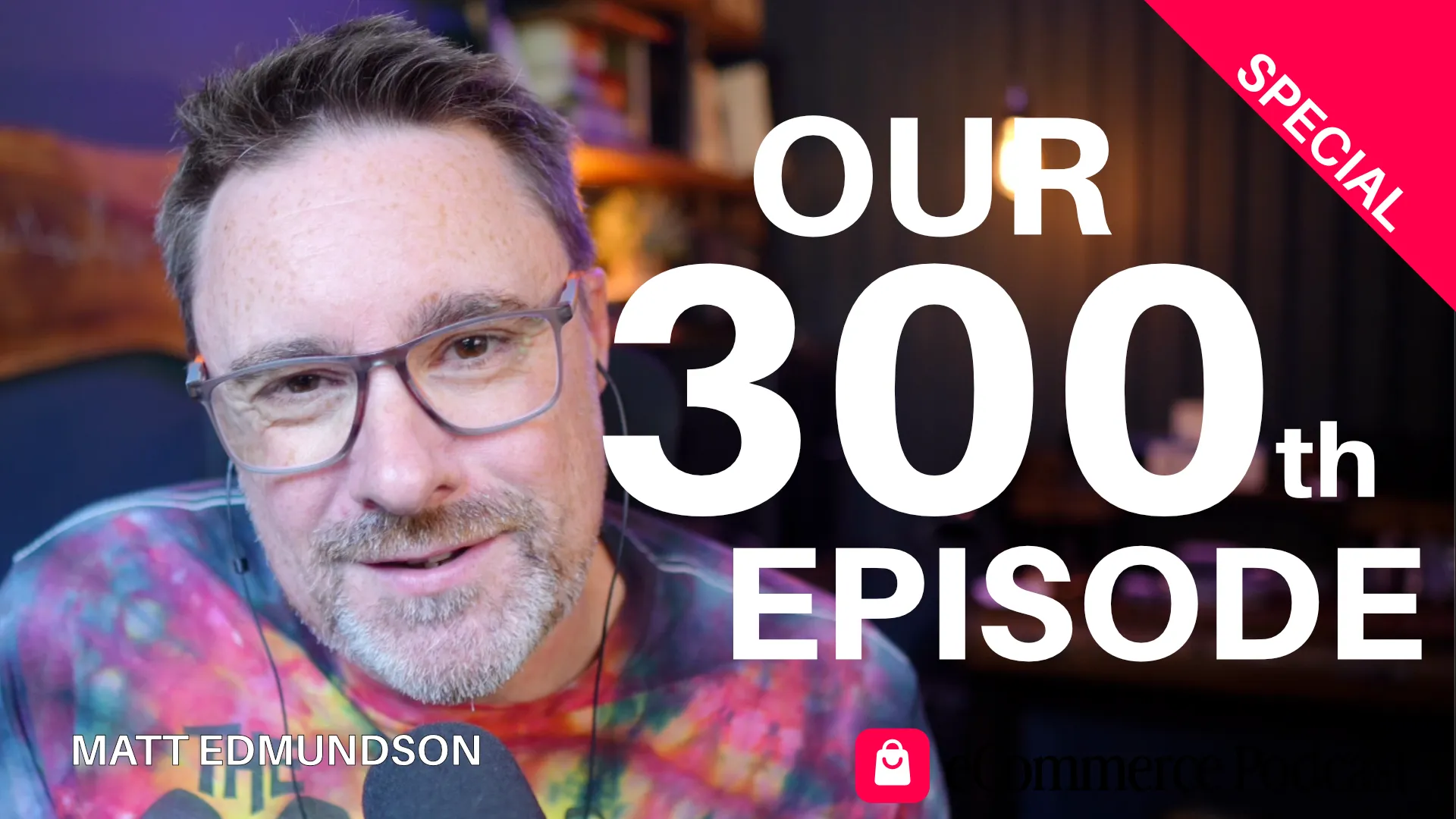
Matt Edmundson
Aurion Digital