He's Done 70 Acquisitions — Day One, He Calls PayPal
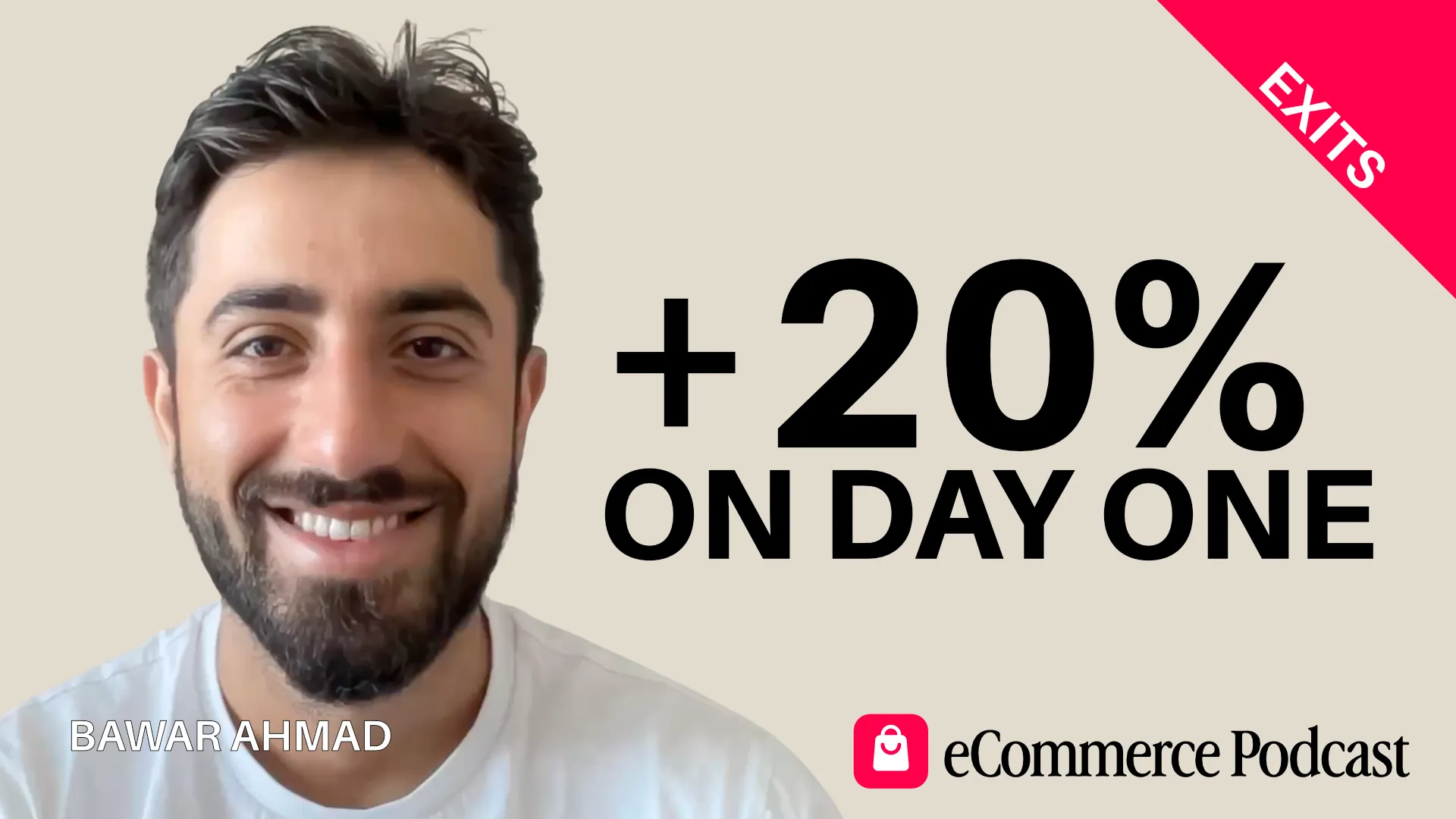
Bawar Ahmad, founder of Ecomma, joins Matt Edmundson on The eCommerce Podcast to explain what buyers actually look at. Around 70 acquisitions and 60 exits in six years, and his team gets from questionnaire to cash in the seller's bank in 14 to 20 days when the industry standard is three to four months. He walks through the 12 to 15 value drivers they run on every store they buy, starting with a day-one round of vendor renegotiation, why voice AI is arriving as the third retention channel after email and SMS, and the three mistakes that quietly cost sellers their price: assuming the sale, rushing to the wrong advisor, and messy financials. Matt pushes him on the other side of the trade too, and how an operator doing a million should think about buying a competitor.
Bawar Ahmad has bought around 70 ecommerce businesses in six years and sold roughly 60 of them. This year his team is aiming for another 30. On day one of a new acquisition they don't open the ad accounts. They ring the vendors — Klaviyo, PayPal, the supplier, the 3PL — and ask each of them for a better rate. "You'll be surprised how much of the vendors were like, we're waiting for this call."
He's one of the founders of Ecomma, a Dubai-based micro private equity firm that buys, scales and sells Shopify businesses. He came to it sideways, after years running a paid-media agency that worked with about 400 ecommerce brands, when a client called Wieger Sietsma rang with an idea about buying an underperforming store and fixing it. Six years and forty team members later, it's a machine.
Valuation Is Profit and Risk
Everything Ecomma does sits on one sentence. "We are playing the game of buying a business at a certain valuation and selling it at hopefully a higher valuation. And valuation is depending on two things, it's profit and risk."
Most founders only ever work on the profit half. Bawar reckons about 20% of the time his team lifts a business's value without touching profit at all. They build a team, remove single points of dependency, add backup suppliers, tighten contracts. The P&L barely moves, but the business is far less likely to fall over, and buyers pay for that. You don't have to grow a business to make it worth more. You can just make it harder to break.
The Value Drivers
Ecomma runs a standardised set of 12 to 15 "value drivers" on everything they buy. Bawar gave three away on air.
Renegotiate every cost on day one. Around 90% of the time, the first thing they do after taking ownership is get every vendor on the phone and ask for better pricing — software, payment processing, fulfilment, supply. His framing is blunt. "So on PayPal, we've added 20% of valuation on the first day." That's his own number from his own deals rather than a benchmark, but the mechanism is available to anybody. Nobody is coming to offer you a discount.
Increase creative volume. When they look at an ad account and the seller says they're producing eight new videos a month for Facebook, Ecomma pushes that to twenty or thirty. More creative, better ROAS. It isn't clever, and that's rather the point.
Turn on voice. Bawar estimates 95% of brands aren't running voice marketing yet, and reckons it sits where SMS did fifteen years ago. It works like an abandoned-cart email, except an AI agent rings the customer about ten minutes after they leave the basket. "It could be 1:00 AM, it could be 1:00 PM, doesn't really matter. These agents, the softwares never sleep." He puts the lift at around 5% of revenue, and you get recordings of customers saying why they were buying.
Stack the increments and Bawar says his portfolio average is a 150% uplift in 90 days. That's his stated average rather than a benchmark.
Three Ways Sellers Lose Money
The pattern is consistent. The founder Googles "can I sell my business", lands on a valuation form promising a lottery-win number, and lists. Fifty conversations later the offers are nowhere near that figure.
They assume the sale. Once a founder has mentally left, they stop investing. Why pay for new creative? Why test a new channel? Why order more inventory? Performance dips, and buyers see it in the numbers. His illustration is a business doing $100,000 in profit at a 3x multiple. That's a $300,000 exit, and a distracted quarter can turn it into $150,000. Any of that sound familiar?
They rush to the wrong advisor. Good advisors exist, and so do bad ones who will sell you a high valuation to win the retainer, then quietly downsell you later. Bawar's rule of thumb is to set aside 5% of the transaction for advisory, so a $1 million business budgets around $50,000.
Their financials are a mess. Businesses turning over millions are still run out of Google Sheets, with the car lease and the Uber Eats going through the same entity. To a buyer that reads as a red flag, not because anyone assumes fraud, but because it suggests nobody knows what's in there.
I put the obvious objection to him. In the UK, if you run a limited company (the standard incorporated business here), you're encouraged to put every legitimate cost through it to reduce your tax bill — and doing that well suppresses the profit your valuation is built on. His answer is normalisation. Personal rather than operational costs get added back as seller discretionary earnings, or SDE, so a buyer sees the real earning power. It only works if the books are clean enough to separate the two, so start at least a full financial year before you go to market.
Speed Is a Feature
From questionnaire response to cash in the seller's bank, Ecomma averages 14 to 20 days. An offer goes out within 24 hours of getting access, due diligence runs in seven days, contracts take a couple more, then handover. The industry standard is three to four months, and my own exits have always taken about six.
Sellers, take that in reverse. Bawar's phrase is "time kills deals". I heard something similar on an acquisitions course years ago, that deals are like concrete and the longer you leave them the harder they get. Every time a buyer asks a question you need three days to answer, the deal cools.
Worth knowing too that around 99% of deals under $2 million are asset purchases rather than share transfers, because buyers want the assets without inheriting your entity, contracts and tax history. Ask your accountant, because the tax treatment differs.
Buying a Competitor Instead of Doubling From Scratch
If you're turning over £1 million (about $1.3 million) and you want to reach five, one route is to double the business twice. The other is to buy someone already doing $2 million and cover most of the ground in a single deal.
Bawar's filter is audience, not niche. A skincare brand selling to 35-year-old women with acne shouldn't buy a phone case company for the revenue, and shouldn't buy a mascara brand either, because that's the same category and a different customer. It should buy the supplement brand those women are already asking about. "It's way better and easier to build the brand and the ecosystem around the specific audience you're going after."
That's a live question for us. Our vegan supplement audience keeps asking for protein and electrolytes. Electrolytes are developed and coming. Protein is harder, because manufacturing quotes at our volumes came back in the hundreds of thousands of pounds, so the better question is who already makes vegan protein well and whether there's a deal to be done instead. Bawar's response was to ask me to bring it to him first if we ever sell, which felt fair enough.
Two cautions. The first is the founder-dependent business. Ecomma bought a brand built entirely around its founder and kept her on a compensation package. She took the money, went on holiday, started thinking about children, and the video quality and involvement fell away. Two-month dip, then another month or two to recover after replacing her. Now they either require the founder to prove the business runs without them, or they walk.
The second is culture, the usual failure mode of a competitor acquisition and expensive to discover late. If you're keeping the owner involved, put a call or put option into the structure so there's a clean exit if you don't get on. Bawar's preference is to buy 100%. "It's cheaper than figuring out the culture."
Due Diligence Is for Understanding
Most buyers treat due diligence as verification, checking that what they were told is true. That matters, and it's what your advisors are for. Your job is to understand the business before your money leaves the account. The seller has spent three or four years making the mistakes you're about to make. They know which pricing points work, which suppliers are reliable, which competitor actually hurts. Go in without extracting that and you'll be a step behind the person who just sold to you. Bawar's version is to run strategy sessions with the team before any money moves.
How to Start
- 1Separate your personal costs from the business today. Get a P&L, balance sheet and cash flow reporting in place and keep the bookkeeping current. Everything else in a sale is downstream of this.
- 2Build the data room before you list. Write the answers to the 400 questions you know are coming.
- 3Ring three vendors this week. Your payment processor, your 3PL and your biggest software subscription. Ask what they can do on price.
- 4Turn on one retention channel you're not using. For most stores that's SMS or voice, and abandoned-cart flows on either take an afternoon.
- 5If you're buying, budget 5% for advice and spend due diligence understanding the business rather than verifying it.
Run your business as though it's already sold and you'll get the price of a business that's already sold. If a buyer asked you for last year's clean P&L this afternoon, how long would it take you to send it?
Bawar is giving his exit-preparation checklist to anyone who emails him at bawar@ecomma.co (note the .co, not .com), and there's a valuation calculator at ecomma.co. If you've bought or sold an ecommerce business, I'd like to hear what caught you out — come and find me on LinkedIn.
Full Episode Transcript
Read the complete, unedited conversation between Matt and Bawar Ahmad from Ecomma. This transcript provides the full context and details discussed in the episode.
Full Episode Transcript
Read the complete, unedited conversation between Matt and Bawar Ahmad from Ecomma. This transcript provides the full context and details discussed in the episode.
# Transcript — EP: Bawar Ahmad (Ecomma)
- **Recorded**: 2026-07-06
- **Publish date**: 2026-07-30
- **Guest**: Bawar Ahmad, Founder, Ecomma (https://ecomma.co/)
- **Duration**: 56.8 min
- **Speakers**: Matt Edmundson (host), Bawar Ahmad (guest)
---
[00:04] **Matt**: So hello and welcome to the eCommerce Podcast. My name is Matt Edmundson and it is great as always to be with you today talking about all things ecommerce. Yes, we are. Now, if you don't know me, my name, like I said, is Matt. I've been around ecommerce since 2002, which is a long old time. That's for sure. I run my own ecommerce businesses. I own ecom companies here in Liverpool. And in the UK we ship all over the world. We've been doing it a while, and I love the fact I get to do this podcast because I get to talk to some really cool people, whether experts or founders, and I get to basically grill them. It's like an hour with an expert on something, that can really help my own ecommerce businesses grow. And so you get to listen to that conversation. That's what, that's what this show is all about. So if you are new, very warm welcome to you. You might want to think about subscribing. Let's be real, because this is a great podcast. Even if I do say so myself, it's a great podcast. So make sure you subscribe and hit the, all the buttons, whether you're on YouTube or a podcast player or whatever it is you need to do. Also check out the website ecommercepodcast.net where we've got some really great stuff. We've got the whole archive, today's notes will be on there. All of the links from today's show will be on there. We've got on there the link for Cohort if you're interested in joining that. This is where we get together once a month on a Zoom call with other ecommerce entrepreneurs from around the world. And we talk about e-com and what's working and what's not working. I really, really love Cohort. So in fact, we've got a Cohort session coming up tomorrow, I think. So really love that. You can find out more information about on the website, it's free to join, you might want to check that out. You can sign up to the newsletter, we send out the newsletter once a week about the podcast, that's really great. You can find out about Slingshot AI,, or SAM, as we like to call it internally. This is the layer we've built onto Claude Code that you can use to really maximise AI for your own e-com business. So you might want to check that out. There's just a whole bunch of stuff you can check out on the eCommerce Podcast website. So just go to ecommercepodcast.net. And of course, if you're a regular to the show, let me not forget about you because you are awesome. You're the reason why I can keep doing this. It's great that you keep coming back time and time again. And if we haven't connected yet, make sure we do so on something like LinkedIn or Instagram. I would love to hear your story. But that's it from me. Let's get into this week's conversation with Bawar. Bawar, welcome to the show, man. How are we doing?
[02:38] **Bawar**: Thank you, Matt. Doing great. Wow, 24 years in ecommerce. I feel like a baby.
[02:47] **Matt**: No, no, no, don't feel like— I feel like a dinosaur. I feel like the old man.
[02:51] **Bawar**: I really do.
[02:56] **Matt**: It is funny, ecommerce, having been around it for so long now and having seen the the evolution of ecommerce. I don't know whether that's an advantage or disadvantage, but it's, we're still here. We're still selling stuff, which is important, I guess. But for those that might not know you, those that don't know your story, just give us the quick elevator pitch into all things Bawar.
[03:22] **Bawar**: Yeah, sure. Let's do it. So I am one of the founders at Ecomma, where we— I've been— my prior experience was a marketing agency. So I've maybe helped 400 ecommerce brands to grow, scale using simple paid media. I had one of my clients, his name is Wieger Sietsma. He's also the co-founder of Ecomma. He had an idea of doing something a little bit different, which is to buy an ecommerce brand, scaled ourselves and tried to sell later on, which about 5, 6 years ago, the first time. Well, move forward about 5 years, we've done about 70 acquisitions. We've scaled up. We have 40 proud team members to have on to help us with this operation. And we've basically changed to being the ecommerce aggregators, single standalone that we buy Shopify stores quite aggressively. We're hoping to do this year about 30 to 36 acquisitions.
[04:17] **Matt**: Oh wow.
[04:18] **Bawar**: Buy them, we do a lot of things to add value and then we sell them off. So it's quite a simple model, but very hard to execute. And I've been doing that for the last 6 years. Wow.
[04:30] **Matt**: Yeah, this is why I've been looking forward to this conversation because this is where we now switch roles. I've been in ecommerce longer than you, but you've been in acquisitions longer than me. You've, you've done a lot more acquisitions than I have. I'm definitely not doing 30 this year. But I do like this idea of acquisition. I do like the idea of us, for example, buying more ecommerce businesses like you, plugging them into our system. We've got the warehouse, we've got the distribution, we've got the team. Can we make it work better and run more profitable and build something collectively that's a bit more valuable? The other strategy that we've not really talked about on the show, so obviously everybody in ecommerce, everybody, most people in ecommerce want to build a business and sell it, right? So there'll be everyone's going, oh, great, what's, what's Bawar's details? Can I get in touch? We'll give you those at the end. Teaser, you've got to stay until the end. But the, the other strategy, which I think is interesting that maybe we should touch on a little bit is actually, let's say, I'm in, I don't know, I've got a pen in my hand. Let's say I've got a website which sells pens. There is a strategy which says part of my growth could be to go and acquire a company, an ecommerce company that sells paper, right? And so you kind of go horizontal. Or I could even have a strategy which says let me go and acquire the pen manufacturer because I've got the output, direct-to-consumer. Now if you're a small ecommerce brand, you might be thinking, how in the world can I even think about buying a company? But I think let's get into it, Where should we start on the whole acquisition thing? I'll tell you where we should start. Why did you buy your first business?
[06:11] **Bawar**: Yeah, I love it. I love it. Love it. It's a good question. Honestly, when I think about it, I sometimes feel like I fell on my head because I had no idea what I was doing. I remember Wieger calling me up and he was like, hey, you do pretty good in paid marketing. How about we just find a small underperforming, undervalued ecommerce brand and we just buy it and without even thinking a second, even thinking about do I have the funds, do I want to spend it or not? I just said yes, let's, sorry for my words, but fuck it, let's do it. So we basically did it quite spontaneously. We made some mistakes along the way. It still ended up being a profitable, happy deal. But yeah, we just got it, which is the same decided to gamble on it and I'm happy I did. We learned the hard way. The first one we bought was a shoe brand.
[07:05] **Matt**: A shoe brand, okay.
[07:06] **Bawar**: Shoe brand, was selling internationally. It was declining actually. That's one of the mistakes that we did. Don't buy a declining business. So we bought it while it was declining. We acquired it just before Black Friday 2020, if I say it perfectly from top of my head. We acquired it, we didn't even got like a Facebook Business Manager with it. So after we provide the funds, the guy was like, yeah, I'm using my Business Manager for other businesses, so get your own. So we had no marketing data, we had no pixel, we had, I think he was using the email list for other businesses as well. So we were like 3-0. Wow.
[07:48] **Matt**: Wow.
[07:49] **Bawar**: But for some reason we managed to turn it around. And it's also one of the advices that I would give if you end up acquiring or selling, just get prepared, get yourself some advice. Don't go in too blind, especially for the first few months. If you've done 2, 3, you get the game. But for the first one, get yourself some advisory. It really helps. There's so many pitfalls. The thing is with buying and selling and exiting, for example, your own ecommerce brand, it's a very long process. It's not as you go to a, you put it on a Shopify store, you run an ad and that's it, the money hits your bank account. Bank. It's quite a long, yeah, painful process, which, if it's your first time, it's like anything, do your first time, it's, it, you will fall a few times.
[08:36] **Matt**: Yeah, yeah.
[08:37] **Bawar**: You have to learn to stand this, to, to get back up and, well, basically do it again.
[08:44] **Matt**: Yeah, it's, I, I, it's fascinating listening to you talk about your first acquisition and all the things that you did wrong because I'm thinking about the first time we did it and very long list of all the things that we did wrong, but we've kind of, we've kind of survived, and made it through. For me, I guess the, the revelation came when, after running ecommerce businesses, we started running other people's ecommerce businesses. We noted, and it was something that we stumbled into, we started to take on other people's ecommerce businesses by taking an equity stake in their business, right? And this was kind of how it all started, and we just, that— and so we've always had partners in the ecom brands that we've acquired, to some degree or another, and it's really worked well for us. But there's been a lot of things that we've, we've learned, along the way, the mistakes that we've made. When you I'm really curious actually about when you talk about get prepared, it's a long process, selling your ecommerce business or conversely buying an ecommerce business. What are maybe 2 or 3— you've obviously bought a lot— what are 2 of the 2 or 3 things, the mistakes that everybody's making on the businesses that you look at acquiring?
[10:04] **Bawar**: Oh yeah, I, I probably have answered the questions too, too many, too often. I love to take you through what I have seen 90% of time happening in the head of a seller. So usually for some reason they, because ecommerce, it's usually built around lifestyle. It supplements an owner's or a founder's lifestyle and lifestyle changes. So the moment comes that they wonder, what's more out there, they want something else. For whatever reason they cannot run it anymore. So they Google, can I sell my business? And well, lo and behold, on top there was a nice ad that says, hey, your business might be worth this amount, we can do it for you. And they click on it and they fill in the valuation form and see a very high valuation. That's usually how the platforms get you in. And the seller thinks like, wow, this could be my bank account tomorrow. Like, yeah, amazing. They go through the process, they list the business at the valuation they were promised. And the moment they go to market, they get a lot of interest. Because again, how the platforms are working is that the moment you're listed, they push you out to the list, they push you out on the front page, whatever it is to make you happy and give you the value on basically the listing fee you just paid. But then after about 30, 50 conversations, people go cold, people die out. You have a lot of people just looking and not really going forward, but you still are fixated on the, the top valuation, maybe suddenly getting some offers, but before you're understanding that the valuation you had in mind and probably the valuations you're getting now from interest, it's not really there. And the more time comes by, the more the time passes by, the more the person, the seller gets detached from the business. They stop thinking as much, thinking as that's the business and that's me. What tends to happen as well, the business performance goes down.
[12:02] **Matt**: Yeah.
[12:03] **Bawar**: Well, it's already sold. Why should I invest in new creatives? Why should I do this new channel, pay for this big influencer? I'm gonna send away, let me just hold it. New inventory, it's not needed, whatever it is. So they already start working on a new business. They're already making a step out. And just this one, the biggest mistake out there, because the moment business gets like, is coming in, is declining, and buyers, they're not stupid, they're seeing this.
[12:27] **Matt**: Yeah.
[12:28] **Bawar**: You lose almost all interest or a big portion of your valuation. Like you might miss out 50% and give an example, let's say you're doing half a million dollars in profit a year or let's start smaller, $100,000 profit in a year and you could have gotten, let's say 3 times, like $300,000, you might only get $150,000. If you're just a bit more dedicated for those 2 or 3 months, you might have had another $150,000 in the— Yeah. Account. So big mistake there is just don't assume the sale yet. It's not done, it's done. While it's not done, open for business. Keep, keep running the business as if you're still the owner, you're still growing it. You don't want to run the business as you're gonna sell it. Buy Stripe out and they go through it. Second is, all these, advisors, and a good advisor is important, and there are for sure out there., but also quite bad ones. And yes, first time is same as you're gonna hire marketing agency. You might get burned a few times before you get understanding what's a good marketing agency and people rush it too much. They go in, they get high, being sold high valuation because M&A party, they just want the retainer or whatever, just get another one on this and maybe sell them. Or they downsell you later. So take your time as finding the right advisor. It's no rush. If it takes another month or so, you might save a few months when you sell, when you go through it properly. Last one, if I may say, is that clean financials. So many ecommerce brands, I still see to this day, they're doing millions and millions and millions a year and they're all run on Google Sheets. And Excel and some data here, Triple Whale there and whatever tools they're using. Buyers are usually the most sophisticated. They're not very known in ecommerce. So it's very tough for them to buy a business that has no key financials. Usually these owners, they're paying their lease through the entity, they're paying for their Uber Eats through the same entity they're using the stuff for. It's just a red flag. Because it's not very structured. It shows that the business might have maybe skeletons in the closet to deal with. So start thinking with the exit in mind. Start with clean financials. Stop every personal cost going through the business. Clearly separate it out. Get the basic, P&L, balance sheet, and cash flow reporting in there. Get the bookkeeping well set up, and make sure it's updated, don't mess with the invoices and stuff. So, clean financials, it's a big deal breaker.
[15:18] **Matt**: Yeah, it's an interesting one, isn't it, the clean financials? Because certainly in England, when you run a limited company, you legitimately want to put as much through that company as possible to reduce your tax burden. But by putting as much as you can legitimately put through the company to reduce your tax burden because you're reducing your profits, you are in effect reducing the valuation of your business because profit is such a significant figure when it comes to value. And so it's this real conundrum, isn't it, that you find yourself in. It's like, do I maximise profits and pay more tax to get a better sales, to get a better exit? And you've gotta— I think you've probably got to start thinking about that 2 or 3 years before exit, I would have thought, right?
[16:02] **Bawar**: At least a year, like at least the prior financial year. And to be fair, there are solutions to it. So even if you want to reduce your tax burden but still not, hit the valuation too much and push down your profit, it's called normalisation. You make a— but this also comes with clean financials. If you have clean financials and you know very understanding, these are costs that might not be very relatable to the business but personal, they're seller discretionary earnings, they call it SDE for short. You just put it in a very nice line normalisation and you can still, but most important is the mindset is that you've had a business that supports your lifestyle and that's why they want to reduce tax burden. You have to start thinking as an asset. This is a business, this is a system, it's not a lifestyle business. This is something that it's a machine that I just need to make better, make it sellable and make it packaged so that whoever was the owner doesn't really matter. Not much would change if everything is reliant, if every, every, everything you do, decision you make, all going through you. There's risk in there. Buyers don't like risk, they devalue it.
[17:09] **Matt**: Yeah, yeah, no, that's a fair comment. That's fair comment. Let's talk about, about the— then the time frame involved.
[17:18] **Bawar**: So there's—
[17:19] **Matt**: I, I obviously, I, I need, I need clean financials I need a, a good advisor and I need to not get detached from the company. I need to run the company all the way till the finish line, and make sure it's, it's, it's, it's hitting the gas. What is the typical time frame for, say, when you guys acquire a business, from the initial point of contact to the owner having cash in the bank and being free and clear of that business?
[17:51] **Bawar**: I love that. So the moment that we send out the first questionnaire and let's say we get a response to our questionnaire, up until the moment the cash hit the bank, it's about, on average, about 14 days to 20 days.
[18:09] **Matt**: So you guys are quite quick in your turnaround then.
[18:12] **Bawar**: Yeah, this is not standard.
[18:13] **Matt**: Yeah, yeah, yeah. This is definitely not standard. I'm intrigued.
[18:16] **Bawar**: Yeah, so we, because we've done 70 acquisitions, we have all the systems and tools to quickly evaluate, quickly go through DD. Like the moment we have our answers and we got our access, we just send the offer out within 24 hours. If you give us a thumbs up, we're doing DD in 7 days, contract maybe a couple more days, and then it's the handover. And then we don't keep you on long enough. So we've been really streamlining this to, and there's a big gap in there that people really value the speed.
[18:45] **Matt**: Yeah.
[18:45] **Bawar**: So that's something that we definitely offer. Typically when you go to market and you sell your business on, let's say in a normal go-to-market scenario, I think the average is like 3 to 4 months.
[18:56] **Matt**: Yeah.
[18:56] **Bawar**: The moment you go to market to hopefully get the cash in the bank, it's 4 months. And we had a thought like, why is that the case? It's because a lot of these buyers, they just don't understand the business. They don't understand the model, they don't understand the ecommerce themselves. So if you do understand the model, if you do understand how these platforms are working, you know what to look for, you know what to do, your quick check and balances, and you can go through it in like a week at most. So, and then we had the idea of making technology around it, which somehow it worked out. So yeah, we can do it within 14 days.
[19:33] **Matt**: That's insane. I'd say, good for you. It's a really fascinating system. I'm just thinking about the businesses that I've sold over the years. They've always been 6 months, right? Just, it's just, it's going to take 6 months minimum out of your, out of your life. There's going to be 1,000 pieces of paper you're gonna have to look at. So the fact you've streamlined the system, I guess what that does is it, you guys have become like super dialled in on what you're looking for in an ecommerce business, right? It's like, fill in this questionnaire, that's going to tell me everything I need to know about whether or not I'm intrigued in your business, I would have thought.
[20:09] **Bawar**: Exactly. We'll know it within an instant. It's simple. And one advice to give as well, and this may be a quick point to note, because we mentioned 6 months, when you do— because for UK you have a limited liability company, I think that's quite— you either do a share transfer agreement or an asset purchase agreement. So 99% of below, let's say, $2 million deals, they are asset purchase agreements.
[20:38] **Matt**: Yeah.
[20:39] **Bawar**: Which means the buyer, they don't buy the entity because they don't want to deal with whatever contracts you've signed. They don't want to deal with, if you have tax liabilities on your own, you've won, whatever it is, there's no skeleton in there. So they just buy the assets of the business, which on its core, it's way simpler, way quicker, way less legal things to sign because the buyer, they just look at the assets, they like what they see and they just take over the assets. They don't take your past, they don't take your account. So my advice as well, always go for asset purchase agreements sub-2 million, in valuation.
[21:14] **Matt**: Yeah, that's fair enough. The only— again, the, the only thing I'd say, being British and having done share transfer agreements and both asset, agreements, is one is slightly better on the tax than the other. So talk to your accountant. But it's— I'm listening to you talk, it's interesting because I think the way you do acquisitions and the way I do acquisitions is different. And this is why I was really keen to talk to you, because I definitely don't feel like our way is the only way, but I think it works for us, right, in terms of how we've done it over the years. I never offer money for a company, right? So, we, we go to a company, it may have on paper a valuation of, I don't know, 200,000, 300,000, 400,000, whatever it is. I guess we do well with companies between half a million and 3 million in turnover, somewhere around there. We found our sweet spot because I, what I do is I, I basically say, listen, I'm not going to give you money for equity in the business, but I will give you value. So what do I mean by that? So for example, we'll house their operation in our warehouse. There's no rent costs. Our staff will do the picking and packing and so there's, you know what we bring value in the other way. We take over the marketing, I get involved, and there's no cost to that. And then when the business does make money, everybody wins. And the founder usually has some equity stake left in the business, so they don't feel like they're giving up their baby. I appreciate this is not for everybody. Some people just like, I just want to check and I want to get out. I reckon though, Bawar, with the businesses that we've done that way, we have been able to bring them in, bring our systems in, and then increase the profitability of that business. So, we end up making more money, certainly in the, in the, in the long run. What systems do you have in place? Like, what are you looking for in a business and think, if I'm looking for this, because I know if we do this over here, for example, with us, revealing all my secrets— they're not really secrets— but, we do really well with companies that have small repeatable products. Right? You take a beauty business or a supplement business, we acquired a gift company, and all these types of businesses. I would never go and acquire a couch business, for example, because that's not our strength. We're really good at getting people to buy the product for a second time, third time, fourth time. I know our strengths, and I know what we do super well.
[23:45] **Bawar**: What—
[23:46] **Matt**: So I can look at a business and go, right, well, we can, we can make an impact here, and we reckon we'll have this, this impact. How do you do it? Because obviously, you get that questionnaire back, You're an investor, you've got to have a return on your investment. You've got to look at that business and go, I reckon within 2 years we can 2x this, 3x this by doing X, Y, and Z. What is it you're looking for?
[24:06] **Bawar**: One of my fun things to do, one thing I— if you wake me up 3 AM in the morning, you ask me this question again, I can just ramble on for like hours and hours. At the end of the day, we are playing the game of buying a business at a certain valuation and selling it at hopefully a higher valuation. And valuation is depending on two things, it's profit and risk. Yeah. So we always think about ourselves, how we can increase profit and how can we de-risk the business. Sometimes, like maybe 20% of the times, we have not increased the profit, we just have removed the risk from the business. Right. We build a team, we remove the set of dependency, we added some extra backup suppliers, we got some better contracts in place, whatnot. So we de-risk the business. We do what we call value drivers. We have about 12 to 15 depending on type of business of standardised things we do for these businesses. I'll give you the first one. It's the, this is a free giveaway for everyone listening out there. It's negotiating cost down. One of the easiest things to do. I can tell you Matt, maybe 90% of the time We get our hands on the business, we buy it the first day, we just call all the vendors or suppliers. This is your Klaviyo software, this is your PayPal transaction fee, this is your supplier, this is your 3PL, whatever it is, get them on the phone and ask for better pricing. You'll be surprised how much of the vendors were like, we're waiting for this call for some time. So let's see what we can do. And we end up maybe whatever profit they do with another 20% almost overnight. So on PayPal, we've added 20% of valuation on the first day. So that's one of the first things. Second, we do a lot around marketing. So we know our strengths as well, which is just to scale up paid media. So it's some, a lot of lists we do on, we check the ad accounts, we check the creatives. Very simple question. If they tell us, yeah, we are launching 8 new videos a month on Facebook. Well, we know if we just, increase the volume to 20 a month or 30, very likely the ROAS on Facebook ads will go up. So we do that as well. Third thing, this is like a big one we do and there's also a big recommendation for someone out there. There's kind of new channel coming up that 95% of the brands are not on, which is voice marketing. Especially if you're selling in English native speaking countries. Voice marketing, it's quite hot new thing. Like same as SMS came up about 10 years ago, 15 years ago and it was like everybody was like milking it out the first few years. I believe now is the time of voice marketing. So we get the business on, we ask like, hey, which channels are you on? And just say like, hey, we do Facebook and email, no SMS, no voice. We know again, the moment you acquire it, we just turn on SMS flows, SMS campaigns and we turn on most importantly, voice flows and voice campaigns. I have an amazing app out there using this. It just adds maybe 5% to revenue overnight. So adding this little 5% here, 20% there, 20% there, before you know it, you doubled the business in 90 days.
[27:22] **Matt**: Yeah. And is that what you are aiming to do? You're aiming to 2X the business in 90 days?
[27:27] **Bawar**: Yes. Our average is about 150% in 90 days. So we actually crush that. And it gets better as we do more of it.
[27:35] **Matt**: Well, so you've definitely got the systems dialled in.
[27:39] **Bawar**: Yes, it's like a system processes. And problem is what we see is that a lot of these sellers, they're solopreneurs, right? So they are one single founder owner. They're usually very good at one thing. You might be very good at retention, someone's just very good at paid media, someone's very good in affiliate marketing and they just do the one thing they're good at. They don't really look for other channels out there. And when you've seen hundreds and hundreds of these ecommerce brands throughout the years, you just see a pattern, right? So you can see that 20% of people, they've done very good in paid ads. That's what they did. 20% of people, they were very good in affiliate. This is what they did. Okay, let's take this stuff, put it on here, and let's take paid media, put it on affiliate business system. Before all goes up.
[28:28] **Matt**: Yeah, it works well, right? And this, I guess, is the benefit of being a company, like you, I suppose, like me in some respects, is we have teams that can do these things. So if you're the solopreneur, or you, you're a little, you're a couple and you're running this business, actually, for you to go and do all of these things, you've got to hire more agencies. And the chances are very strong you've been burnt with agency, and it's not a route you want to go down. And so, come into a company like yours, you've got the big team, you've got the experts in influencer marketing and in paid media ads, and you can use that expertise and leverage that expertise straight away. I'm curious what you define as voice marketing, though. This is something that you mentioned. Let me just press that button a little bit.
[29:11] **Bawar**: Yeah, I love it. So right now, if you're not doing this, and you for sure should be doing this. So right now, all Shopify stores, they have at least email flow setup. You go to any website, you add something to your cart, you fill in your email, your phone number, whatever, and you don't check out, you at least send an email, hey, you forgot something in your cart, here's 10% off, please finish your checkout. Almost all of them, they do it. If not, you're sleeping on something, just turn it on, takes 30 minutes via Klaviyo. Amazing. You're making at least 5% extra. Some of them are doing SMS. Oh, hey, you were checking out, you filled in your phone number, okay, I'm done, here's 10% off, go forward. But now with the cost of AI going down very quickly and also the quality of voice AI going up very quickly, there was a new channel popping up, which is voice AI, which is voice agents or voice marketing, which is basically the moment you fill something up to your cart, you get immediately after 10 minutes a phone call. It could be 1:00 AM, it could be 1:00 PM, doesn't really matter. These agents, the softwares never sleep. They give you a call like, hey Matt, I saw you were checking out on our website, what made you interested? You even get feedback from them. Oh, I was looking for, to stop my acne on my forehead or whatever it is. You get the input and then they give the discount code and then they converted. It's quite a high converting channel. Yeah. Because it's such personal. And this is something that for sure it'll change in the next 3 to 5 years. But for now we see this as a new untapped channel. That's, that's a new retention channel. After SMS, it's a voice, the third one. And we believe that 3 years from now, you can see them as email. You cannot think without it anymore. You need some voice channel set up if it's inbound and outbound. But yeah, we're pretty early with it and to be honest, we are milking it out.
[31:04] **Matt**: What top tip? Go and get your voice marketing set up. I suppose you could dip your toes in slightly here just thinking this through because I know a lot of people would be quite nervous about letting AI loose on their customers, or potential customers. You can also do voice memos, can't you? So you could send a voice memo through SMS or WhatsApp and go, hey Matt, it's Susan here and just checking in. And things like that, they just add a little bit of the old je ne sais quoi, don't they? They add that little bit of extra that you're not getting from anyone else.
[31:35] **Bawar**: Yeah, yeah, exactly. And, I think it's great what is with voice marketing specifically, especially if if you get it set up well, you can finally listen to your customers. A lot of people are still sometimes guessing or running surveys like why they want to buy it, who is my audience. But the moment you go back and you listen to the recording and you see a mother of 10-year-old looking for the toy for the gift and you understand why they're buying, it gives also so much intelligence that maybe you wouldn't have gotten if it was just, the paid ads and the email and SMS.
[32:08] **Matt**: Yeah, yeah.
[32:10] **Bawar**: We do the thing that, that voice, and even do voice memos, it's also at least a step forward. But we do voice, it's going to be a very powerful channel in the next few years.
[32:19] **Matt**: Yeah, that's really interesting.
[32:21] **Bawar**: I, I very—
[32:22] **Matt**: I shall watch with bated breath on the old voice marketing thing. Let's switch tracks slightly, Bawar, if we can, because I, I mentioned at the start of the show, maybe one of the things that you could do to grow your business is to acquire another business. Right. So let's say somebody out there is listening to that and going, I've never thought about that as a possibility, Matt. Where would I even start? And what would your advice be?
[32:48] **Bawar**: So this is fun. This is like shopping. You just got to spend money. That's the fun side of things. So when you are deciding on buying a business, first the question becomes, why are you buying? Are you, as you mentioned, a strategic buyer? Do you want to strengthen the business you have currently, or would you like to just care about, the yearly return you make on the amount of your invest? Because there are two different acquisitions. One, you might purely look at stable cash flow, which is when you look at the yearly return. Or you might purely look at revenue, and if you can just, what you call skin the meat, so you can cut a lot of things when you, when you're becoming the owner, and you combined one team doing both. Once you're clear on what you want to do, there are quite a lot of platforms out there. I've also mentioned that, get these sellers into the platform with high valuations. They do have a lot of deal flow and volume coming. A great start, same as you will go shopping on Amazon, get on these websites. You have Flippa, you have Acquire, you have BizBuySell, you have you have local natives. So for example, you're in UK, you have like sellanybusiness.uk or I think something in that line. You have very localized websites as well. Get those websites and just go Amazon shopping. You can look at description, you can look at the history. Just get yourself in there. Don't set your eyes immediately on the first one. Same as you wouldn't buy the first thing you see in Amazon. At least I don't. I would just at least scroll down and start comparing a little what's out there, what's out there. So then you start shopping, as we say, you start to be in touch with sellers, you're asking for P&Ls, you're asking for more questions, you start to understand it, you're trying to understand how it would look like to buy and you just pull information. This is step 1. Build your knowledge base, you're gonna pull information. Once you have it, you will have a good idea of how an acquisition would look like, what businesses are out there or coming up to the flow or which amount of structures and valuations and yeah, what you're funding to think of if, that's something you want to do. And once you have it, again, I advise get an advisor on board or at least someone to guide you through the process. They might be costly, but they will save you. Yeah, the good rule of thumb is 5% of the transaction amount, set it aside for advisors. So if you're looking to buy, let's say, a million-dollar business, set aside about $50,000 to get yourself advised.
[35:24] **Matt**: Yeah.
[35:25] **Bawar**: On online acquisitions. Well, once you have that, great. You gotta start choosing your business. Once you've chosen the target company, you can make offers. Fun period. Again, you always feel full of optimism when you make an offer. You just start sending offers out, which for sure they'll negotiate, they'll come back forward. There'll be lots of questions. Same as you would buy real estate, for example. There's a lot of back and forth. Once you have that clear, and now comes the biggest advice I can give, you're gonna go into due diligence. So let's say the seller accepted, congratulations, you're one step closer to buying your first business. Due diligence is the moment to understand the business. A lot of people just focus on verifying, which is for sure something you have to do, and that's why you have advisors. Make sure whatever was being told to you is also the truth, there's nothing being withheld. But most importantly, what people will miss out, understand the business. Yeah. A lot of buyers, they wait for this until they've acquired and they understand that, well, maybe they wouldn't have bought the business if they knew, if they really understand the business before. But during DD, it's to verify and to understand.
[36:32] **Matt**: Yeah.
[36:32] **Bawar**: Put emphasis as the owner or as the buyer more on the understanding and let your advisors do the verifying. You just really have to understand the processes, the team, get to know the team, how you work together, A big advice, plan a few strategy sessions with the team before you send any money out. Strategy sessions, or you just say like, okay, hey, if we end up acquiring, this is what we will do. Or like, what do you think? Yeah. You will see that amount, but the problem is a lot of buyers is that they come into this with a lot of optimism, a lot of optimism. We can do this, it's easy. You can turn on one button and it's out there. The truth is it's the old owner, the seller, they have been in the business for 3, 4 years. They have made the mistakes that you're about to make. They have tested a lot of things that, you just want to go test out or touch the buttons. They have their own idea behind it. They know the business the best. They know which Excel sheets, which buttons, which persons, which pricing points, which competitors out there. If you go in blind and you're less informed than, let's say, the current seller, you're always one step behind. You will perform very likely less than the person. But if you can enrich yourself with their knowledge and information and you can add on top your own because you have your own experience, that's when you will start having an advantage over someone who's in the business. So really focus on the knowledge. Before you send the money out.
[38:05] **Matt**: Is this how you deal with, like quite involved founders then? So there's a lot of smaller ecommerce businesses which are founder-led, aren't they? And they're all their social medias around the founder and what the founder's doing in the factory that day. And, they're like the driving force behind that. And if you lose them, you kind of lose, a good chunk of the business. It's like, how do you deal with that?
[38:32] **Bawar**: We typically don't touch it while we're the buyer because as you say perfectly, the moment they leave, they're either, the moment they sell, they're either less motivated to keep doing or the whole marketing will fall apart. So when you're a seller and you're founder-led marketing, try to move away from it as quick as possible. Try to pay the price for going to either a different person or just not founder-led basically before you go into the process because the buyers fall over. It's like, I'll give you a story. Once we did buy a business that was very high dependent on the founder and she was making the videos, she was on every post. The moment, the deal got through, we wanted to run on like a salary or on some compensation package so we could, use us still for at least a year moving forward. Even though we had it all on contract, well, she had the money, she went on holiday, she started thinking about kids moving forward. So the whole life changed of her after that, which had a big impact on the quality of videos and involvement she had in the business, which eventually gave us like a 2-month dip. We had to let her go. We stepped in ourselves, we hired someone else, took another month or two to get back up and running. And finally we basically came back from the pit. And then after that we said, okay, either, when we do a deal, we ask the founder, make yourself replaceable, find someone, train it, show us that this is profitable without you, and only then we move in or we don't touch it.
[40:09] **Matt**: Yeah, yeah. Interesting, interesting. What about then, if I'm, if I am thinking, I'm, I'm turning over a million quid, I, let's, you're going to have to be doing at least a million, I think, for this to be a sensible solution, aren't you? Probably a little bit more in terms of sales. But, and you think, I want to get to 5 million in growth. Okay, so one thing I can do is double the size of my business, which I think is probably reasonable. But the other thing I can do is buy my competitor or someone on the side here that's also doing $2 million, and instantly I've got a $4 million turnover. So growth by acquisition, they call it, as the, as the strategy. How would you approach that as an ecommerce operator? Like, how would you think about the types of businesses that would be worth acquiring? What would be your, your thought pattern there?
[41:09] **Bawar**: It's a good question. How I'll probably go more about it is that I think all of ecommerce brand marketing and whatever is really worth in there, it's built around the audience. So if you're selling, let's say a skincare brand, you have a skincare brand, then your audience might be 35 female with acne problems. To stick with that example, you don't wanna buy a phone case company and add revenue on top. You don't even wanna buy, let me buy the fake mascara, 'cause it's different. Even though it's the same niche, it's a different audience. At the end of the day, it's way better and easier to build the brand and the ecosystem around the specific audience you're going after. So I think if you know very well who's your audience, start asking them like what kind of products or asking for problems, what kind of solutions do you think you'll be interested in? And if you're selling skincare for acne problems, they might say like, hey, yeah, but I also want some moisturiser to go after, or maybe I want to have something for my supplement because I think that food also has an impact. Acne, then you can go out and look for supplement company to basically integrate into it because then it's very easy to either upsell or cross-sell your own audience to the other brand. I would just go with audience first. Who's the audience, what they are looking for, and by basically what they are using or which problems you can solve for them around your audience.
[42:51] **Matt**: Yeah, that's a really good idea. I like, I, we, for example, one of the things that we've been thinking about, we have a, a supplement company, that's quite niche. It's vegan supplements, right? So it's a niche product, it's growing really strongly at the moment, really stoked with how everything's going. And we've looked at the market and gone, well, one of the things that our audience, to you just talked about, asks us for a lot is, protein. Okay, so you then you go, right, well, okay, well, we, we have a menu, we know how to manufacture supplements, we've got manufacturing facilities. So, can we manufacture protein? No, not really. We could go buy the machines to do it, I suppose. So then you go out to the manufacturing companies and the prices come back and you go, goodness me, that's crazy. So because we're not buying like a lot at the start, the costs are quite high. You're talking hundreds of thousands of pounds just to get started. And so for me, the next logical step is to go, who out there is a vegan protein company that's doing well? Let me go have a conversation with those guys and see if there's anything that we can do, as a deal. Like, could we do a merger? Could we acquire their company? Could we— and what would that look like? You know, and all of those sorts of questions. I think It makes sense as an ecommerce business, like you say, to think about your audience, think about what it is they want. And yes, you can look at supplying that. Like, we could do a vegan protein. We've got all the, the quotes and stuff in. But before I hit the button there, I want to look at what's involved in acquiring a vegan protein company. It's probably already doing 2, 3, 4 million online in sales. Will that get me where I need to go faster?
[44:40] **Bawar**: Yeah, I think, I think it's a great idea. And if you do it and you end up selling the business, do offer it to me. I'd love to buy the company.
[44:49] **Matt**: I'll fill out your questionnaire.
[44:52] **Bawar**: I think it's a great market to be in either way, 'cause it's very, the retention is high. I think the customers are coming back and of course you have to love it, but the moment they love it, it's just, they're hooked for life kind of.
[45:04] **Matt**: Yeah, yeah.
[45:05] **Bawar**: And I think if you can make the product flywheel just add more basic products to the product file. So protein, maybe supplements. What do you have in there? But it could be more around this kind of health benefits food. I think you can really easy build it out to a big strong brand and I'm sure you do it. But if you add subscriptions to it as well, you fly.
[45:34] **Matt**: Yeah, we definitely converted to a subscription company when I got involved and it's like So yeah, the things that we're thinking about, like vegan protein— obviously we could acquire a company there. We could actually go and find the company that's making the vegan protein and think about the horizontal as well as the vertical, the vertical as well as the horizontal. Could we or should we acquire a manufacturer of those, of those products because we know about manufacturing? Yes or no? Probably not, but it's a question that we're gonna, ask. But again, it all comes down to listening to your audience. So I was with some folks just a couple of days ago, my target audience, massively, the two questions they asked me, do I do protein, do I do electrolytes? And it's like, very good. Well, electrolytes actually are coming. We've developed that product. So, that's an interesting story. Protein's a little bit more complicated. But I'm like, let me, let me come back to me in 6 months' time. So you are right, listen to your audience and what the possibilities are there. And don't just assume you have to make it. You could go out and acquire a company or merge with a company that's already doing what you're doing.
[46:39] **Bawar**: Yeah, yeah, buying both. I love it. Yeah, it's the cheat way, the cheat code to, fast growth, I think, if you structure it well.
[46:48] **Matt**: Yeah, yeah. Well, if you structure well, what do you mean by that?
[46:52] **Bawar**: So when you end up buying a competitor, and we have done it a few times, again, we've made mistakes you will see that if it's the exact— for example, if you, if, if you're keeping the owner involved, you gotta make sure that you like the owner. If, if you don't, you have to structure it that there's still— I'll give an example. When you're the acquiring party, it's always good when you're keeping the owner involved to have a call or put option in there. Yeah, that if for whatever reason you don't really sync well with the, with, with the, with the seller or with the owner, that you can still buy them out without too much hassle. Because a lot of situations has happened that one company full of optimism was to buy the competitor and they keep the owner involved for whatever, and they clash later on because the culture is not the same, because the team doesn't go well together. You need either a way out of this or you need a way that governance that, okay, if the situation happens, what do we do, right? Do we just vote and is it deadlock? Nothing's happening moving forward. So when you are going with the buy and build approach and you basically have one platform company and you want to do the add-on acquisitions, let's say below, it's really important to understand if you want to keep the owners involved, yes or no? Yeah. The teams involved, yes or no? How about, if it's cross-border? So there's a lot of things in there that, you have to think about for at least your first one and just copy-paste for the rest. Yeah, the structure there, it's very important.
[48:32] **Matt**: Yeah, that's true, that's true. I think one of my biggest lessons that I learned was, like you say, not necessarily so much do I want to keep the owner on, more what's the culture of the business and is it similar to ours? Right? Because if the culture of that company is not similar to ours, it's just not going to work, at all. And so I do spend a lot of time understanding values and culture of the companies that we're looking at, like, because if, if that, if that can work, then I'm fairly sure we can get through most of whatever difficulties we'd face.
[49:07] **Bawar**: It's a harder spot. Yeah. Assess a culture. Yeah, positions, right? You need to be there, walk around. You need to honestly look up their past interviews, whatever, not speak with people. You know, it's probably also the hardest part. So usually my event, my, my, what I prefer, my preference, also just buying out 100%.
[49:32] **Matt**: Yeah, yeah.
[49:33] **Bawar**: I think if you, you would rather spend the time and energy or say like, hey, we don't need them anymore and we have the team and we have the process, everything in place to not rely on the team or the culture, I think it's cheaper than figuring out the culture.
[49:49] **Matt**: Yeah, yeah.
[49:51] **Bawar**: You know, going afterwards. But if you have a way to quickly understand the culture or integrate between cultures, it's very valuable.
[50:03] **Matt**: Yeah, yeah, no, I get why you do that. Well, I do get why they do that. Listen, but I'm aware of time and it is fast disappearing in front of me. So if people want to reach out to you, if they want to connect with you, what's the best way to do that? And I guess also, Bawar, just maybe just to avoid confusion and maybe an influx of people, what businesses do you work well with? What What things are you looking for?
[50:31] **Bawar**: If you're doing more than, let's say, $30,000 a month and you do less than a million a month, so between $30,000 to a million, you have something that's not seasonal and you're profitable, maybe also profitable for at least like a year and you're more than a year, we like to buy you, at least to make an offer. So what we can do, because I've made the mistakes of, we've also gone through like 60 exits in the last 4 or 5 years. So I've seen the pain, I felt the pain. We have a lot of checklists and we have example, one due diligence checklist, how to prepare yourself before you go to market. Shoot me an email, it's my name, bawar@ecomma.co, that's .co, not .com. Shoot me an email, I will send it free to you. It's just, let's say a gift me back to the community about how to prepare your business for sale and just pitfalls to watch out for. If you're looking to also understand how much your business might be worth, we have an amazing calculator on our website, it's ecomma.co, check it out. But you don't have to do it. Feel free just to get my value on my checklist and I'm happy to send it over.
[51:44] **Matt**: Yeah.
[51:45] **Bawar**: So yeah, that's it. That's the way to at least get started on selling your business.
[51:51] **Matt**: Yeah, yeah, fantastic. We will of course put that email and the website link in the show notes. Just scroll down on your podcast app, just look in the YouTube description, and they will be there. Of course, they'll also be on the website or in your inbox if you subscribe to the newsletter. And— wow, this is great. It's been great. I'm genuinely— so many more questions. But alas, we've got to that time of the show where I need to ask you for a Question for Matt, sir. This is where you give me a question and I go away and answer on social media. So, Bawar, what is your question for me?
[52:23] **Bawar**: I'll be honest, last 15 minutes I was like cracking my brain, what should be the, what should be the question. You're, you're a true dinosaur in the ecommerce market. So my question is, you've been in this for 24 years. Do you think in 24 years from now you'll still be in ecom?
[52:41] **Matt**: Oh, that's a great question. That is a really good question. That's probably one of my favourite questions. I will answer that on social media. Come find me @Matt Edmundson. At some point in the not-too-distant future, I will give you my answer to that question. The second thing, Bawar, that we like to do at this stage of the show, for those that have stayed around, we like to deliver something called saving the best till last. So if someone is selling their ecommerce business. You've talked about various things, on the show. For those that have stayed around, what's your best bit of advice that you've not yet covered that's really going to help them maximise the value for their business?
[53:22] **Bawar**: Clean financials. I got to reiterate it, I would double down even on it, is that the more, the more you can— the amount of you can get extra if you just prepared in life. You prepare your financials, if you prepare your SOPs and your systems and your teams, it really, really helps a lot. People really underestimate it. If you come in prepared and buyers blown away— we have a very nice saying which says time kills deals. Yeah, time is value for, for that matter. The moment someone asks you for financials or they ask you for, for explanation, you have to go back. 3, 4 days, it just kills deals. If you're prepared and you have everything ready, you have the data room, you have the financials, you have the invoices all well, nicely structured and so on, follow somewhere and they ask you a question and within 5 minutes you say, here's the answer. I can guarantee you that the probability of closing a deal goes up by 1,000%. So get prepared.
[54:22] **Matt**: Get prepared. The data room, I think is, or the data vault as sometimes we call it internally, is the biggest thing, isn't it? It's— we found when we've exited businesses, going, right, they're gonna— we know these are the 400 questions they're going to ask us, so let's write the answers to those ahead of time so that when we get asked, it's like, oh, here everything is. And you, like you say, I have a slightly different phrase which I— similar to yours, time, time kills deals. But, I, I remember one of the guys one of the training courses I went on around acquisitions. One of the things he said was, deals are like concrete— the longer you leave them, the harder they get, right? And it's, I might steal that one, which is so true. And so the quicker you can make the whole thing, the better. And, if you're selling, like you say, the whole thing is about preparation. So I love that, get your data room ready. Bawar, listen, thank you so much, man. Genuinely loved this conversation. I know I say that most weeks, but I did. I just get so much value out of these things. Always good to connect with people that are also doing similar things to me and just pick your brains a little bit. So thanks for sharing your knowledge and sharing what you know. It's been great, man.
[55:38] **Bawar**: Thank you, Matt. I appreciate that. You got something, you got a great podcast going. So I think the amount of value you're giving to the audience, I'm happy just to be able to contribute. So thank you for having me.
[55:49] **Matt**: Ah, wonderful, wonderful. So there you go, another episode of the eCommerce Podcast all wrapped up. What a great episode, eh? So if you're not subscribed, make sure you do subscribe because we've got more of these great conversations coming up, and of course I don't want you to miss any of them. And like I said at the start of the show, anything you need to know about today's guest, about the show notes for today, the detailed blog post, that's all at ecommercepodcast.net. If you are a SAM user, in the email you'll have some thing which will be a prompt to get SAM to help you understand what Bawar has said and how the— that's going to impact your business. So try that and see how you get on. But yeah, that's it from me. Thank you so much for joining us. Have a phenomenal week wherever you are in the world. I will see you next time. Bye for now.
Meet your expert
Bawar Ahmad
Bawar Ahmad
Ecomma
Even more episodes...