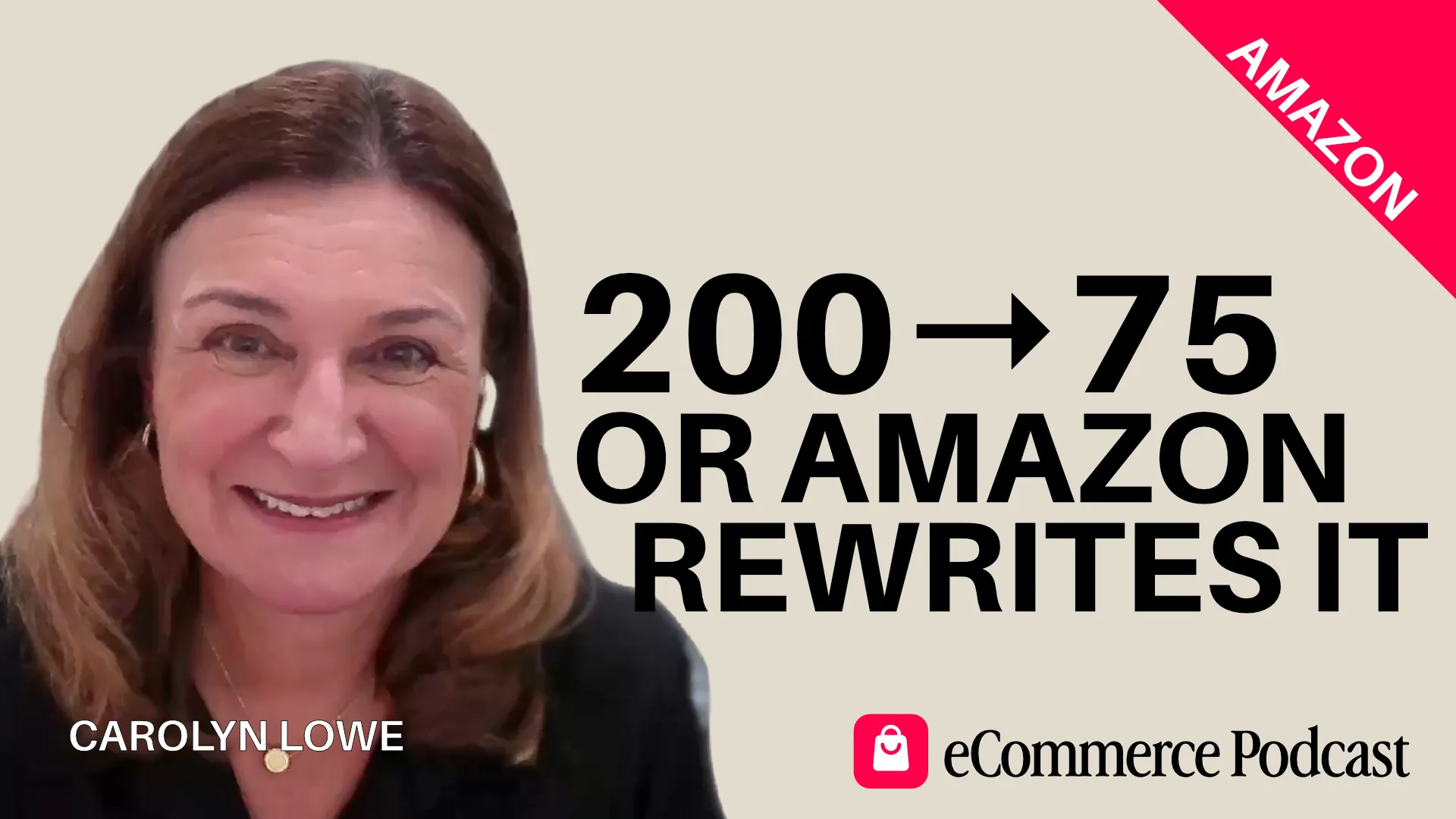
Is Amazon Cutting Your Product Titles to Just 75 Characters?
Carolyn Lowe left a $2B division at Dell to build ROI Swift, an Austin agency that's helped 150+ consumer brands generate over $100M on Amazon. Her core argument is that when sales stall, most brands throw more money at ads when the real problem is their product pages. She explains how she grades listings A to F, why roughly a fifth of most ad budgets is wasted, and the clean rule that your main image drives traffic while your content drives conversion. There's also a hard Amazon deadline every seller needs to act on, plus why she backs affiliates over influencers and rates Amazon Business.
When something goes wrong in an ecommerce business, the reflex is almost always the same. Sales are soft, so we spend more on ads. It feels like action. It feels like progress. And according to Carolyn Lowe, CEO and co-founder of ROI Swift, it's usually the wrong move. Most brands don't have an ad problem. They have a product page problem, and they're papering over it with money.
Carolyn has earned the right to say that. She started at Dell in 1999, ran a $2B division and then Dell.com on the consumer side, before leaving the Fortune 100 to build ROI Swift, an Austin agency that's helped over 150 consumer brands generate more than $100M on Amazon. This is a conversation about where the money actually leaks out of an ecommerce business, and why the fix is rarely the one we reach for first.
The Panic Move Nobody Questions
"People throw more ad dollars instead of going back and fixing fundamental problems," Carolyn says. "Whether it's a product issue, a webpage issue, a listing issue. They try to throw more good money after a bad product page."
The maths is unforgiving. If a website isn't converting at 2 to 3% and the average order value is under $100, more traffic just means more expensive failure. Same on Amazon. If a listing isn't converting at 15 to 20% or higher, buying more clicks pours petrol on a fire that's already burning the wrong way.
I've had this exact conversation from the other side of the desk. Years ago a chap called me, genuinely excited, because he'd found a budget to spend £30,000 to £40,000 a month on ads. His competitors were spending it, so he felt he had to match them. When we actually looked at his conversion rate, it was obvious that spending that money would lose him a colossal amount, because he was fixing the wrong problem. It was a hard conversation. Telling someone not to spend the money they've just fought to free up rarely goes down well.
So how does Carolyn win that argument with a client who's convinced the answer is more spend? She doesn't argue. She measures.
Data Wins Arguments
There's a saying from her Dell days that runs through everything ROI Swift does. If you can't measure it, you can't manage it.
Most brands never look at profitability at the SKU level, so that's where Carolyn starts. Grade the best sellers, apply the 80/20 rule, and read the pattern in the numbers.
- High traffic, low conversion means the product page is broken. Fix the page.
- Low traffic, high conversion means you've got a great product nobody can find. That's where more spend is justified.
"Usually when you put data in front of people and you explain it," she says, "it's very easy to see, yes, why would I go spend more money on that? That makes no sense."
Her audits grade product pages A through F, like at school. The one wrinkle is that she never tells a client when they've scored an F. "We'll just say needs improvement." Though she did offer to write it in big red marker if the situation called for it.
Your Main Image Sells the Click, Your Content Sells the Sale
This is the cleanest idea in the whole conversation, and it's worth committing to memory. Your main image drives traffic. Your content drives conversion. Each does a different job, so you optimise each one differently.
The example that makes it stick is a pair of shorts. One brand had a main image of the shorts on their own, flat, floating. Carolyn's team swapped it for the shorts worn on a person, so buyers could see whether they fell at 5, 7 or 9 inches. Conversion went up around 30%. Then they improved the content on the page and picked up roughly another 12% on top. No extra ad spend. It came out of the monthly retainer as part of the ordinary optimisation work.
The image logic changes by category. Compression sleeves photographed next to their branded box read as a premium brand rather than a cheap overseas knockoff. A strawberry-flavoured drink shows a picture of a strawberry, because you can't taste a listing. On a two-dimensional page you're recreating as much of the in-store experience as you can, in the microsecond before someone scrolls past.
Thinking like an owner also means looking past the page entirely. One brand was selling floss picks in a bag. Carolyn's team moved them to a box and cut packaging cost by 25%, saving a dollar on every unit. At 200,000 units a month, that dollar drops straight to the bottom line. No agency paid only on ad spend goes looking for that.
Why the Human Still Beats the Software
Plenty of brands hand their ads to automated software and assume it's handled. Carolyn's team keeps finding the same thing. Roughly 18 to 20% of spend wasted. On a £30,000 monthly budget, that's about $6,000 a month, in her words, "lighting on fire."
Her favourite example is a women's fertility product whose AI ad software kept happily spending on the keywords "dog, cat, horse, pet." The machine never worked out that none of those apply to a human woman trying to conceive. "So this is why we use AI to analyse things, automate things, but we use a human to actually look at the data."
That owner's mindset is baked into how ROI Swift is built. There's a retainer that keeps the lights on, with five specialists on every account, and then the team also takes a share of the brand's growth. Skin in the game, on both sides. It's the same reason Matt's own businesses have moved towards taking equity stakes rather than selling a service. The brands that feel like partners do far better than the ones who just hire a supplier.
The Amazon Deadline You Can't Ignore
Amazon is cutting the maximum length of product titles from 200 characters down to 75, and enforcement lands on 27 July 2026. It applies to every category except media. If your title is too long and you don't fix it, Amazon's AI will rewrite it for you, which is not something you want happening unsupervised. Only brand-registered sellers get a 14-day window to review the change before it takes effect.
The driver is mobile. Around two-thirds of Amazon traffic now comes from phones, where a long, keyword-stuffed title is useless. To soften the squeeze, Amazon has added a new Item Highlights field worth 125 searchable characters, so the total indexable space stays roughly where it was. But the title itself has to earn its 75 characters now.
If you sell on Amazon, this is the one thing to action this week. Go into your listings, rewrite your titles to be compliant, and get the most important attributes in first. The keyword-stuffing era is closing, the same way white-text tricks stopped working on Google years ago. Play the game long enough and the platform eventually changes the rules.
Two Channels Most Brands Are Sleeping On
Carolyn's parting advice points at two places brands routinely leave money on the table.
The first is TikTok Shop and TikTok affiliates. She's seen nine-figure brands grow almost entirely through it. Her line on the difference is worth borrowing. She backs affiliates, who get paid when they sell, over influencers, who get paid for visibility. Pay for results, not for attention.
The second is Amazon Business. 96 of the top 100 Fortune brands have an Amazon Business account, and over $30 billion moves through it. Plenty of sellers don't even realise their listings aren't visible to that audience. You don't have to think of yourself as a B2B brand to be missing B2B sales.
Where to Start
If you take one thing from Carolyn, make it this. Before you approve another £$ of ad spend, look at your numbers at the SKU level and ask an honest question. Is this a traffic problem or a conversion problem? Because the answer tells you exactly where the money should go, and most of the time it isn't into more ads.
If you doubled your ad budget tomorrow, would your product pages actually be ready to convert the traffic? Or would you just be spending faster to lose the same way? If you're not sure, that's your starting point right there.
Full Episode Transcript
Read the complete, unedited conversation between Matt and Carolyn Lowe from ROI Swift. This transcript provides the full context and details discussed in the episode.
Full Episode Transcript
Read the complete, unedited conversation between Matt and Carolyn Lowe from ROI Swift. This transcript provides the full context and details discussed in the episode.
# Transcript — Carolyn Lowe (ROI Swift)
*The eCommerce Podcast · Recorded 2026-06-29 · Publish 2026-07-23*
Speakers: **Matt** (Matt Edmundson, host) · **Carolyn** (Carolyn Lowe, CEO & Co-Founder, ROI Swift)
[00:04] **Matt**: Well, hello and welcome to the eCommerce Podcast. Yes, welcome back. My name is Matt Edmundson. It's great to be with you on this sunny day from Liverpool, England, talking about all things ecommerce with my transatlantic guest. Oh, yes. But before we get into that, let me give a warm welcome to you if this is your first time to the show. It's always great having new listeners join. We talk about all things ecommerce. I myself have been in ecommerce since 2002. I still run multiple ecommerce businesses. And I love the podcast because I get to grill the experts with all the questions burning in my head about how to make my business better. You guys get to listen in and hopefully get some of your questions answered as well. If you would like to know more about the show, about today's guest, about all the show notes, the links, all of that sort of stuff, you will find it on the website ecommercepodcast.net. That's www. Feels old-fashioned now, Carolyn, doesn't it? Say www. www.ecommercepodcast.net. You'll find everything there. Go check out the website. Be great to see you on there. And of course, reach out to me on social media @MattEdmondson or LinkedIn, Matt Edmundson, whatever their linkage is, you'll find me. It'd be great to connect with you, but that's enough from me. Let's bring on today's guest. Carolyn, how are we doing?
[01:31] **Carolyn**: I'm fantastic. How are you, Matt?
[01:34] **Matt**: Well, I was just chatting, weren't we, before we hit the record button. I've just come off a weekend of camping, and so I'm both really relaxed and really tired. Which is sort of the odd mix you get when you come off a camping trip, I feel, because sleep is slightly elusive, but you still feel kind of refreshed anyway.
[01:55] **Carolyn**: Yes. Well, I'm in Texas, so nobody camps here in July. So if there's any camping to be done, it's in air-conditioned lodges with, you know, comfy beds. So that's my way of camping is you go out, you hike all day, you swim, you do everything. And then you actually sleep in a bed.
[02:14] **Matt**: So yeah, yeah, maybe should start thinking about things like that. But no, no, I think this is just the way it is. For those that don't know you, Carolyn, just give us a quick sort of elevator pitch, quick 30 seconds, who Carolyn is and why you're here.
[02:31] **Carolyn**: Sure. Thanks, Matt. So I am here, first of all, because Matt is lovely and we had a great conversation and we are both ecommerce. We don't even want to say we're 25-year veterans because that would date us.
[02:47] **Matt**: I call myself an ecommerce dinosaur. I know it's not very flattering, but that's my phrase.
[02:52] **Carolyn**: I'm right with you. I'm a fellow stegosaurus. So I started—
[02:58] **Matt**: Love it.
[03:00] **Carolyn**: Started at Dell in 1999. So I was living in Boston. They recruited me. People were buying their first computer. iPhones didn't exist. A lot of people listening probably can't even remember a day when iPhones didn't exist, but they didn't. And so I ran a massive division at Dell, and then I ran Dell.com on the consumer side for a while, and then I did product roles. So I've just been in ecommerce for a long time, left Fortune 100, went to a small mom and baby company, loved it, 4x'd it in a year, said I want to do this for a bunch more, and then made the crazy choice to go and start my own agency to help emerging brands and challenger brands grow profitably since they don't have the Fortune 100 resources that I had. So that's what I've been doing since, I started ROI Swift about 11 years ago.
[03:50] **Matt**: Wow. Well, it's great to have you on the show. I was, I was excited when I, you know, you get these little bios from people saying when they sort of apply to come on the show, and it's just like, was at Dell. I was like, that's really cool, because I think over the years I must have spent a small fortune, with Dell over the years. Whatever, I was a PC guy until I became a Mac guy. It was always Dell. It was kind of kind of the way it worked. How was it at Dell? Was it fun? Was it eye-opening? Was it laborious? I'm curious.
[04:20] **Carolyn**: It was all of those. It was, you know, we loved— I came in and we were number 6 in market share behind a brand called Gateway, who is now out of business. So, that rise from, you know, to number 1. And we used to say we were the nicest house in the worst neighborhood because Nobody liked PC manufacturers, but at the time we made, you know, high quality PCs, great support. You know, this was before the world changed. And so, you know, you were really proud to work there. And everybody I worked with, I mean, I worked with some Harvard MBAs and Vanderbilt and some of the smartest people I've ever met. And 25 years later, we all still talk. Like, you know, I had coffee with someone last week who, ran a division of Staples, and I had coffee with someone else who, you know, was with Tenuity. So just an amazing group of— yeah, we were all Type A, and that's why Dell hired us. But, you know, we sort of— we ground— we kept grinding it out. And then when they changed it to restricted stock, everyone was like, why are we working 80 hours a week and killing ourselves? And there's not that much upside anymore. So yeah. So I was there for that whole culture change where Work-life balance was a taboo subject when I was there, and now it's all about that, you know.
[05:42] **Matt**: Yeah, yeah, that's funny, isn't it, how times have changed in that, in that regard. So you're working now with emerging brands, your ROI Swift is your company. You're bringing, you know, all of this experience. I'm curious, I love to ask this question, my guest, if you could wave a magic wand and solve the biggest, biggest single problems you come across with your clients, right? What is that mistake that you would solve? What is the mistake we're all making and why are we making it?
[06:13] **Carolyn**: Well, I can't speak for you, but I can speak to most brands that come to us is, and you probably see this too, Matt, in your work, people don't know what they don't know. And yes, a lot of times what I see is people throw more ad dollars instead of going back and fixing fundamental problems, whether it's a product issue, a webpage issue, a listing issue. They try to throw more good money after, you know, a bad either product or a bad product page or a bad experience. And so that's the biggest mistake that I see is that so many people out there just want to tell you to spend more money and you don't need to spend more money necessarily. Yes, eventually you do. But, you know, if your website isn't converting at 2 to 3% and your AOV is less than $100, like, go back and fix your product pages. If your Amazon's not converting at 15 or 20% or higher, go back and fix your product pages. You know, whereas everybody just thinks throwing more money after it will get them more sales, but that'll just basically run them out of business eventually.
[07:19] **Matt**: It's a really interesting point, isn't it? And I, And, and I'd love to say that it's changed in the years, you know, we've evolved into dinosaurs in ecommerce, but it hasn't at all. It's always been the big thing, hasn't it? What's the problem? Sales are down, or something's going on, therefore it's marketing, therefore we need to throw more money at it. right. And I remember years ago having a conversation with a chap. He called me and said, listen, I've got, I think it was like he, he wanted to spend like 30, 40 grand a month, which at the time was a lot. I mean, it's a lot of money now, but at the time it was a lot of money. He wanted to spend 30, 40 grand a month on ads. He said, I've gone and found a budget where we can spend £30,000-40,000 a month, but I need us to get up to where our competitors are, right? They're spending this amount of money on ads, so therefore we must spend this amount of money on ads. And I'm more like, well, hang on a minute, let's— before we go down that road, let's just put the brakes on a little bit and look at your website. and we quickly realized with his conversion rate that if he spent £30,000-40,000 a month on ads he was going to lose like a colossal amount of money because he was fixing the wrong problem. And I thought this was quite an interesting— it was a very hard conversation to say to him, you don't need to spend the money on ads, you need to spend the money here.
[08:36] **Carolyn**: Yes.
[08:36] **Matt**: How do you find that conversation? Because I imagine if this is a big problem, how do you convince people that actually it's not more money on ads? Because it is— I think it is the default place we go to.
[08:48] **Carolyn**: And it's interesting because I think what we have found is that, you know, one of the things that differentiates us is that we think like owners. You know, we're not just looking at, hey, we'll spend your money and do your listings. We're looking at every single piece of this. So we're looking at, hey, can you save money by changing your packaging? So one brand, we saved them 25% from going to a bag of floss picks to a box. They saved a dollar on every unit that went out the door. And when you're selling 200,000 units a month of floss picks, that's a lot of money that just drops to your bottom line. So we will look at the entire profitability, but in terms of that conversation, normally we had a saying at Dell, you know, if you can't measure it, you can't manage it. So we measure everything and we feel that data wins arguments. And so we'll show, the brand— and most people don't even look at this— at a SKU level profitability, how much you're spending per product and how profitable is it. And we'll look and we'll say, okay, if this one has high traffic, low conversion, let's go fix your product page. If this has low traffic, high conversion, let's go spend money there because this is a great product, it just doesn't have the visibility. So Usually when you put data in front of people and you explain it, they, you know, it's very easy to see, yes, why would I go spend more money on that? You know, that makes no sense.
[10:17] **Matt**: Yeah, that's a really interesting point. So how do you figure it out, right? I mean, what's your process? So I'm listening to the show. I've got my, you know, my company is doing well. What are some of the key points that I need to think about straight away that you would you would just go and check as default on every single company? I mean, you've, you've talked about packaging, you've talked about conversion rates and stuff, but where would, where would you go? Where would you start?
[10:42] **Carolyn**: So usually when we do an audit for a brand for Amazon, we'll pull 3 or 4 different, you know, high-level reports and then we'll look at their best sellers, right? You know, the 80/20 rule, right? 80% of your sales are coming from 20% of your products. So we'll look at those, we'll focus on those, we'll do, we'll grade those product pages, you know, A through F. Like in school. Yeah, we won't tell them if it's, if it's an F, we'll just say, you know, needs improvement. And, and so then we'll do that. And then we'll look at their advertising and we'll look and typically we see and this hurts my heart, Matt, like, we'll see people wasting 18 to 20%. Of their spend. And like, to your point, if they're spending £30,000 a month and 20% of that is wasted, I mean, that's $6,000 you're just lighting on fire. So yeah, I really hate to see, you know, anybody, whether it's Amazon, Google, Meta, TikTok, just, you know, take advantage of people because they don't know enough about how to run their ads that they light their money on fire. And a lot of times we'll see this with software, right? We'll see, oh well, we've got this AI software, and we're using this company, and it's all automated. And, and here's a great example. One of the brands we worked with was women's fertility. And so the AI software never caught that dog, cat, horse, pet is not applicable to this product, right? This was for a human woman. And so it just kept— it would keep spending. So this is why we say, okay, we use AI to analyze things, automate things, but we use a human to actually look at the data. Yeah, you know, I feel like 80% of the way there, but still wasting 20%. It just— I just hate seeing, you know, agencies mail it in and not think like it's their own dollars that they're spending. You know, this is like, it's not a job to our team. It's like, these are our companies. Like, we're proud of what we've done with brands like Chubbies, which is like their men's shorts and swimsuits. And we're proud of that growth, almost as if it's, you know, we're part of the team. And so we tend to treat everybody like it's our business because we don't want to waste someone else's dollars. And we certainly don't want to give them to Amazon, Meta, and Google if we don't have to.
[13:05] **Matt**: Well, I agree. I mean, frankly, they've all got enough of my money.
[13:09] **Carolyn**: Exactly. They don't need any more.
[13:12] **Matt**: No, no. I mean, how many space rockets can you build, right? So I think it's It's an interesting one, isn't it? Because I mean, there's two sides to what you're saying here, Carolyn, and there's two things I, I sort of want to go down. the first, I want to come back to how you grade a website, A through F, right? Like, or a product page. Like, what is it that gives you an A versus what gives you an F? I'm kind of curious about that process. But the second thing that I want to get into, you talked about working with Chubbies. Okay, so one of your brands, and you use this phrase like you, you're part of the team, right? You— this is one of our brands, we treat it like one of our brands. And this, I think, is one of those things that, having worked in the industry for a little while, you find really great agencies not by the glass-walled offices and the art on their walls and whether they look like Google and all that sort of stuff, You find agencies that are great by how much they care about what you're doing, right? By how much they feel like a partner rather than a service provider. And the agencies we have stayed with longevity have always been those that feel like they're on the journey with us. And so there's a great guy, Craig, shout out to Craig, who runs some of our paid media stuff, for example. Well, when we've— in the past we've acquired brands and they've had no money, the brand has had no money to grow, and it's like, well, don't pay me, I'm going to grow this and you can— we'll get it working, and once it's working, then you can, you know, I'll charge you maybe a little bit extra. Craig, this is awesome, man. And he's been with us a while, right? How important is it to you as an agency owner to feel like you know, you're part of the team, you're part of the family, whatever phraseology fits for you.
[15:10] **Carolyn**: Yeah, that is— I mean, it's, it's sort of built into our core values. It's funny, you said you actually almost used verbatim one of our core values, which is care about what you do. So we have 4 core values, and this is how we hire, fire, bring on brands to work with, you know, no jerks rule. But our 4 core values are Care about what you do, make it better, always be learning, and, glass half full mindset.
[15:39] **Matt**: So I love that.
[15:40] **Carolyn**: Yeah. And so like, find a way, find a way to yes. You know, we— you, you've worked with people before who go straight to no, and so that mindset is not helpful, especially in something like digital or ecommerce or AI or anything that's emerging. You You have to find a way to say yes because it's probably not been done before. So, you know, those are the people that we hire for. And then when they care about what they do and they're always learning and they're looking to make it better, then, you know, they proactively do a lot of those things where a lot of agencies are reactive. So we sort of have that proactive culture built into our company, like don't wait till it gets there. Like, you know, if you see something, we, what I love is that we have no bureaucracy. I came from Dell where there was 80 hours of meetings and we maybe have 3 to 4 hours of meetings. That's it a week. And everybody is free to make a suggestion to make it better. We have changed software, we've changed service providers, we've, you know, brought people on, we've restructured things just all based on everybody's feedback. So I think that's the biggest thing is we are all invested. and then the other way that we do it is we do take a percentage of their growth and then the team shares in that percentage of growth. So if you help grow someone's sales, you get a percentage of that.
[17:11] **Matt**: It's a really— I, I'm, I'm a big fan of it. I'm not going to lie. I did— I mean, people might say it sounds odd, but I think Like you, we, we have, are we an agency? Maybe we are in some respects. We do work with other brands, but we tend to focus on the brands that we acquire now. Yes. But it's more, and the reason we've gone down that road, Carolyn, to sort of speak to this a little bit, is because we have found the brands that we work with that feel like partners we do really well with them. The people that use us just because we have a service, we don't do so well with them, right? And it's, and it's, it's a really interesting sort of discovery that we've had. let's go with the people that we feel like we can partner with. And for us, that usually means an equity stake in the business, right? We have to have some kind of skin in the game. and so as a result of that, we we grow these companies from where they were to hopefully something, something better, and we do that because we have skin in the game. And it's quite an unusual thing, I think, to find agencies that will do that because they all want their $5,000 a month retainer. Or one company we worked with wanted a $32,000 a month retainer. I'm like, this is, this is insane. Right, in, in so many ways, because for them it was all about retainer, it was all about predictable income. how have you found that though, that whole going down that road of, no, we, we want to have a bit of skin in the game here, guys, because we're going to make it— we, we need to be invested?
[18:55] **Carolyn**: I, I think that it's refreshing, you know. I've seen more agencies copy us, you know. People used to just do percentage of spend and that's great, but half the time your problem isn't your ads. Half the time your problem is your organic, and then they're ignoring that, and then they're saying spend more money and pay us more money. So, and who ends up losing is the brand, right? So then all these great brands go out of business, and then you're left with nothing but Coke and Pepsi, you know. So I sort of, I like the, the ability for consumers to have choice. And so this is, I mean, it, it goes over very well with people because they say, okay, there is a retainer that keeps the lights on, right? We do have 5 people working on your account: organic specialist, ad specialist, copywriter, designer, and account strategist. So, you know, we do have to have some sort of retainer because if you go out of stock and you have no sales, I'm sorry, but we still have to pay our people. But yeah, our people make sure you don't go out of stock. They will give you the inventory recommendations you need to stay in stock. and that's one of the things we're really proud of. When people partner with our team, if they follow our inventory recommendations, they've never run out of stock.
[20:07] **Matt**: Yeah. So yeah, that's just—
[20:09] **Carolyn**: I love that way you think, like owners, right?
[20:12] **Matt**: It is, it is. I think it's really powerful too, because you're thinking about the business from 5 different angles, which is how we found it, which is why we, we end up partnering with people. Because if we just focused on one special thing, like we will do your website, for example, then because there's all these different elements to e-com, it's like, no, actually I need to talk to you about your customer service because that's having an impact over here. and I, and I need to stick my nose in a little bit. And I think you've got to have a good relationship, with your customer to be able to do that. and I think, you know, those listening to the show, who are running ecommerce businesses, I think My advice, and I definitely don't want to put words in your mouth, Carolyn, but what I'm picking up from you is that seek out these kind of relationships with the agencies that you have, and don't rest until you find them because they're, they're like gold dust in many ways.
[21:11] **Carolyn**: I agree, I agree. Most people that come to us are— it's either results, responsiveness, or reactive. Those are, you know, they're not getting the results they're not getting timely responses, or they're working with someone who's just reactive, who's not, you know, who fixes things when they break, but isn't thinking about the good and the health of the company. And we had one, this great brand. It was the dad, two sons, and one marketing person. They were 90% Amazon. We did everything for them. They had 10% of their sales off Amazon on website. And they had a 9-figure exit. And we did everything from, you know, help them with product strategy. You know, they came to us, they had 2 or 3 products. When they got acquired, they had 12 products, right? They did product line extensions. So we would clone a product for another use because that market was massive. so it was like if it was a certain type of, wipe, then we would clone it and make it another type of wipe and just open up another huge market. So I mean, we sort of are in the business of making other people millionaires and billionaires. And so, you know, I should probably do this for myself one day.
[22:29] **Matt**: Yeah, yeah, yeah. And that's a funny thing actually, is the amount of agency owners that I speak to. I always ask the question, why are you not doing your own ecommerce business? And it's like, well, we're too busy with other clients, but everybody wants to get into it, right? It's, but I don't have the warehouse, I don't have this, I don't have the distribution. It's really quite funny. But I do think sometimes it's it's just as good staying in your lane, right? Do what you know to do.
[22:57] **Carolyn**: Insider tip here. We are launching our own brand in Q3 in the home and kitchen space. So I have finally, I guess—
[23:05] **Matt**: You bit the bullet.
[23:07] **Carolyn**: Figuratively got off the pot. Yes.
[23:11] **Matt**: Brilliant. And I'm curious, how would you— I'm bringing it back. This is a very good segue. How would you grade your own product page?
[23:21] **Carolyn**: Well, it's not launching till Q3. So, but I would grade what is going to be a 10 out of 10 because we have done enough research. We've done product market fit. We've done, we've done TAM analysis. We've done competitor analysis. And so, yes.
[23:37] **Matt**: Okay. Very good. Well, let's, let's jump into how you, I'm curious how you grade pages. Like, I'm curious about your A to F grading system that you never tell your clients about?
[23:48] **Carolyn**: Well, it, it depends on a, you know, a webpage. And because we don't do paid search and social anymore, we're 100% focused on Amazon. I'll, I'll spend time talking about Amazon instead of product pages.
[24:01] **Matt**: Mm-hmm.
[24:01] **Carolyn**: But I, I can, you know, you have probably have a whole Shopify page grading system and some A/B testing we've done. And, you know, like I've seen 20% lifts in conversion from just pages that I've A/B done on Shopify even before I started the agency when I was on the brand side. But so first thing, I mean, it's everything from— there's things that you need to do for the computers, you know, so for Amazon's algorithm, and then there's things that you need to do for the people. And so for the computers, you need to have great titles. Now this is a big deal. Amazon just shrunk their product titles from like 250 to 70. So in terms of characters, so people are right, go back and redo. And if you don't do it, Amazon's going to cut your titles for you, and you probably don't want that. So that is happening at the end of July. So hot tip to readers, if you're selling on Amazon, go back in, redo your titles, make them compliant, or else Amazon will do it for you. So titles Everything from the order of the title to the order of the keywords to the— like, all the right things have to be in the title. Bullets. Your bullets, you need to maximize that space. You need— that's also, you know, people don't read, but computers do. So the bullets are largely, again, for the algorithm. It's trying to figure out what your product is, etc. images. Everybody, you know, You should have a minimum of 6 images and a video. A lot of times we'll see people have 6 images, but if it's say a shirt, it'll be the front of the shirt, the back of the shirt, someone wearing the shirt. Like it doesn't tell you why you should buy this shirt. Like there's no features, benefits, there's no comparison chart, there's no lifestyle, there's no brand building.
[25:55] **Matt**: Like it's a t-shirt.
[25:57] **Carolyn**: And then you go down into the A+ content And that's where, you know, we see either bad brand stories. If you— so we work with a great brand that's been featured in GQ, Men's Journal, lots of sports and outdoor magazines. Put that social proofing in there, like as seen in, and you can use all their logos, right?
[26:19] **Matt**: Yeah.
[26:20] **Carolyn**: Have a Q&A section. Like a lot of times we'll see people have access to premium A+ content, but they won't use it. It'll be those like horrible Amazon blocks and it looks nothing like your brand and it's horrible. So, and then also have the Q&A section because that gets read by Amazon's Rufus AI as well. So those are some of the things that you can do. And then there's a lot more that we go into, but those are kind of, you know, everybody has a checklist. Like when I got my pilot's license, right? You have a checklist. Before you take off. So yeah, make sure, oh yeah, did I put the fuel cap back on? You know, those are those kinds of things. Same thing with us. We have a checklist on the product pages and so ones with high traffic, low conversion, we go through the checklist and say, okay, we're going to fix this, this, this, and this first. And we've seen when we've changed the main image, we've seen anywhere from like 20 to 30% increase in conversion. Because your main image is going to get you more traffic. Your content is going to get you more conversion. So, right. If you think about it.
[27:30] **Matt**: Yeah.
[27:31] **Carolyn**: If you, if you go to Amazon, you search on garlic press and you see all those search results, right? So how are they going to click on yours? They only have, you know, those 50 characters. They see the price, they see the number of the reviews, they see the brand name and they see the image. And so lot of main image testing. So this was a big one where we got a 30% increase in conversion by changing it from just a pair of shorts to a pair of shorts on a person so they could see where the, where the shorts fall. Are they 5-inch shorts? Are they 7? Are they 9? Yeah, because people don't read, right? So once we change from that, like, oh, oh, I want to click through that one. And then once we change the content, we got about a 12% lift in conversion. No more money on ads. Didn't spend any money on ads. and that was all part of our monthly retainer. We didn't, was nothing else, you know, that was part of the optimizations in the monthly fees. So that, that's how we typically grade pages. And then we'll do like an AI review analysis where we'll plug all the reviews into AI and find out what they like and highlight that and find out what they don't like and fix that.
[28:40] **Matt**: So, yeah. Yeah. Well, there's a lot there. I love this idea that, the main image is about traffic, the content is about conversion. I think I, I love the simplicity of that in many ways. What have you found then that works well in main images? So you, you, you, you've talked about taking a pair of shorts and putting it on a person, which gives context, I suppose, to the product. Is that what I should be thinking about in the main image?
[29:12] **Carolyn**: Well, think about it this way, right? You, you probably do the same thing with Google Shopping, right? You— that's all you get is your main image and your price. So that's what people are going to click through. So you can do some, some testing there as well. I feel like the Google Shopping is as close to Amazon as you're going to get, right? That people are in the buying mode and they just get one picture and a price and a name, right? So very similar. So I would A/B test that. You know, luckily Amazon has that built into the platform, so you can do it right there on platform. It gives you the results and you don't have to— yeah, you don't have to worry about it. But for apparel, I would definitely do main image testing, especially for Google Shopping, and definitely for other categories. So we work with another company that makes compression arm sleeves, knee sleeves, same thing. Mm-hmm. Everyone else just had a picture, especially the sort of cheap overseas knockoffs. I mean, so we actually put it with the box and then the product next to it. And so you've built some branding, like just by having that box in your main image and seeing your logo, it's like, oh, this is a legit brand. And it's a premium brand compared to the cheap knockoffs. And, but they're still doing 7 figures a month. So, and then on food and beverage, flavor is really important. So having those pictures of what the flavor is, since you can't taste it. We did this with a strawberry flavored, breastfeeding drink when I was at the Mom and Baby Company. And on the box you put the flavors and, or you put pictures of like a strawberry and a lemon. And so they get a sense of, oh, this is what it's going to taste like.
[31:03] **Matt**: So that's really a really interesting idea, just putting the, the image of the fruit that it tastes like as well as the word.
[31:11] **Carolyn**: Yes.
[31:11] **Matt**: Yeah, smart. I, I would not have thought of that.
[31:15] **Carolyn**: So for each vertical, there's different ways you can optimize that, those images, or for conversion, because it's a, you know, it's a two-dimensional listing. You know, you can't see it, you can't touch it, you can't feel it. So we try and make that experience as close as you can to actually being in a store and being able to see that.
[31:37] **Matt**: And like, and you've got to do that in a matter of seconds, haven't you? so microseconds maybe, which is why the image is so important. the picture paints a thousand words, as they say, especially as you're reducing your characters down to 70. it's going to be even more important. And do you know why Amazon are doing that? Have they released a statement as to why they're doing it, or they're just having a go?
[32:00] **Carolyn**: There's a couple reasons. One is, you know, now 65 to 70% traffic is mobile, and so, they're trying to try and get you to shorten it so that people are clicking through. And once they're getting to that page, they're, they're understanding. they didn't give a lot of reasoning why they're doing it. I think, you know, Amazon does everything, quote, for customer trust. If you look at their core values, it's all about customer trust. And so there's, I think there is a lot of keyword stuffing. And so by doing this, it's going to force it to, it's going to force you to be intentional about, okay, what are the most important aspects of your product? And getting those in the title. And also just because there is a smaller maximum character count on mobile versus desktop.
[32:52] **Matt**: Yeah, yeah. It kind of reminds me, I mean, going back a few years ago, when you used to keyword stuff blog posts, just try and get ranking. And then Google eventually went, yeah, no, that's not going to work, is it, boys and girls? And it kind of feels a little bit like Amazon's gone, yeah, we look at these listings, and I have no idea what this product is from the title. It's just a stream of keywords which you're trying to gamify the system and they're just gonna go, let's just shut that off, aren't they? So you can gamify it for so long, can't you, I suppose, but, or play the game for so long.
[33:22] **Carolyn**: Did you ever do white text for blog posts?
[33:26] **Matt**: Yep, yep, white text.
[33:27] **Carolyn**: In the old, old days where you would do white text and keyword stuff, everything in white text?
[33:31] **Matt**: Yeah, yeah, yeah.
[33:31] **Carolyn**: How did Google not pick up on that sooner?
[33:33] **Matt**: It's funny, the things that you kind of do. And now even on Instagram, people keyword stuff. So you take all the keywords, you put it on the reel, you make the text really small and you hide it behind an image or a GIF that you add from it or a sticker. How do I mean? Instagram obviously could care less, but it just fascinates me. You know, all these sort of humans are very good at finding a way to break the system to make it easier for themselves. We're really good at shortcutting this. Sometimes it works, sometimes it doesn't, but we're really good at finding these things because we don't want to play the game by the rules. We just want— we just don't. And I find it fascinating part of human psychology, especially when it comes to taxes. We all want to pay. How can I get around paying less? It's quite funny. I'm curious with your own product now. I'm obviously not asking you what the product is. I wouldn't dare to do such a thing. You've decided to sort of take the plunge. Walk me through the process that you went through to decide whether one, this was a goer, and two, where, you know, where it's straightforward to do so, Carolyn, the steps that you've taken to launch, that you're going to take to launch this well.
[34:55] **Carolyn**: Yes. So first thing to do is get the product right, right? Make sure it's 5 out of 5 stars before it ever sees the light of day. So first thing is product development. We're in product development right now, working with manufacturer, going back and forth. In terms of exactly what we want. And then—
[35:13] **Matt**: And sorry, sorry to interrupt. Is that 5 out of 5 stars for you? Because you're, you know, you're, you're quite— if you're like me, you'll be quite OCD about the quality of it. Or is this 5 out of 5 stars based on consumer testing that you're running?
[35:30] **Carolyn**: So first of all, we want it to be 5 out of 5 for us. And then we will put it in front of focus groups as well and get people to actually use the product, get their feedback before we launch it. Then once we, we feel like we've got a solid product, we'll go ahead. And so when you launch a product page on Amazon, you never want to turn it on till you've got everything done, you know, that you, that you know. You can send an email. So a lot of times when we launched a brand at the mom and baby company, we launched a new product, we'd send out a Klaviyo email to our database with a promo. It's totally legal to do a promo. So you can do that and, and send them a promo code for Amazon, which kind of juices the sales. You know, you, you want that first 30 days to look really strong. And then you also do Vine, which is Amazon's review program where you can give away up to like 32, 2 to 33 units.
[36:33] **Matt**: Yeah.
[36:33] **Carolyn**: And then you can, then you can get legitimate reviews from— and this is, you know, you just have to pay for the product and then you get charged by the, you know, for per ASIN. But, it's nominal, it's a couple hundred dollars. So then you've got that. And then also on the off-Amazon side, we're seeing lots of success with TikTok affiliates. Driving Amazon traffic or reels for TikTok shop. So I'm not a fan of influencers, but I am a fan of affiliates. I believe in paying when they sell. I don't believe in paying for just visibility.
[37:14] **Matt**: Yeah. Yeah, I'm with you. Again, it's old school. It's, I'm with you. I'll pay for results. If you get me 1,000 sales, I'll make you really wealthy. But if you don't, I'm not interested kind of thing. Yeah. And for your own product, are you— is that your playbook? It's like, we're going to do Amazon, we're going to play the Amazon system, and we're going to go get TikTok influencers to help us. Are you thinking about doing, an ecommerce site? Not necessarily Shopify. I'm definitely not affiliated with Shopify, but I'm, I'm kind of curious, where's your, where's your thinking at there?
[37:50] **Carolyn**: Yes, there'll definitely be a Shopify website for the brand. And of course, we'll have, you know, one hero product. It'll be a very small site to start with. and then as we add products, we can add those categories.
[38:03] **Matt**: Yeah, interesting, interesting. So when you talk about doing your, research, so you, you understood that there was a product-market fit. how did you do that?
[38:18] **Carolyn**: So there's a couple of ways, especially on Amazon. So I was just with Amazon out in Anaheim, California, like 2 weeks ago with a bunch of, they call themselves Amazonians, and everything from advertising to—
[38:33] **Matt**: Of course they do.
[38:35] **Carolyn**: Product listings to, you know, you name it. And so there's a great thing called the Product Opportunity Finder. And so you can go in and see what kinds of products are people looking for. We also have third-party tools so we can see what anybody is selling on any particular listing at any given moment. So if you give me a listing, I can tell you in the US, what they're doing in monthly sales. And so we looked at— there's white space in the market. There's some products there, they're not great. It's a big market, people are looking for it. we can do— you know, there's lots of good adjacent products to this, and also it's a consumable. So, you know, as you know, it's way easier to get something that people are going to put on subscription and reuse versus selling it, you know, t-shirt or a pair of glasses. I mean, well, I guess glasses you could use again, but you know, those kinds of things like someone buys a hose reel, they're probably not going to come back and buy another one.
[39:34] **Matt**: Yeah.
[39:35] **Carolyn**: Yeah. Yeah.
[39:38] **Matt**: Yeah. I mean, I would never sell hose reels for that very reason, but that's just me. Someone's got to sell them and I'm sure they're very good at it, but it's It's definitely not my, my, my cup of tea, as we like to say. How do you see AI interacting with all of this? With, you know, Amazon, with what you're doing with your own, you know, brand, what you see it doing with customers? Where do you see AI changing the rules?
[40:05] **Carolyn**: Everywhere. I can tell you what I've seen. Anytime there's a massive advance in technology, we also see like kind of a little pullback to old school. Like for example, when you got flooded with email in the beginning and then people actually went back to direct mail and catalogs and they actually worked really well, right? There's a reason why you still get catalogs around the holidays because they still work. And my background was direct mail and you only had to be right 1% of the time to be very profitable. So I feel like it's the same thing with AI. People are now calling BS on it. And I love the fact that Reddit is one of the few platforms that's very, you know, they'll bash you if you're using AI to write and you're not authentic. And, you know, but so, but I will tell you, we use a lot of it in analysis, automation, you know, thought leader, like thought leadership as we're solving problems and, you know, we're, and we've built some custom code to automate things that you can't do in Amazon that goes through Claude now. And so, but I do see, you know, it is kind of a nice leveling playing field for smaller brands. Like Amazon has AI generation for your images. And I saw one video out in Anaheim with Amazon that I did not think was AI. Like, you know, you can usually tell. I was like, that was really good. So Amazon is evolving that, trying to get more people on the platform, especially these kind of newer brands that are doing well off Amazon. They want them on Amazon. They have a whole team. Like, I can recommend someone, they'll help them onboard for a year. They'll, they'll give them all kinds of services. So that's what I've seen on the, on that side. I still think the AI ads that people have been using for 5 to 6 years is still not great. But yeah, I've seen it help a lot with doing 80% of the work for brands in terms of helping them do a product page if they're small and, you know, they don't have a lot of resources. You don't have to go get a photo shoot or a video shoot anymore. Like, that's where I'm seeing it kind of leveling playing.
[42:19] **Matt**: Yeah, yeah, they can do some really interesting things like that. Do you do the copy and paste. So you take up your researching competitor brands, for example, and you give Claude— we would use Claude Code. So we would give them, you know, all the competitors' pages and you're like, and all the competitors' reviews and go, find me the gold in this. Do you do that?
[42:44] **Carolyn**: Yeah, we have different tools we use. Like there's been review tools since before Claude and ChatGPT even existed. Like we've been using review automation tools for, not really, not automation, review analysis tools for about 8 years. So there's a couple of Amazon-specific ones that have been doing that before AI even came along. and now Amazon is kind of gating the reviews, which is a little bit hard because you used to be able to see all of them and then you could just throw that URL in, right? Or you could, or you could even just do Claude right on your Chrome extension and just say, tell me what everybody loves and hates about this. But, and you used to be able to, with one of our tools, even just download it to a CSV. And then you could, we have a script in Claude that would, you know, do all the analysis and spit it out. And it would even tell you like, these are the types of images you should make based on what people like about it. Like, for example, one was like a collagen peptide and people were mentioning putting in their coffee. And it's like, well, okay, you should have a coffee image of or a video of someone pouring it into their coffee because so many people loved taking it that way.
[43:52] **Matt**: Yeah, interesting. Carolyn, listen, I've just, I've genuinely just looked at the clock and thought, oh my goodness, time is fast creeping upon us. I was enjoying the conversation. If people want to reach out to you, if they want to connect with you, find out more about Swift ROI, what you guys are up to, what's the best way to do that?
[44:11] **Carolyn**: Best way to do that is go to our website, roiswift.com. Roiswift.com. you can also find me on LinkedIn. and I'm, I'm gonna throw this out there, Matt, to your audience. If anybody's doing $5,000 or more on your single product page on Amazon and you want me to do a free analysis of that one page, we will happily do that. I would love to see, what your listeners are— what your listeners are selling out there, and I'm happy to give them a one-page complimentary listing audit.
[44:45] **Matt**: Fantastic. In my head, Carolyn, that's just going to be a big piece of paper with A, B, C, D, E, or F written on it.
[44:52] **Carolyn**: I'll put it in a big red marker if it's an F.
[44:57] **Matt**: I love it. Yeah, we are going old school now. That is brilliant. that is brilliant, Carolyn. Listen, we love to do this thing called saving the best till last. So for those listeners that have hung around, til the end. what's your top tip for doing super well on Amazon? you've got 2 minutes, the microphone is yours. Give us your best, best value.
[45:20] **Carolyn**: I think the best value is doing a benchmark analysis of where you are today and where you want to be and what it's going to take to get there. So all the way down, and it's not sexy, but just looking at a SKU level analysis. And saying and seeing, okay, and coming up with a plan of here's where I want to be. And then also huge, just do not ignore TikTok Shop and TikTok Affiliates. We have seen 9-figure brands grow exclusively from TikTok Shop. So those are my, you know, that's kind of the best and it's not super sexy. But the other thing is, if you don't know what you don't know, you might not even have your, your business listings visible. 96 of the top Fortune 100 brands have an Amazon Business account. Over, $30 billion is transaction— transacted on Amazon Business, and your listings may not be even showing up. So don't ignore Amazon Business even if you don't think your product is a B2B product, you would be surprised how many people have a business account. So those are kind of my tips. We've seen the brands we've grown 2 to 3x, those, they have done all of those things. They started with SKU-level profitability. They then went to product line extensions, and then they beefed up their Amazon business, and they've invested in, you know, TikTok affiliates.
[46:49] **Matt**: Well, fantastic. There's a whole podcast right there, waiting to be recorded. But, Carolyn, thank you so much for joining us on the show. Genuinely love the conversation. appreciate your insight and listening to your stories. It's been great.
[47:02] **Carolyn**: Thank you. Do you have one more question for me?
[47:06] **Matt**: Yes, I— good, well remembered. This is the question for Matt, and I completely forgot about this because I'm, I'm useless. this is where I ask you for a question, and I go and answer that question on social media. So, Carolyn, what is your question for me?
[47:22] **Carolyn**: Okay, this is one of my favorite questions to get to know people, is if you found $20 on the floor of a grocery store and you had to spend it on yourself— at grocery stores here in the US, Whole Foods, or, you know, a Central Market, H-E-B, whatever— so, what would you buy with that $20 if you had to spend it on yourself from the store? Yes, so whatever grocery store you normally go to Post on social media and tell me what would you buy with $20 that you found on the store, the floor of the grocery store?
[47:56] **Matt**: Love that question. That's a great question. I know the answer, and I will reveal it on social media. If you want to know my answer to that question, come follow me @MattEdmundson. Love to know, actually, listeners, if you're— what your answer to that question would be. I'm really, really intrigued. Carolyn, listen, thank you.
[48:10] **Carolyn**: Post that on LinkedIn. Post it on LinkedIn.
[48:11] **Matt**: I will.
[48:12] **Carolyn**: And I would love to hear all your listeners' responses.
[48:14] **Matt**: Yeah, yeah, we should just put them on LinkedIn and tag us. It would be great. I would love to hear how you would spend the $20, or £20 or €20, wherever you are, in the world. I, I, part of me would be quite surprised seeing cash on the floor because I'm— cash, what's this? Do I need to— I don't know, can I use it still? Is it still profit? I don't know. so anyway, we'll take all of that aside. but yeah, there you go. Fantastic, Carolyn, and thank you. For joining us. It's been wonderful.
[48:50] **Carolyn**: Thanks for having me, Matt.
[48:52] **Matt**: Well, there you go. Another episode of the eCommerce Podcast recorded. All of Carolyn's links will be in the show notes, or on, which will be on the website ecommercepodcast.net. You can also click any of the links. We'll put all of Carolyn's links in the show notes, which are, you know, if you scroll down on your podcast app, or if you just click the description on the YouTube channel. You'll find it all there. Do connect, do go and say hello. I'm sure she would love to hear from you. That's it from me. Thank you so much for joining us. Make sure you stay connected and subscribed and all of that good stuff because we've got yet more great conversations lined up and I don't want you to miss any of them. So that's it from me. God bless you. Have a phenomenal week. Bye for now.