Can Old-School Direct Mail Beat Email Marketing in Ecommerce?
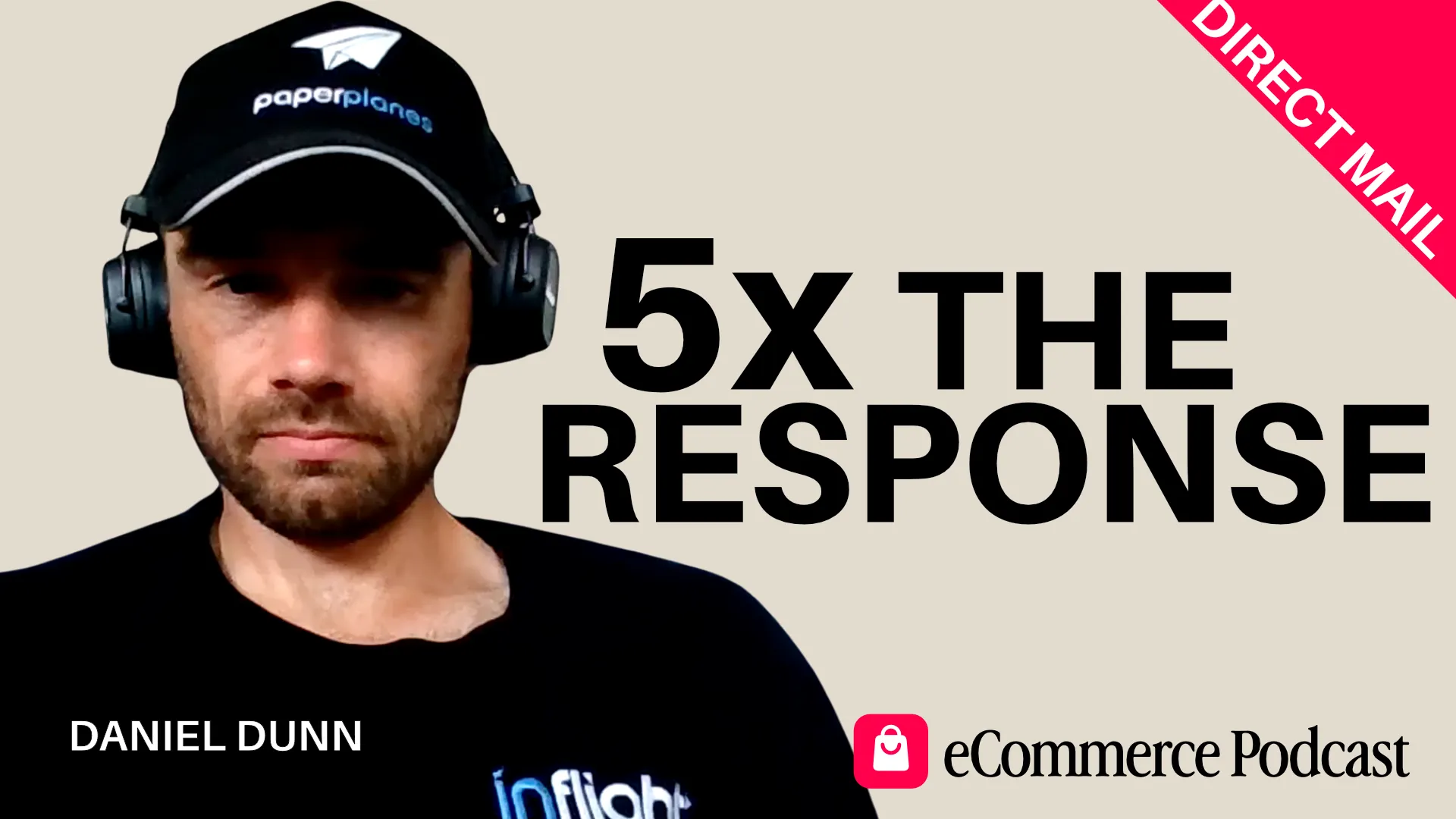
Daniel Dunn spent years inside Tesco Clubcard data before co-founding Paper Planes, and he thinks almost every ecommerce brand is ignoring a hugely profitable channel, the letterbox. He explains why direct mail to your warm, first-party customers pulls four to five times the response of email, how a single abandoned-cart postcard nudges buyers back around day seven, and why the right product combinations lift basket spend by 25 to 30 per cent. The real prize, he argues, is the second purchase, loyalty needn't mean discounting, and one loyal customer is worth thirteen who only ever trial your brand. Drawing on his Clubcard heritage, Dan makes the case for mail as the reactivation channel hiding in plain sight.
In the hour it takes to record a podcast, you'll receive twenty or thirty emails. Maybe in this whole day, your postman will deliver one or two letters, and then he's gone for another couple of days. That gap is the whole argument of this episode. Daniel Dunn, CEO and co-founder of Paper Planes, spent years working on Tesco Clubcard data strategy before setting out to drag direct mail back into the DTC marketer's channel mix, and his claim is bold: postal mail to your warm customers pulls four to five times the response of email.
Dan isn't a nostalgist arguing that the old ways were better. He's Vice Chairman of the DMA Print Council, and Paper Planes exists to make direct mail something a Shopify brand can plan, personalise and track exactly the way it plans an email campaign. So most ecommerce brands are sitting on first-party data they've worked hard to earn and the chances are that a good chunk of that database has gone quiet, right? Especially on email, and almost nobody is reaching those people through the one channel that isn't saturated. Which means maybe we should stop treating the letterbox as a relic.
Why the Unsaturated Channel Wins
Let's be clear, email deserves to be at the front of your ecom marketing strategy. It's a high-ROAS generator, you can plug data in, personalise it and create relevance, and for certain segments it does the job well. The problem isn't email itself, it's the cadence of it. Everyone's inbox is a battlefield, and a proportion of any database simply stops opening, stops clicking, stops responding.
And it's with these quiet contacts are where our opportunity lives. They've bought from you, so they're worth talking to, but the channel you keep using to reach them is the one they've tuned out. Something tangible and physical arriving in the post cuts through precisely because so little arrives in the post any more. Dan makes the point that direct mail used to be an acquisition game full of pizza leaflets, estate agent postcards and credit card prospecting, which is why you still see the odd "no junk mail" sticker acting as the real-world equivalent of a spam filter. That version of direct mail has long gone. What's replaced it is personalised, relevant, and it plugs into your customer communications the same way email does.
Your First-Party Data Opportunity
First-party data is the customer you own. The minute someone comes to your Shopify store and buys, you know who they are, and they haven't arrived via Amazon Marketplace or Etsy. The more successful you are at selling, the more of this data you accumulate, and most brands on a growth curve reach a point where they have plenty of people who've purchased and now need a reason to buy again.
The default way to work that data is email first, quite rightly, then maybe SMS, maybe social. Rarely does anyone reach for direct mail, and that's the gap Dan wants to close. His argument is backed by none other than Tesco Clubcard. Tesco is a large British supermarket and Clubcard is it's reward system, and their data is so valuable that Procter & Gamble, Unilever, Reckitt Benckiser and Coca-Cola all pay good money for access, because they can track what landing a coupon in someone's home does to sales on the shop floor. The lesson from that world holds for a small DTC brand just as much as a multinational. Follow up with customers across more than one channel and you create more value from them.
The Abandoned-Cart Postcard
Here's how the idea works in practice. A customer comes to your site, gets right to the end of the funnel showing every intent to buy, and then life gets in the way. The doorbell goes, the kids play up, the dog eats the beef chilli. They've put £200 of tank tops and trainers in the basket and vanished.
The usual email flow fires at two hours, twenty-four hours and seventy-two hours. If, by some point that week, the customer still hasn't come back or engaged with any of those emails, that's the moment to trigger a postcard. Trigger it on day three and it lands around day seven. You build the card around the exact products the customer looked at, and that relevancy is what creates the extra sales. The clever part is the tracking. Because Paper Planes tracks straight off the Shopify or Magento checkout, there's no need for a QR code, a discount code or a micro site. You know who you triggered and roughly how long they'll take to return, so the moment they engage in a checkout you can see it. Better still, if they'd come back via email first, they'd have been stripped out of the postal targeting automatically, so you never waste a card on someone email already recovered.
The card itself gets picked up, put on the kitchen table, and comes back into view a couple of days later with a subtle "we thought you might like this" message, just like the Clubcard days. That answers the two oldest objections to direct mail in one go. On cost, you're not posting your whole twenty-thousand-strong list, you're posting to the handful of people who didn't complete checkout three days ago. On relevance, digital printing means you're not sending a stock photo of the Lake District, you're hyper-personalising the design around what that specific person browsed.
Where Direct Mail Earns Its Keep
Abandoned carts are the obvious starting point, but the audience there is always small. The bigger prize since COVID is the second purchase. Moving a one-time buyer out of what Dan calls the "nursery programme" and onto a second order as quickly as possible is the challenge that keeps DTC founders up at night, and mail recovers those customers at a rate Meta, TikTok and email struggle to match.
Then there's loyalty, which is where Clubcard shines. Imagine something arriving in the post that tells a customer how much they've spent with a brand and offers a proposition off the back of it, signalling that they're a high-value customer. Brands coming up to a big product launch can pick their best VIP cohorts and tell them first, and the buzz that generates on social, along with how special it makes those people feel, is out of proportion to the cost.
Loyalty plays don't have to lean on discounting either. One of the questions Dan hears most often is whether you always have to give something away to protect margin, and the answer is no. Reminders and status prompts, "here's how many points you have" or "thank you for being a valuable customer", can work as well as ten per cent off. As with everything here, the honest answer is test and learn.
What the Numbers Look Like
- Direct mail to warm customers pulls at least four to five times the response of email.
- Getting the right complementary product combinations on the card drives 25 to 30 per cent increases in basket spend on average, which matters because digital marketing obsesses over cost per acquisition and almost never asks how to make people spend more.
- One loyal, committed customer in your database is worth thirteen non-committed customers who trial your brand and drift off. Dan calls this a well-known fact from the Clubcard data, and one that still holds.
The Pet Birthday Postcard
The personalisation goes well beyond a name and address. Dan's favourite example is working with pet suppliers on surprise-and-delight postcards that carry the customer's actual pet. "Stanley, it's your birthday." "Happy petaversary, Arnie the cat." The image is one the customer already uploaded, so it costs almost nothing to pull in, and the effect is out of all proportion to the effort. It's the difference between being marketed at and being remembered, and it's the sort of thing email can gesture at but never quite deliver.
How to Start This Week
The old barrier was scale. A year ago the advice would have been that you needed maybe a hundred thousand people in your database and a couple of million in turnover before direct mail made sense. That's no longer true, and Dan's counsel is to integrate mail into your customer strategy straight away, the same way you'd plan SMS from the start rather than bolting it on later.
- 1Plan mail alongside email and SMS from day one. The point of starting early, while your lists are small and you're still agile, is to understand how the channels relate before the stakes get high.
- 2Begin with the cheapest formats. Postcards and A4 mailers feed easily into always-on flows and cost the least. Save the birthday cards, samples and wedding-style invitations until you've proven the channel works for you, because those need bigger cohorts to stay cost-efficient.
- 3Trigger on silence, then track off the checkout. Let email have its two, twenty-four and seventy-two hour attempts. Only mail the people who've gone quiet, and read the result straight from Shopify rather than leaning on discount codes.
- 4Test, then optimise. Handwritten against branded, previously-bought products against bestsellers against machine-learning suggestions. So much of this is brand-specific that the only honest way to find your answer is to split the audience and compare.
Paper Planes is releasing a Shopify app this summer that lets brands set up campaigns on templates with a design editor, a creative resource and access to the analytics, and Dan mentions a small monthly credit to let brands dip a toe in before scaling up. Worth checking the current terms directly, but the direction of travel is clear. The tools that used to be reserved for a Huel or a Gymshark are now within reach of the skateboard shop down the road.
What Would You Sellotape to the Letter
Years ago, sending mail-merged letters offering bookkeeping and web design, I sellotaped a fork to each one. The line was "you pick the restaurant, I'll pick up the tab," and nobody else was posting cutlery, so it worked. People rang up wanting to book the restaurant, and the fork was the doorway into the conversation. The same letter became a different letter because of the fork.
Dan's advice is maybe you don't need to send forks these days, and certainly don't send anything chocolate-based, because it melts, especially through a British June. Rich tea biscuits travel far better!
Standing out has never been about the gimmick, it's been about landing something relevant in front of a real person at the right moment. Direct mail spent a decade being written off as clunky, impersonal and aimed at the over-sixties, and that stereotype is now simply wrong. So the question to take away is a practical one. If you had to send one physical thing to bring a quiet customer back, something they'd pick up and leave on the kitchen table, what would it be, and why? Have a look at your first-party data, find the people email has stopped reaching, and try it. Not many of your competitors are.
Full Episode Transcript
Read the complete, unedited conversation between Matt and Daniel Dunn from Paperplanes. This transcript provides the full context and details discussed in the episode.
Full Episode Transcript
Read the complete, unedited conversation between Matt and Daniel Dunn from Paperplanes. This transcript provides the full context and details discussed in the episode.
# Transcript — Daniel Dunn (Paper Planes)
**Episode:** The eCommerce Podcast — Daniel Dunn, CEO & co-founder of Paper Planes
**Recorded:** 2026-06-25 · **Duration:** 42.2 min · **Speakers:** Matt Edmundson, Dan Dunn
> `[?]` marks a section flagged for Matt to confirm.
---
[00:04] **Matt**: Well, hello and welcome to the eCommerce Podcast. My name is Matt Edmundson and a very, very warm welcome to you today. Great to have you with us on the show. If you're new here, a very warm welcome to you. We talk about all things ecommerce — the clue is in the title, as they say. And so whether you're just starting out, whether you've been up and running a little while, or whether you're a big $100 million pharmaceutical company, a very warm welcome to you. And yes, all of those types of people listen to this show. It's great to have you on board with us wherever you are in the world. If you haven't done so already — well, if you're new, you won't have done — but let me tell you this: if you are new, you can check out the website ecommercepodcast.net. There you'll find the whole archive of our entire back catalogue. And our conversation from today — the show notes, the links, everything — will be on that website at ecommercepodcast.net. You can find out all kinds of cool things on there about cohort groups. If you fancy joining a cohort group, they are free to join if you want to meet up with other ecommerce entrepreneurs. If you want to do some really cool stuff on AI, go check out the website — there's some great stuff on there for you as well. So just head over to ecommercepodcast.net. There's a whole host of amazing things waiting for you if you run your own ecommerce company. Now, if you don't know me, by the way, I've been doing ecommerce since 2002, which is a long old time, and it's getting longer every day. But I still enjoy it. And it's still great to do this show because every week we get to chat with experts and founders and all kinds of crazily cool people. And today is no exception. Dan, welcome to the show. You've got some very cool hat thing going on there. How are we doing?
[01:52] **Dan**: I'm all right, thank you, Matt. Thank you for having me.
[01:56] **Matt**: It's great to have you, man. For those that don't know you, just give us a quick elevator pitch about who Dan is and what Dan does.
[02:05] **Dan**: Well, first of all, I'm not cool. So you shouldn't be misleading your audience straight away.
[02:14] **Matt**: I'm terribly sorry. I just assume everybody's cool.
[02:17] **Dan**: Yeah, I know. So I am Dan Dunn — Daniel Dunn. I am the CEO and co-founder of Paper Planes. I am based here in East London, originally from Birmingham though. And Paper Planes is all about bringing direct mail — good old-fashioned postal marketing — to the forefront of a DTC ecommerce marketer's mind. Getting it plugged into their marketing plans, ensuring that they're using it to hit up first-party data in a way that gets noticed, and allowing them to track the results through our dashboard and the analytics that we provide clients.
[03:00] **Matt**: Very cool. And I have to be honest with you, Dan, I've been looking forward to this conversation, because I like the conversations which go back to what I call old-school marketing. Where you forget about what the latest silver bullet is, the latest shiny object and all that sort of stuff, and we just get down to good old-fashioned marketing 101. And you talk about these kinds of things. I enjoyed our pre-call, where we chatted about the show, because direct marketing is where I started my marketing career — figuring out how to write letters to cold audiences in a way that generated some kind of action. It's a bit of an art form, a bit of a skill. So I was excited to talk to you about this. So let's jump straight into it, Dan. You obviously work with a lot of clients around the world with relation to this. What's the key mistake we're all making that you'd love to solve if you had a magic wand?
[04:08] **Dan**: Well, for anyone who has the benefit of not seeing Matt on the podcast, he's got this amazing DeLorean Back to the Future t-shirt.
[04:17] **Matt**: Oh, yeah.
[04:18] **Dan**: Which is very nice. I mean, you mentioned my cap — the branded cap — but that DeLorean t-shirt is very good. And it's funny, because a lot of people talk about what we do as kind of going back to the future with direct mail. I don't know if that means I'm Michael J. Fox, or—
[04:35] **Matt**: I would take it. I don't know who's Doc Brown, but I would take Doc Brown.
[04:40] **Dan**: Yeah, maybe Steve, my co-founder, is Doc Brown. I'll go for Michael J. Fox. We've been described as going back to the future in direct mail. And I think the one thing that we are doing wrong as ecommerce marketers, if you're utilising mail, is using it for prospecting and acquisition — using it as a way in which we are trying to build sales, which isn't utilising first-party data. But more importantly than that: a lot of DTC ecommerce marketers will not be using direct mail at the minute, but they will have first-party data, and they will have a significant proportion of that database who are not responding, clicking through, or opening emails. Now, they are prime for something tangible and physical in the post. So I think what a lot of us are doing wrong today from a marketing perspective is not fully utilising the value that can come from our first-party datasets by having the right marketing channels plugged into your portfolio — your options of how you reach customers.
[05:44] **Matt**: Okay, so I'm furiously scribbling notes here, Dan. Let's define a few terms before we carry on. Define, for those that might not know, what first-party data is.
[05:56] **Dan**: Yeah. I might have a lot of these — I bloody love an abbreviation or a crossover into some sort of terminology that just doesn't make any sense outside of my own mind. So, first-party data. A brand opens up a Shopify store, opens up an online store. The minute a customer comes to your store and starts buying from you, they are first-party data. They are effectively someone who — you own the customer, you know who the customer is. They haven't come via Amazon Marketplace, they haven't come via Etsy or anything else. They are on your platform. They are first-party data. And obviously, the more successful you are at getting people to come to your store and buy, the more first-party data you're going to have. A lot of brands on their growth trajectory get to the point where — oh, now we've got quite a few people who have purchased. Now we need to continue a conversation with them. We need to speak to them in channels and in ways that enable us to continue to drive value from them. And that's where direct mail can really play a role. Because traditionally, if you're looking to get value out of first-party data, if you're looking to continue a conversation with them, you're probably investing in email to do that. Email is probably your go-to channel to try to get someone to buy again, or to follow up on an abandoned-basket flow. Or maybe you're also using SMS to try to get people back. So it's very rare that within that channel mix someone will also be utilising direct mail, postal marketing. And that's a shame, because in the duration it takes us to do this podcast — complement each other's attire, talk about the benefits of the channel — we are going to have probably received 20, 30 emails.
[08:05] **Matt**: Yeah.
[08:05] **Dan**: In that 45-minute, one-hour period today, the postman came and delivered three letters to me, and I won't see that man again for another couple of days.
[08:16] **Matt**: Mm.
[08:17] **Dan**: So if we're talking about the value of a channel that isn't saturated, and why that could be so powerful to get people back, I think that's a great way of demonstrating it.
[08:26] **Matt**: Yeah, that's fair play. So just to reiterate: first-party data is the data that we own that's come from customers or leads on our website. And the default thinking we have to take advantage of first-party data is, first, email — quite rightly so — possibly SMS, possibly social media if you have the social media outreach. Rarely do people think about direct mail. Why do we rarely think about it? For me there are two things that come to mind, Daniel, maybe you can talk to them. Number one: it feels old-school, so I'm wondering how many people even know about direct mail. And secondly, having come from the field of direct mail, the reason we all got so excited about email in the first place 25 years ago was because it was very cheap compared to direct mail.
[09:33] **Dan**: Yeah, and I think that's a fair point. Email is something which should be at the forefront of your strategy. You should be planning everything around email, because it's a high-ROAS generator. You can plug data into it, you can personalise, you can create relevance. And email will work for certain segments of your customer base, no doubt about that. But it's the cadence of email. It's like any good thing. Prior to Paper Planes, I spent years working on Tesco Clubcard data strategy.
[10:08] **Matt**: Yeah.
[10:09] **Dan**: And that data was so valuable that it's not just Tesco who use it to plan direct mail campaigns. Procter & Gamble pay good money for it. Unilever pay good money to get it. Reckitt Benckiser pay good money to get access to that data. Coca-Cola pay good money to get access to that data, because they're able to track the sales impact of landing a coupon in someone's home, and what that then does for the bottom line in terms of the sales it generates in store.
[10:36] **Matt**: Yeah.
[10:37] **Dan**: Now that is an approach whereby direct mail has been plugged into a journey which may include some email follow-up, may include some physical in-home follow-up. And it's absolutely, categorically a fact that if you follow up with customers on a multichannel journey, you are going to create more value from them. So email will always play a role in that. But I think the misperception of direct mail is that you need scale in order to plan it. You don't need scale in order to plan it. The common perception around direct mail is that you can't make it personalised — you absolutely can make it personalised. That you can't control it within a budget. That it's very hard to control dedupes and get ready-to-mail addresses, and all of those things that you're able to do easily on email. These were the barriers that, over 10 years, me and my co-founder have been looking to really break down with Paper Planes. And now, in general, brands globally across many different areas can plan campaigns in the same way that they will plan their email campaigns. Direct mail was acquisition-led — pizza leaflets, estate agent postcards, things that would come into your home. I walk by so many post boxes and it feels like a bit of a relic now of an older age. But you know when you're going down your street and you walk past the postbox that has "no spam, no junk mail" — you'll see them every now and then. It's the real-life equivalent of a spam filter on an email. It's right in front of your face outside. You don't see that much nowadays, but you'll see it every now and then. And that's because the perception of direct mail was pizza leaflets, junk mail, credit card prospecting — "have you been mis-sold insurance?" We're in a new age now. Direct mail is something completely different. It's something new. It's something personalised. It's something relevant. It's something that plugs into your customer comms in the same way that email does. But people hang on to what they know. And there are a couple of stereotypes and misconceptions of what direct mail is: it's clunky, it doesn't personalise, and it's for an older audience, 60+. Which is complete nonsense, by the way.
[13:04] **Matt**: Yeah, I imagine it is. Like you say, I don't remember getting a letter that wasn't the council tax bill through the door. And I'm curious about the impact something like direct mail can have. Just from running my own ecommerce businesses, I'm revisiting this slightly. One of the big shifts I'm hearing you talk about is — when I was doing direct mail, I would do things to stand out, because everybody was doing direct mail back then. That was your acquisition channel in many ways. And I remember we put together some letters, mail-merged with Microsoft Word, and we printed them off. The letter said: listen, this is what we do — we offered bookkeeping and web design services at the time, this was in the late '90s — love to chat to you about that if that makes sense. You pick the restaurant, I'll pick up the tab. And I would sellotape a fork to the letter to make it stand out, because no one was sending a fork. We bought hundreds of forks and taped them to a piece of paper and sent these things out. And it's interesting the business that brought in, because people call you and go: okay, well, let's go to this restaurant, let's talk about it. It was the doorway into having an interesting conversation with somebody. But the reason I tell the story: the same letter sent to 100 people right now is different because of the fork. And we try now to be different with email marketing by using different designs, or using clever AI-merge technologies where AI researches you — "Matt, I've heard you on the eCommerce Podcast, and it was amazing" — and you're like, no, you haven't. But what I'm hearing you say, Dan, is that acquisition is perhaps not the best thing for direct mail for ecommerce businesses. Am I getting that right?
[15:25] **Dan**: Okay, it's a great question. Should direct mail be used for prospecting and acquisition? Absolutely. Direct mail is really effective at driving people back to your brand, and it always has been. And — I'm vice chairman of the DMA Print Council — some of the best campaigns I've ever seen have been door-drop campaigns, partially addressed campaigns. They can really create that awareness. It's effectively delivering the brand in-home.
[15:57] **Matt**: Yeah.
[15:57] **Dan**: And having it sit there in-home, so they can be really incredible. But I think where the game has changed is that there is value in not just sending something out — the fork-led prospect stuff, surprise-and-delight to get people to use your brand for the first time or be familiar with who you are for the first time — but in first-party data reactivation. Talking to people who have purchased from you previously, or are currently on the journey of purchasing you for the first time. There is absolute value in also following up with those warm customers. And when you compare the type of direct mail that goes to warm customers — postal card follow-ups for abandoned-basket flows, or A4 mailers for reactivating win-back customers — the results for sending something in the post are four to five times higher, at least, than sending email. So yeah, the ROAS generation from email can be good, but when you're complementing it with something physical, that's where things get really powerful.
[17:07] **Matt**: That's really interesting. So how do we think about this as ecommerce operators? Because you said a postcard for an abandoned cart — talk me through how that works.
[17:24] **Dan**: So, a postcard for an abandoned cart. You're going to have customers coming to your website. They're going to be right at the end of the funnel. They're going to be showing intent to buy, and something's happened. The doorbell's rung, the kids have started playing up, the dog has eaten your beef chilli — something's going on. Those are all real-life examples from my household, by the way. Something's gone on, you've got distracted. Let's say you've been on Gymshark's website and you've looked at the tank top you want to use for running, the trainers, the leggings. You've put £200 in the basket, you've come off the site, and life has got in the way. Typically you should be getting an email after two hours: "hey, here are some items you might be interested in." You then might get another email after 24 hours, another after 72 hours. Generally speaking, at some point in that week, if you have not come back and purchased, and you're not engaging on the email — that is the perfect time to trigger a postcard that nudges the customer to come back. Now, that postcard will probably land in-home around about day seven. Trigger it on day three, it lands on day seven. The approach with that postcard: you can make it very personalised around the products the customer has looked at. That relevancy creates extra sales. You can maybe give them a little incentive to get them over the line — it's not always necessary, because we've got better ways of tracking directly from the checkout on Shopify — or you might just get that brand prompt in front of them. The key is, when you land that postcard, it's just like what we used to do back in the Tesco Clubcard days. You can be extremely personalised to the customer, but you deliver a subtle message in the creative: "we thought you might like this. These are the types of things that people are showing real interest in." That postcard which has landed through the postbox and has got the customer's attention is most likely going to be picked up, put on the kitchen table, and they're going to come back to it in a couple of days and do something with it. Now, that's the beauty of being able to track in this modern day and age off things like Shopify and Magento, which have made things very easy to track. You don't have to be reliant on them scanning a QR code, entering a discount code, or coming back to a certain microsite. The moment that customer — because you can track who you've triggered in the first place — you know exactly how long it's going to take for them to come back. The minute they engage in a checkout, you can see that customer, you can track them. And that's effectively how the postcard works alongside everything else in your marketing channels. If they came back on your email, you would have stripped them out of the targeting. So that's how it really adds value all together — a lovely built-out, multi-channel approach.
[20:36] **Matt**: So what you're doing then — it seems to me, Dan, you're answering two of the biggest objections I'd imagine people have to direct mail. One is the cost, and you're being really specific in who you target with the postcards. It's not like you're postcarding everybody on your whole 20,000-customer list. You're sending postcards out to half a dozen people who three days ago didn't complete the checkout.
[21:07] **Dan**: Yeah.
[21:09] **Matt**: And the other thing you're doing — correct me if I'm wrong — is you have the ability with digital printing to hyper-personalise the postcard that's going out. So it's not like you're sending a landscape picture of the Lake District. You're being much more intentional in the design that you're sending to the customer.
[21:34] **Dan**: 100%. And that personalisation and relevance is so key. Being able to get the right product combinations in front of people can be so powerful, especially for increased basket spend. In a lot of digital marketing, we talk a lot about CPA. We never talk about how we can actually get people to spend more. Getting the right products in front of someone — complementary products, things they actually looked at in their basket, things our algorithms suggest — are really powerful. That does wonders to grow basket spend. On average, we see 25–30% basket spend increases on campaigns just by being able to get the right product combinations in front of people. And then it's imagery as well. Maybe, Matt, you're on a certain website engaging with trainers, I'm engaging with t-shirts — it's being able to get that category feel pulling in. One of my favourites is working with pet suppliers and the pet category — being able to pull in surprise-and-delight postcards with your actual pet on it. "Stanley, it's your birthday," or "happy petaversary, Arnie the cat," or whatever it is. And then having an image you've already uploaded of your pet that comes in the actual card. That's so powerful, so personalised to you, and it's so easy to do nowadays. There's no limit to the amount of personalisation you can have pull in.
[23:05] **Matt**: That's really cool. It's very different to how it was when I would sellotape forks to a piece of paper.
[23:16] **Dan**: It's a bit of a different approach, isn't it? By the way, if you ever want to send something for "hey, let's grab a cup of tea, here's a snack" — if you ever go down that route, never send anything that's chocolate-based, because chances are it will melt. Rich tea biscuits are normally quite durable. That's a little bit of advice. Chocolate can be — especially in the heat we're getting in the UK in June and July — you don't want to be sending anything chocolate-based. Stick to the forks or the rich tea biscuits.
[23:50] **Matt**: Yeah, no, totally. So the process is very much: I'm going to send you one or two emails, I'm going to realise you're not responding, so then I'm going to throw you a postcard. Or the other one you mentioned was an A4 mailer — for our American cousins, A4 is slightly bigger than letter. Again, are you using different tactics? It's the same principle you send in direct mail, but an A4 mailer feels different to a postcard. Are you using different tactics there?
[24:22] **Dan**: Yeah. I mean, they are actually quite similar, those tactics. In both the US and the UK you can find distributors who will work on A4 mailers and postcards. They're really simple formats, Matt. Even though, with an A4 mailer, you can personalise the front of the envelope — which is so important. Get your branded message on the envelope. It's so good to do that, especially on warm data. The front of the letters you can personalise, the back of the letters you can personalise — it can all be personalised. The postcards, the front and the back can be personalised. But they easily feed into always-on flows, because a lot of people like to send postcards, a lot of people like to send A4 mailers for transactions, bills, reminders. So you can easily run them on a daily basis. But we don't limit ourselves to those two things. We send out campaigns with samples attached to them. We send out campaigns in birthday card format. We send wedding-style invitations out to people for certain events, openings and stuff like that. The thing is, there's always going to be a cost associated if you want to send something physical. My advice to brands starting off is always start with the most cost-effective options. Because if you want to send a wedding-style invitation, or a birthday card with your dog on it personalised, they will cost more money, and you'll probably need a bigger cohort of people to get a good cost efficiency. So you really want to know that the channel can work for you before you start doing those types of things. And that's what we always preach to our clients.
[26:01] **Matt**: So what have you seen work well, and what's working well in the direct-to-consumer sector for ecommerce guys at the moment?
[26:11] **Dan**: Second-purchase occasions. It's really interesting. We always started off — abandoned flow, we should do something on abandoned flow, it's a massive problem. And of course it is, but the audience is very small on abandoned flow, typically. The biggest challenge I've seen, the shift change for ecommerce since COVID, has been: what do we do about people who have only purchased from us once? How do we get them out of the nursery programme onto the second purchase as quickly as possible? And how do we encourage people to buy from us multiple times? You'd be amazed at how valuable triggering postal marketing and direct mail is at bringing people back for that all-important second purchase. It is so important. There's so much time spent thinking about, "oh, how can we reactivate someone?" But actually you can get mail to recover customers at a rate you can't really get across some of the other ways of doing it — via Meta or TikTok or email. So the second-purchase occasion, and the increase in loyalty. I love loyalty plays because of my days back in Tesco Clubcard. So I love that ecommerce brands are now thinking about loyalty and trading people up into tiers of loyalty. Imagine getting something that comes through the post which tells you how much you have spent with a brand, and gives you some sort of value proposition back off the back of that spend, alluding to the fact that you're a high-value customer. We work with brands now, when they're coming up to their big product launches, and they're picking their best-value, VIP cohorts to tell them about the product launches first. And it's incredible what that does for creating buzz on social, and what it does to make those people feel special. Surprise-and-delight loyalty aspects and second-purchase triggers are such an amazing opportunity with postal marketing and direct mail.
[28:19] **Matt**: Great. Let's deal with the first one, the second purchase. What sort of strategy and tactics would I be thinking about there? What's working well?
[28:33] **Dan**: Personalisation around usage. Not just name and address, but tier-based systems, loyalty triggers. Any points that show we know the customer — again, without being too in-their-face in terms of how we utilise their data — really does tend to work well. Giving people occasion reminders and triggers if they've got a big anniversary coming up, or if they typically buy within a certain time frame. Now, interestingly, it's not always about the incentive. One of the questions we get in this space is: do I always have to give someone something extra? Can I protect margin? And I think you can protect margin. Reminders and prompts — "this is how many points you have," "thank you for being a valuable customer" — that can work as well as giving them 10% off. The key there is test and learn. You've got to A/B test, you've got to optimise. You've got to look at the results and see what you can do better, or how you can do things differently to drive the result that you want.
[29:41] **Matt**: Okay, and I'm curious how I could use direct mail for loyalty plays as well.
[29:50] **Dan**: Yeah. So loyalty is really around when you decide to trigger it. One of the things I suggest people do at an early stage is work out where it's going to be most effective — especially if you're on a subscription-based journey, or you need people to be buying from you more than four or five times a year. Is it more effective to trigger something after the third purchase, or after the third box has been purchased, versus the first one? Test out where the value proposition is in your overall multi-channel customer journey for plugging direct mail and postal marketing into that. Once you know that, you can begin to run creative tests. Things like: is a handwritten message better than a branded form of message? That's always different depending on who the brand is. When it comes to product personalisation: is it better to talk about products people have purchased previously, or better to look at bestsellers on the website, or what our machine learning is suggesting people are buying at that time? So it's an answer without giving you the answer — because a lot of this is so specific to the brand that the only way they're going to find it out is through test and learn and through optimisation. And again, those weren't easy words on direct mail five or six years ago. It wasn't easy to split audiences into groups and cohorts and look at the differences. What happens when you give half your audience a fork versus half of them a knife? That type of thing wasn't easy to get to.
[31:47] **Matt**: Sorry, Daniel, let me just — there's a phone. You can't see it. As bizarre as it sounds, there's a phone hidden on my wall. It's like an emergency internet connection in case it all goes a bit wrong. And occasionally somebody gets the number right and tries to call me on it.
[32:06] **Dan**: You know who that was?
[32:09] **Matt**: No, no idea. It'd just be some random—
[32:11] **Dan**: That was the post office who just worked out—
[32:17] **Matt**: Yeah, they're like, "Matt, you owe us some money, dude."
[32:19] **Dan**: Exactly. Get him now while he's on the podcast.
[32:25] **Matt**: Brilliant. I'm sorry about that. I genuinely thought — true professional that I am — I always put my phone on do not disturb when I'm recording. I'm like, what? Is that your phone? No, it sounds like it's here. Oh, it's the one on the wall. The bat phone. Let me just make sure that doesn't happen again. True professional. So let me follow this up. I'm trying to think — if I like the idea of having a bit of a go, do I need to have a certain size of customer list, or a certain size of company, for this to make sense? Or is it literally, "nah, Matt, you should integrate this from day one of your operation"?
[33:10] **Dan**: Well, if you'd have asked me that question last year, I'd have been like, well, to work with us you'd have to have maybe 100,000 people in your database, and maybe you're turning over a couple of mil. But the great answer to that question now — and there'll be other providers out there — from my perspective, you should be looking to integrate direct mail into your mix and your customer strategy straight away. Do I wish it was with us? Of course I do. But if it's not with us, you should be looking to do it anyway. Now, funnily enough, we have just released — or will be releasing this summer on Shopify — an app that will allow brands to download our software, look at setting up campaigns on templates, and they'll get `[?]` £100 of free credit a month `[?]`, and they'll be able to dip their toe in the water and see the journeys that work for them. And then of course you can scale it up as you go. We have a design-editing template they can lean into, a creative resource they can use, and then they'll have access to the analytics. So that could be anyone just starting off. The reason it's important now to not just be a Huel, or a Gousto, or a Gymshark using direct mail as part of your multi-million-pound budgets — the reason it's important for the skateboard shop down the road who wants to start selling their stuff online to do it now — is because you need to understand the relationship with email, and how it can all come together for you, as early as possible. So there's no point waiting. In the same way you would plan your SMS now, plan for your direct mail now. Plan for it all at the same time, because you can. It's easy to put it all together, and so you should.
[35:05] **Matt**: It feels like it's easy to start playing — like you're saying, start testing — when the lists are smaller and you're a bit more agile and nimble. I think that's pretty straightforward. Well, Daniel, this is great. I'm aware of time, so before we get too far into the conversation, let me do a few housekeeping things. I love to ask my guests for a question for me that I can go away and answer on social media. So Daniel, what is your question for me?
[35:38] **Dan**: Okay, so this is stemming from what you shared with me about your past life in forking. But I'd be curious to know: if the people who listen to this podcast, or listen to you, Matt, had to send anything in the post to attract their customers' attention — not just mail, but anything — what would that thing be, and why?
[36:11] **Matt**: Okay, that's a really great question. I've written that down. I will answer that on social media if you want to know what I would send in the post. It would not be a fork — I'm not going to lie, I've done that one. I need to be a bit more creative. But if you want to know how I would answer that question, do come follow me on social media, @MattEdmundson, and I will do my level best to answer it. Daniel, listen — how do people reach you? How do they get hold of you in case they want to do that? What's the best way?
[36:37] **Dan**: Yeah, so you can reach me on daniel.dunn@paperplanes.co.uk. You can reach me via our website at paperplanes.co.uk. You can follow me, or reach out to me, on LinkedIn — I'm Daniel Dunn. I think there are a lot of Daniel Dunns, so you'll find me on there. Paper Planes UK `[?]`. I also have a newsletter I do every month on direct mail trends that might be of use if you're in ecommerce. And outside of all of that, you can just come find me in East London. Just ask around, they'll show you where I am.
[37:22] **Matt**: Anyone in East London will know who Daniel is. Do that.
[37:25] **Dan**: Yeah, just ask — go to Stratford tube station, ask for Dan, they'll point you in the right direction.
[37:32] **Matt**: You know what, I would love it if that genuinely happened. That would be amazing. Daniel, listen, man — I've really enjoyed this conversation. It's really good to think back to how effective direct mail was, and actually, with the technology changes we have now, how effective direct mail can be again in our businesses. It strikes me as something we should definitely be doing. I like to do this thing at the end of the show where we call it "saving the best till last." So for those listeners who have made it this far — Dan, I'm going to turn the microphone over to you for the next two minutes to deliver your best, highest value to the guests that have stayed. What's one thing they should know, or one thing they could try today, that will really start getting them in the right direction?
[38:26] **Dan**: I think understanding your customer really comes from trying a lot of different things to work out the best combinations. You should be looking to explore AI as much as possible to guide you on that journey. We are only touching and scratching the surface of what AI can allow for targeting builds for DTC ecommerce journeys, and for what it can mean for analytics. It is relatively cheap to utilise AI as things stand. It's not going to be this cheap always. So I'd be leaning into it as much as you can to work out the models that are going to work for you. Most channels nowadays are cost-effective. You don't need to spend an arm and a leg to trial into multiple different channels. And for God's sake, if you're going to spend time following up with customers on first-party data, use personalisation. Personalisation is power, it is money, it is where you're going to get increased sales. So whatever you're doing, look for the opportunities to bring in the products that are relevant to customers — what people are looking at, what they're buying, browsing behaviour — because that will make a difference to you. And don't let your growth manager tell you that all of the value comes from CPA and growth and new customer acquisition. Because before I started Paper Planes, it was a well-known fact with Tesco Clubcard data — and it's still a well-known fact today — that one loyal, committed customer in your database is worth 13 non-committed customers who are coming in just trialling your brand promiscuously. So do not turn your back on the value of first-party data and what it can mean for your brand.
[40:24] **Matt**: Fantastic, love that. That was brilliant, Daniel. Thank you so much for coming on the show, man. Really appreciate it. Thanks for getting us to think a little bit differently about how we do it.
[40:35] **Dan**: Thanks for having me, mate. I really appreciate it. It's great.
[40:38] **Matt**: That was wonderful. So there you go — another episode of the eCommerce Podcast, all nicely wrapped up. Go connect with Daniel. I genuinely think you should go and look at this direct mail aspect, because I guarantee you not a lot of people are, and it would be a really interesting experiment to try on your ecom business. Go hit them up, see if they can help, or even just go and ask them your questions. If you want to reach out to him, all of the links for Daniel will be in the show notes. You can get those on the website I mentioned earlier, ecommercepodcast.net. Of course, if you're listening on a podcast player, just scroll down, because it'll be in the show notes on your player. And all of Daniel's links will also be in the YouTube description. If you're part of our AI community, just go and ask Sam to get you in touch with Dan, and Sam will do all of that — even ask Sam to help you think about some of the direct mail things you can do for your business. But go have a go, have a play, and see what comes out of that. And let us know — genuinely interested. If you want to know about Sam, if you want to know about the AI stuff, it's all on ecommercepodcast.net. But that's it from me, that's it from Daniel. Thank you so much for joining us. Have a phenomenal week wherever you are in the world. I'll see you next time. Bye for now.
Meet your expert
Daniel Dunn
Daniel Dunn
Paperplanes
Even more episodes...