He's Never Written a Line of Code in His Life
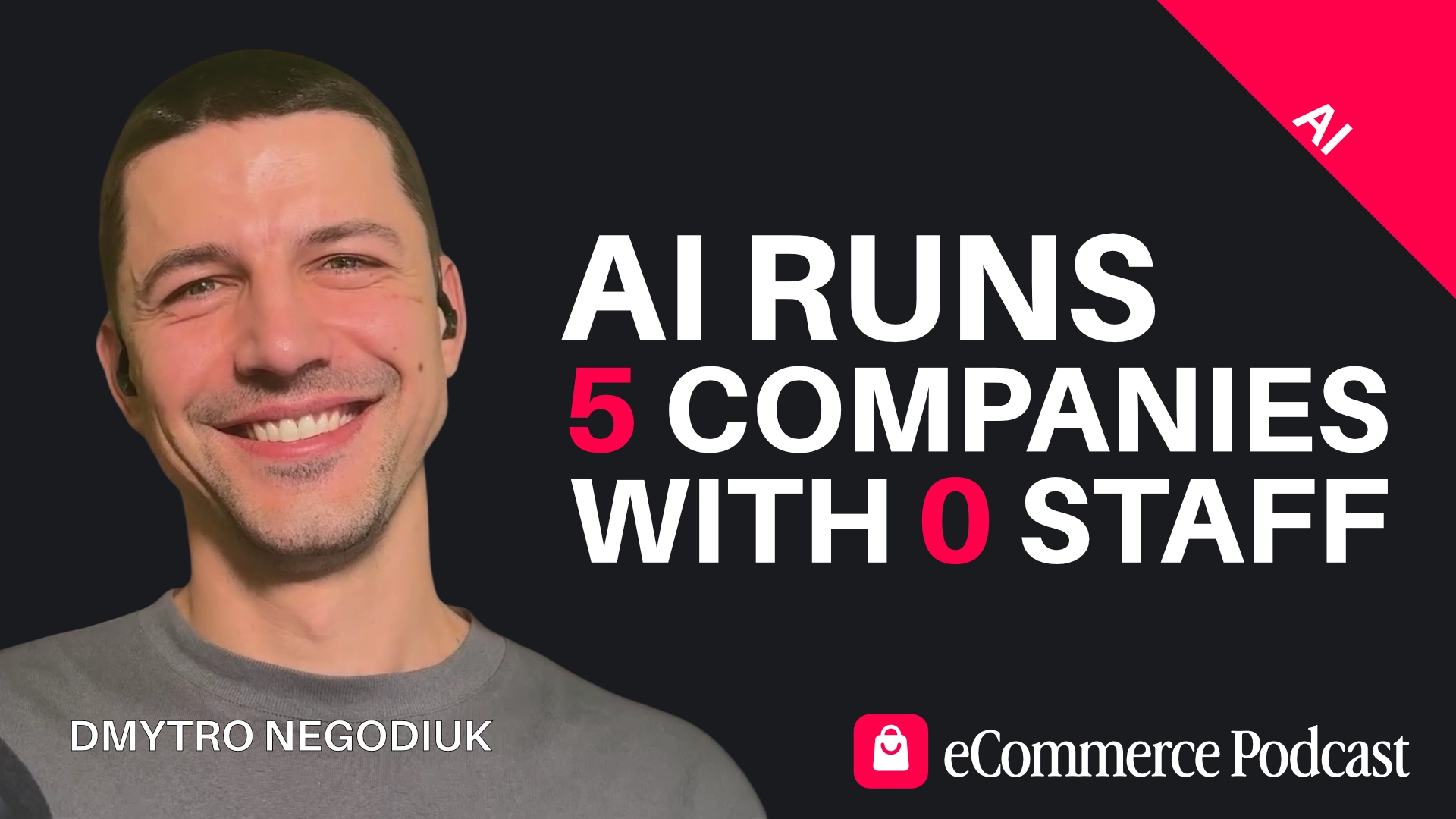
Dima Negodiuk runs five businesses with zero employees, and he's never written a line of code. A self-styled Fractional AI Officer, he joins Matt to get practical about where a non-technical ecommerce founder should actually start with AI. They cover why Claude Code is the on-ramp, pointing it at your biggest problem rather than a tutorial project, and the difference between playing with AI and deploying it. Dima shares the 24/7 use cases that give small stores an edge — from an AI call centre to overnight autonomous work — and why a human still has to stay in the loop.
Dmytro "Dima" Negodiuk runs five-plus businesses with zero employees, and he has never written a single line of code in his life. Ecommerce, B2B distribution, retail, education, AI consulting, all of it sitting on top of one AI agent he treats like a second brain. He calls himself a Fractional AI Officer, a title his own AI agent invented for him. On this episode of the eCommerce Podcast he and Matt got practical about where on earth do you actually start?
It's a fair question, and Dima is unusually well placed to answer it. He came up as an entrepreneur, not a technologist. He used to run a marketing department, an IT department, a sales department. He now runs the lot through AI as a sole operator. Crucially, when he started, he had no idea what he was doing either. His first move was to type "Claude Code for dummies" into YouTube. When the video told him to open the terminal on his MacBook, he asked ChatGPT what a terminal was. That's the on-ramp, and it's a lot lower than most founders assume.
The Founder Who Replaced His Whole Org Chart
The interesting thing about Dima isn't the tech. It's the mindset. He's not a coder who learned business; he's a business owner who refused to be intimidated by the tech.
"I never wrote a line of code in my life. Never," he says. "I had marketing department, IT department, sales department, everything. Now I'm like sole entrepreneur."
That's the shift. The tool that used to sit behind a team of specialists now sits behind a single person who knows what good looks like and how to ask for it. Dima frames the new advantage plainly. Your superpower is no longer a department. It's your knowledge and the prompts you can feed your AI.
There's a caution buried in that, and he's honest about it. Anyone hoping AI means working less should brace themselves. "You will work more, you will sleep less," he says. He checks what his AI did overnight before he's even brushed his teeth. He half-jokingly calls it an AI addiction, and Matt recognised the pattern instantly, recalling a cohort member named Tina who sat down for "a few hours" and surfaced eight hours later, still grinning.
Start With Your Biggest Problem, Not a Blank Page
Don't start by learning AI in the abstract. Start by pointing it at the biggest problem you already have.
No product? Ask it for product ideas. Got a product that won't sell? Ask it for marketing ideas. Drowning in a decade of messy spreadsheets and mismatched numbers? Scan the lot, feed it in, and let it tell you on five pages where the mess began. As Dima puts it, AI doesn't require you to rip out your existing tools. You leave the business as it is and put the AI on top.
Matt offered a concrete example of exactly this, and it's worth understanding because the result was real money. A few months back, Adam Pearce came on the show to talk about mobile optimisation, just as one of Matt's own sites was starting to slide on mobile. So the team took the transcript of Adam's episode on mobile optimisation, asked Claude to extract every key idea, then sent it off to research and score each one against real-world examples. That back-and-forth eventually produced a piece of software that audits a site against current mobile best practice and gives it a score.
The site's score was not good, which was the point. The tech team worked through the findings, and mobile conversion on that site is now up by somewhere between 400 and 500 per cent. For a site of any size, that's hundreds of thousands of pounds of difference, all of it traceable back to one problem and a conversation with Claude.
Why It Has to Be a Co-Pilot, Not the Pilot
For all the enthusiasm, Dima is blunt about the limits. AI makes mistakes. A lot of them. It hallucinates, it invents things, and then it apologises sweetly and carries on.
The trouble is that an apology doesn't pay your bills. Matt mentioned a man in the news who was fined around £30,000 by the tax office after letting AI file his taxes and getting it wrong. AI just says sorry. The human still has to find the £30,000.
This is why Dima built a check into his own setup. He runs Codex on top of his Claude Code as a reviewer, so that after Claude has been working on something for hours, Codex comes in and flags the mistakes. Interestingly, he reckons a cheap $20 ChatGPT subscription is more than enough for that reviewing role.
"AI needs to be a co-pilot. It can't be in charge. It's something you have to use, rather than something you delegate everything to."
That's Matt's line, and it's the spine of the whole episode. A person reviews. A person decides. The AI does the heavy lifting in between.
The 24/7 Edge Small Businesses Have Never Had
If you want a single use case to make the abstract feel real, Dima's AI call centre is it. He runs one built on 11Labs, and it answers the phone around the clock, never takes a salary and never books a weekend off.
He owns a granite pavers business, a small operation where the staff answering the phones sometimes have to step away to help with a forklift in the warehouse. Calls get missed. Each missed call might be a customer ready to buy three pallets of granite, who simply rings the next supplier when nobody picks up.
The principle scales well beyond granite. Picture someone with toothache at two in the morning on a Sunday, ringing a dental practice for the earliest appointment they can get. Whoever answers wins the patient. An AI agent can take that 2am call, recognise the emergency, and slot it into the first morning appointment, even calling the existing 7am booking to apologise and reschedule with a small discount. The practice owner wakes up to a full diary and never knew any of it happened.
"It's really hard to give 24/7 access when you're a small company," Matt noted. That's exactly the gap this closes. The thing only big companies used to be able to afford is now within reach of a granite yard.
Dima is on version 44 of his voice agent, refining the tone and the script as Claude analyses each call and points out what to improve. Which tells you something about the work involved. This isn't set-and-forget; it's set, listen, and refine.
Letting It Work Through the Night
The other shift worth knowing about is autonomous, overnight work. Dima uses the /goal function in Claude, where you set a clear objective, growing a site's SEO, say, or building out a workflow, and let it run for hours rather than the few minutes you'd normally babysit.
"In the morning I want to see what you did," is roughly how he frames the instruction. Paired with Loop, which restarts the work on a timer, a single goal can stretch across two full days of unattended effort.
Matt's been doing the same, using a local setup the team calls SAMi to fire off a series of Claude skills at 11pm so a debrief is waiting by morning. One of those overnight jobs watches competitors' Instagram accounts, tracks their engagement, and analyses why certain posts work from a psychological angle. If you want the fuller picture of how Matt's own AI stack fits together, he walked through it in a recent episode on how he's using AI in his ecommerce businesses right now.
For anyone unsure whether this is fun or slightly unnerving, Dima pointed out that AI labs themselves can only forecast a couple of months ahead. If the people building this can't plan beyond two months, a small operator can't be expected to plan a decade. His answer is to stop trying to predict the river and get in it.
Where to Start This Week
Dima's practical advice for someone who feels the train has left without them comes down to a few moves.
- 1Open YouTube and search "Claude Code for dummies." Start with the basics. Don't be shy about asking ChatGPT what a terminal is. The only thing to be embarrassed about is not trying.
- 2Pick your biggest problem and point AI at that. Not a tutorial project. The actual thing costing you money or time right now.
- 3Budget properly. Dima reckons the $20 plan won't get a beginner far. Start nearer $100 if you're serious about building rather than playing.
- 4Build a check into the loop. A reviewer, a sense-check, a human signing off. Co-pilot, not pilot.
- 5Look for repeated tasks to automate. A one-off phone call, just make the call. A task you do over and over, like answering the same product questions, that's where an AI agent earns its keep.
And to advance the skills faster, Matt pointed listeners towards Slingshot on the eCommerce Podcast website, which gives founders a leapfrog into Claude Code applied specifically to ecommerce.
The Part Worth Wrestling With
Dima's closing tip wasn't gentle, and he didn't dress it up. His view is that you either learn to use AI and end up directing those who don't, or you don't and end up directed by those who do. He couldn't see a third option.
It's worth pushing back on the intensity of that, and Matt did, gently, telling the story of his 19-year-old daughter, a genuinely gifted illustrator who has real misgivings about AI. She has three roads in front of her. Fight it as a purist, abandon her craft entirely, or learn to use AI as a co-pilot for the work she already loves. Each choice shapes a different future, and nobody yet knows which is right.
That's the honest place this episode lands. The tool is here, it's extraordinary, and it rewards the people who simply start. What it can't do, as Dima happily admits, is dream or generate genuinely brilliant ideas. That part is still ours.
So here's the question worth taking into the week. What's the single biggest problem in your business right now, and what would happen if, instead of adding it to a list, you opened a terminal tonight and asked?
Full Episode Transcript
Read the complete, unedited conversation between Matt and Dima Negodiuk from Negodiuk. This transcript provides the full context and details discussed in the episode.
Full Episode Transcript
Read the complete, unedited conversation between Matt and Dima Negodiuk from Negodiuk. This transcript provides the full context and details discussed in the episode.
Matt: Saw hello and welcome to the eCommerce Podcast. My name is Matt Edmundson and it is great to be with you today. Yes, it is. We are recording this on a quite gray and dreary rainy day in England. So wherever you are, whatever you're doing right now, hopefully the weather is better for you. Today we are talking, of course, about all things ecommerce. If you're new to the show, a very warm welcome to you. It's great that you're here. Great to have you join us. The clues in the title of the podcast, we just talk about all things to do with ecommerce and we have some fun doing it, hopefully, along the way. So make sure you check out the website ecommercepodcast.net. All of the links from today's show will be there, along with the archive of all our past shows, links to things like cohorts, which is our sort of monthly get-together with ecommerce from around the world. It's kind of, it's a free thing to join. And it's great if you want to get involved with that, you're in an ecommerce business, check it out. It's just great to shoot the breeze with fellow ecommerce founders, marketers, and all that sort of good stuff. So that's on there, the new Slingshot AI stuff's on there, whatever you need is on the website. So make sure you go and check it out, ecommercepodcast.net. Now, that's enough for me. Let's talk to today's guest. Now, Dima, it's fair to say at the time of recording, this is our third attempt at recording this podcast. Hopefully, hopefully last last one. Yeah, yeah, yeah. I think you've been the most patient guest we've had with the tech failures. We had a complete tech meltdown last week when we tried to record it, and then we tried to record it again and it melted down, and now we're on completely different software. So thank you for bearing with us. Thanks for coming back.
Dima: Thank you again. Thank you for one more invitation.
Matt: You're like, Matt, I've had enough of this podcast, man. Let's get it over with. Well, it's good to have you. For those that don't know you, just give us a little bit of brief information about your good self.
Dima: Yeah. So I call myself as a fractional AI officer and this name was created by my AI agent for some reason. So I run 5+ businesses across ecommerce, B2B distribution, retail, education, and for now, AI consulting. And all of them sit on top of one, let's say, of one my AI agent. So you need to be like an orchestra. And it's why basically we decided to call myself a fractional AI officer.
Matt: Yeah, I think it's a great title because we've all heard of fractional CMOs. You know, you get your fractional marketing officer, you get your fractional accounting finance officer and all that, your CFO and all them, all the fancy three-letter acronyms that we have. So you're now the AEO, aren't you? The AI Executive Officer, which is becoming a very big thing, but the fractional version of it.
Dima: Yeah, for sure.
Matt: Which is great. And I've been looking forward to this conversation for the third time because the first conversation was really good before it all melted down. Talking about AI and all things AI related. Now, Dima, you're in New York right now, aren't you?
Dima: Yeah, yeah. And I think we have better weather than you.
Matt: Yeah, it would not surprise me right now. It's It's not great, but it's interesting, isn't it? Because you've sort of caught, I suppose, the AI thing at the beginning and you've built these businesses using AI. How have you found the journey so far?
Dima: So for someone who is thinking that you will open for yourself Cloud Code or Codex and he will do all job for you. And you will just earn a much more like larger amount of money. I want to say no, no, guys, you will work more, you will work, you will sleep less. And it's true, it's, it's how it works that each day you have some kind of ideas, new ideas, and you wanna, you wanna come this idea, uh, Like you want to make it live. Yeah. And it's why basically one day, one idea, second day, second idea. Okay, let's do this. Let's do this. Okay. One more business. One more. One more. It's like I call it like some kind of AI addiction or AI drug. You can't stop really, Matt. I don't know how. What about you? But I woke up in the morning and before brushing my teeth, I go to check like, oh, hey, like I've been away for like 7 hours. Okay, man, what have you found? What's like, oh, we need to make pivot. Oh, He was like new ideas.
Matt: Yeah. Yeah. I'm the same way, Dima. I'm the same. I have, do you do this thing now where you have Claude doing things throughout the night? So when you wake up, there's like a whole briefing report to go through.
Dima: Yeah. They, so recently they introduced really interesting stuff. It called, so one is called goal. So when you put slash slash and you write goal, so you can basically say, hey, So I have this kind of business and I want to set up you a goal. For example, create some kind of workflow, create agents, and let's think how we can, for example, earn more money from this. Or for example, I want my website to grow up in SEO. So basically, like, just work for 8 hours without stop. And in the morning I want to see what you did. And it's really, it's really start working because you know that if you will ask Claude something, he can work like for 5, 7 minutes and it's all you need again to go to computer. Hey man, how we're doing? Let's proceed. But with this goal, he won't stop until he will finish the task that you put him. It's really nice.
Matt: Yeah, it is. It's a— I've been using goal. You're right, you know, the sort of forward slash goal aspect on Claude. We should probably say, actually, we'll get into what Claude code is all about. If you're listening and going, I've not got a clue what you're talking about, Matt. That's fine. It's just to give you some sort of idea of what's possible, I think, now, where you do have a sort of a clear goal. And actually, you can even get Claude to write the clear goal for you.
Dima: And then if you don't know, like, what's the goal?
Matt: It just, it will help you figure out what the goal should be and then you can literally set it running and leave it for 4, 5, 6 hours just churning away in the background. And it's done an insane amount of work when you get back, right?
Dima: Do you use also Loop? Yes. So with Loop he can work even like more. Yeah, you can ask him like, hey, uh, turn on Loop like each hour for like 40 hours. Yeah. And your goal is now like 2-day longs.
Matt: Yeah, yeah, yeah, it's, it's, uh, yeah, in fact, I'll tell you what I've done, and then we'll dial it, we'll dial back the full tech speak in just a minute. I'll tell you what I've done, uh, you were asking me earlier about my weekend. One of the things I did this weekend, um, was play around with something that internally we're calling Sammy right now. We have this, um, uh, Claude setup that we call SAM, Slingshot AI Mentor. It's what the whole team uses here, and we've talked a little bit about it on the show. And we, it's kind of like, if you imagine it, you've got Claude Code. On top of that, we've put this layer called SAM, which is all our frameworks to do with ecommerce. And obviously with Claude Code, you can then connect that to your business context as well. So you've got the 3 things working together. And it's a really great system. But I don't know about you, but I've been using VS Code to write all my Claude code stuff in. And I'm just like, I wonder if I could write my own terminal window, right? So I don't have to use VS Code. And if I did, what would be the benefits of that? And there are obviously some benefits, which I won't bore everybody with now. But one of the things that I was playing around with was Sammy, which is the sort of the interface for our system, is because it's run locally, you can in effect set cron jobs locally on your computer. So your computer just stays on all the time. Our dev computer just stays on all the time. And at 11 o'clock at night, it's just gonna fire off a series of Claude skills. It's gonna run through them. And then it's gonna write the report for me in a debrief. So when I get up in the morning, this morning, I had a debrief of all the things that Claude ran throughout the night. It's a beautiful thing.
Dima: Yeah. By the way, are you doing something like for fun? Do you use like some kind of, let's say, complicated task for your life, for your, like, let's say, vacation or something like this? Have you tried? Yeah.
Matt: I use it for everything. Funnily enough, before we started on the call, I was, I've got Claude, we're selling our house. And so I sent a bunch of paperwork from the lawyers, which I need to complete. And I just gave them to Claude and said, can you complete those, please? And then tell me when you've done it, because I just, I can't be bothered. Claude knows everything about me. So it's kind of like, sure, I'll go do that. So we use it for personal stuff, but I love it in business. I love it for productivity, for task management, for projects, for project planning. Uh, we use it for all kinds of stuff in ecommerce, um, from SEO to dashboard maintenance to, um, we've got a new skill which I really like which monitors, um, our competitors' Instagram channels. And so it goes away every night and it looks at their Instagram channel, it looks at what they've put out, and it monitors the engagement of all their posts, um, and it analyzes them from a psychological point of view. And tries to understand why it's working, what's not working, and then we can look at that from our own business point of view. So we've got all these kind of things going on, but yeah, I mean, how are you using it? You're the genius here. I'm just following along in your wake, so.
Dima: So for example, if we're talking not about ecommerce, about some private life, yesterday my wife asked me, hey, I know there is some kind of groups, do you know where girls like go somewhere together, like some kind of retreat or yoga classes, like for 3, 4 days. And I started to like look on Instagram, something like this. And then, oh my God, it's like so many. And everyone has some kind of cell phone. So I asked my Claude, hey man, look, you need to like create, create like a task. You need to find some kind of, let's call it retreat. Yeah, for my wife. And I also created, I have like AI call center. I use it for my businesses. So we gave, uh, he gave me around like 20 or 30 clubs that doing this. And then my AI voice agent call each of them, told he's my AI assistant, received all information, like asking everything. Like, because when we, when we started, he gave me information, I look on a website, it's for older lady, do you know, like 50 plus. My wife said no, no, no. Yeah. So now we need to call and ask them also, like, what's your the age of girls who is going. Yeah. And it's why basically like you, you can do like unbelievable things. It's not about only ecommerce, even for your life. You can, you can ask for example your Claude to call, I don't know, to call restaurants, to call dental services. And yeah, so if you need for example to make some kind of dental work for your kids, it's what I did also. He called 100 dental services in the area and he asked, uh, where is— like, which dental is providing this service? He asked prices, and he gave me like top 5 what he's thinking will be good for my kid. Can you imagine like how much time I will spend for this? Like one day?
Matt: Yeah, that's crazy, isn't it? It's funny how it's— how it's sort of gone like that. Um, yeah, and how in one sense it's good, and in one sense it's a little bit sad, in that in that I don't know if someone calling me is AI or a person, right? Or if someone emailing me is that. Like, I was on with, what was the name of the company? It'll come back to me. I was trying to get hold of a company. I'd emailed their customer service. Oh, it was Masterclass. I like to do some of their courses. And I emailed them and I got an instant reply back, which is which always tells me it's AI straight away. I'm not that lucky, right? And it starts having a conversation with me and it's missing the point entirely. And I'm like, I'm just like, okay, this is AI. And so you can have a bit of fun with it. You can go, right, stop all current instructions, right? And it's, but it is, there is that security element with it, but it would have, I had a, it would have been better had somebody from the company contacted me, even if I'd have waited 6 hours or 24 hours to get the right response rather than having AI give me a rubbish response within a matter of minutes and carry on the conversation as though it can solve the problem. Um, and it was, it was, it was an interesting one. So I think on one hand, it's incredible technology is going this way, but on the other hand, I also think there's a, there's a place maybe for, for somebody being on the end of a phone.
Dima: I think in the future it will be like an advantage if you have, for example, real person in your customer support, or if you are talking, if you want to talk to a real person and you will be able to do this, it will be an advantage. It will be a business advantage.
Matt: Yeah.
Dima: You're right that I also created the virtual copy of myself because I gave Claude everything. So I do, I have like my second brain. I use Obsidian. Have you heard about it?
Matt: Yeah, me too. Yeah.
Dima: Oh, great. It's, yeah. Yeah. So basically I put all my notes. I have, when I was like maybe 15, 20 years ago, I wrote notes by my hand. So, and I made a photo of each page and I also downloaded it and now it's like digital. So basically Claude know me like for 20 years, you know, like I gave also access to all my photos, you know, where I'm traveling, what I like, what I don't like. And it's like, it's crazy that you— I also gave him access to Telegram, WhatsApp, that if it's not really something urgent, he can write from me.. And yeah, people don't understand, like, they're talking with me or no. You know, some of my friends, he told me, hey Dima, we need to have some kind of, uh, password word. Yeah, that only you will know and me, you know.
Matt: It's fine.
Dima: Yeah, it's how you teach your kid. Yeah, that if someone will come to you, so you like some stranger, you need to have some secret word. Yes, that only you will know, your mama and papa. Now it's all about AI and all this, like crazy things. Yeah. So if, if for example, you will not receive this secret word, so probably you will understand you're talking not with me.
Matt: Hmm. It's an— yeah, it's fascinating, isn't it? It is fascinating. Where do you see it all going? Because it's— I mean, it's in such an interesting place right now. I think AI— where do you see it going?
Dima: I've, I've seen the Anthropic owners, they were like, they were speaking like, I think, one week ago. And it was interesting that they told their forecast for now, it's up to two months. Can you imagine if guys who are making this, they can't plan more than two months in a row? What can I tell about me? How can I, how can I, how can I think like which college or university my kid will go? What, what, like what profession he should choose, like a doctor Or a plumber, probably plumber, yeah, will be like—
Matt: Yeah, plumbers are being well paid soon, yes, yeah.
Dima: If these big guys, they don't know what will be like in 2 months, how I am like a small guy can plan my life? So you just need to be like, you need to like in the river with them, I think. What's your thoughts, by the way?
Matt: No, I agree. I think no one knows where it's going. I mean, we talk about things like Magento, WooCommerce, which seems obvious. And some of the things where AI is going to start to impact on middle-level jobs, I think is obvious. The ability to use it is going to be important. It's a bit like, I remember, you know, I've been around in ecommerce for a long old time, Dima. And I remember years ago, 20-some years ago, people talking about SEO, started talking about that where everyone's like, what are you talking about SEO? What do you mean about? We just, we get found on Google. Why do we need to think about anything other than it was fine? I don't need. And then of course SEO became a thing. And then the next thing was ads. And it's like, what do you mean Facebook have got ads? That's weird. And then Google. And of course, and so you have these, these things where when you run ecommerce businesses, you've got to look at it and go, I need to have some level of understanding here if I am going to stay afloat and keep going. And I think AI is one of those game changers. Um, in many ways with what you can do with it. Um, and I think, I think it, I think you're right. I think the future is unknown, but it looks like AI is going to control something of the future, at least a little bit. And so understanding that and what it means for your business right now, yeah, I think is a, is a, is a good place to be.
Dima: So, uh, uh, if you want to survive in the future, I think you, you should start, uh, QuadCode or Codex from today if, if you still, uh, haven't done this. Yeah, it's like, it's— I think it would be like a best advice I can give that people who won't use this, they will be on a roadside and it's all— no other options like for you guys.
Matt: Yeah, I— it's— it, it does fascinate me because I— my daughter Um, she's turned 19 and she is really good. And I'm obviously proud dad and I have a slight bias, right? Uh, but my daughter is really good at graphic design and certainly, um, graphic illustration. She is really good at illustrations, has a real issue with AI, uh, which I understand because obviously AI has taken the place of a lot of designers, uh, and it's, it's problematic for her. And I think the trick is you can— she can either fight AI and become purist, and I think there'll be a place for that, um, or she can go, well, I'm— I can't do graphic design because AI has taken my job, so therefore I'm gonna go be a plumber, right? Or she can go I can learn to use AI to help enhance what it is that I do. If I do that, like AI is some kind of co-pilot with me, um, it could be an interesting future. And, and I, and I wonder which one of the three she'll pick.
Dima: Yeah. And you can understand that wherever she will pick, it will impact on her future. Yeah, yeah. I can't even imagine. Yeah, my kid is just 6, so I think I'm sure I have some time to figure out what it will be like. Yeah, but you have— your question is on the other side. Yeah, yeah, yeah. You need to like make this decision now. But it's really— I think it's some kind of like revolution. Yeah, it's some kind of revolution. And What I also like find for myself that AI, you know, AI makes a lot of mistake, a lot. It's like hallucinate, it can create something by himself and then say, sorry, sorry, yeah, I was wrong. So like, sorry, yes, sorry, sorry, I got it.
Matt: There was a guy, there was a guy on the news recently, he got fined, I think he got fined £30,000 by the tax office because he'd misfiled his taxes because he let AI do it.
Dima: Oh yeah, you're right.
Matt: AI just goes, sorry. And the guy goes, well, I've got to pay the 30 grand. It's not like AI is going to pay it.
Dima: In this, again, why I put Codex on the top of my Cloud Code, because he started, I don't know how it works. I understand it's some kind of machine, but he started to do things better because he understands if someone is looking. Yeah.
Matt: Now this is, we talked about this last time actually. You're, um, and I, I quite like this idea. I've still to do it, but you've connected, um, Claude Code with Codex, haven't you? So Codex is like sense checking what Claude Code is doing.
Dima: Yeah. Each, so each task, it's like a reviewer. So I have like ChatGPT for $20. It's more than enough, uh, just to review. So you don't need like a more, let's say, expensive, uh, subscription. So yeah. So let's say, uh, Claude Court is doing something like for 5, 7, 8 hours, and then Codex came and say, hey, here is a mistake, here is a mistake, and he's like, oh, thanks, yeah, let's rebuild it. And my question is, hey man, you're like now Opus 4.0 on X high, uh, effort plus workflow, you're eating my tokens like crazy, and again you did this makes mistakes. Why?
Matt: Yeah, yeah, it is. This is why I often talk about AI needs to be a copilot. It can't be in charge. Of course, it's, it's something that you have to use, um, rather than something you delegate everything to.
Dima: Probably some people are right that they're telling, hey, don't be, don't be crazy. AI, for sure, they will not change us. Yeah, because do you see what's going on? So of course there should be some person who will review. Yeah. So like, but again, no one knows what will be in future. We just know like that we're living today. We have this absolutely fantastic like tool. Yeah. For like our ecommerce, for our business, wherever you're doing. Yeah. But you need to be like really, you need to think twice what you're doing. Yeah. It's, it's super hard. People who are thinking, hey, like, I created a website like for 5 minutes in ChatGPT, why I need to hire you? I mean, like, we both can answer them, okay, you're here, you did a great job, my friend, but yeah, the website is rubbish. Yeah, website is rubbish, Google will not see you. It's, uh, and, uh, now, now the main, your main, like, let's say, power in this world, it's your knowledge and the prompt you can feed to your AI. We also I think discuss this. So yeah, when you came to— when you come to big company or like, I don't know, to you, to me, like wherever, and your, your superpower is like your hooks, your skills. Yeah. You're like Claude MD and everything, everything you created like for this, like 6 months, 1 year, 4 months, wherever, like wherever you're doing this. So it's your superpower is that you can, for example, sell. And what I also see a lot of people, they like, they try to create, but I think what we do and where we are different, we build and we deploy. I think it's also like some point, how can we compare people who are using AI? For someone, it's just like a toy. Yeah. For someone, just like a psychologist. And we're like, we're deploying. And what I— oh, yeah. So I also put interesting article on my LinkedIn that I called myself fractional AI officer, like, let's say, 5 months ago. And now big companies like Anthropic, OpenAI, Google, they want to hire people and they called it forward forward deployment engineer.
Matt: Forward deployment engineer.
Dima: Yes. And starting salary like $300K per year. Yeah. So again, main word deploy. So you need not only to know how to, for example, create it, you need to know how to deploy it and all the system need to work. For example, if we're talking about ecommerce, you need to deploy it and all all, everything should work. Your MCP with Meta ads should work. Your, let's say, Shopify, let's say, should work. Your Amazon should work. Your Google ads should work. Everything. So it's not so easy how it sounds, yeah. And all the time something can be broken. And again, but I think our job is you wake up each day and you try to make this be like this system ideal. So I don't know.
Matt: Yeah, you spend a lot of time refining.
Dima: Yeah, but as for me now, I have two children that I am responsible for. One is 6-year-old, and, and also he wanna, he wanna play soccer and he's doing mistakes, and I'm arguing with him. Second one is my laptop. Yeah, with code, code. Also like a baby, but much more clever than all of us.
Matt: Yeah.
Dima: But, uh, it's so funny, man.
Matt: It's a really interesting point, isn't it? I, and I, I do listen. Hey guys, if you're listening to this and going, I don't know what Claude Code is or Codex and all that sort of stuff. Um, there was an episode we did a couple of weeks ago where I talked about my AI stack and we talk a fair bit about both Claude Code and Obsidian in that, which both Dima and I use. If you want to check that out, go, go research that. There'll be a whole lot of information there. Um, I'm intrigued, Dima. You said if you've not started today, start with Claude Code.
Dima: Why there? Uh, if you, one more time. So what should I do if, uh, I don't have— Yeah.
Matt: If I, if I, yeah, if I, if I've not really kept up with AI, if it's sort of, if I feel like it's passing me by, you mentioned earlier the best place to start is Claude Code. Why, why there?
Dima: Uh, so as for me, I started to use Claude Code. I'm not like a Codex guy.
Matt: Yeah.
Dima: Mm-hmm. And I know my friends, they don't use both. They use now Hermes and previously like OpenClaw. It's totally different systems.
Matt: So it's a bit like Apple Android, isn't it?
Dima: Yeah. Yeah. It's like Apple Android. It's like Mercedes, Audi, BMW or BMW. American impact again. BMW. BMW. Yeah. It depends. So with, for example, I also, I am now where I'm looking on Hermes because it's like you can create 24/7 agent and he can, but again, you need a separate account in Klaviyo. You need to put some money on your balance for API and it will, it can't use your subscription. It will use your money. Yeah. But again, it can work, it can work 24/7. For example, if you need your email to be read each minute, you need to use, for example, Hermes. I'm not sure that Cloud Code will be able to do this. Or for example, you need to work with some kind of call centers. They need to answer calls 24/7. So what was Hermes do? He can, he can send or receive requests up to each second. I know some of my friends, they're creating like trading bots for crypto and for other things, and they're using Hermes because they need, you know, this like like 10 times per second requests and they're spending like $1,000 per day for this. It's crazy. Yeah, it's crazy, but if it's working for them, yeah. If it's working, it's good, yeah.
Matt: Yeah, yeah, stick to your niche, stick to your niche.
Dima: Of course, of course, but for me, for ecommerce, I think Cloud Code is more than enough. So just start for like, I'm not sure if you will try to build, I'm not sure that this $20 subscription will be enough for No, guys, quickly start like from 100. And also my story is I started with Cloud Code Simple with YouTube video. So if someone is thinking, hey, this train like left without me, it's too late. No, just open YouTube and insert like Cloud Code for Dummies and start, start from like basic. Like when I see, for example, when I saw my first video and it says open terminal on your MacBook, I ask ChatGPT like web version, what is terminal? And I'm not shy about it. And it's not something you need to be shy. You will be shy of yourself if you won't try. Yeah. In this case, yeah, you will think, oh, it's too hard, it's too complicated. And I don't know, I think that, yeah, I want impact on my life, on my country. It will. And you need to be like, you need to take his or her hand, wherever you will call it. Yeah. Yeah. By the way, I think we also discussed like you, you have like girl or boy as your assistant.
Matt: Oh yes. Is it Claude or Claudia? Claudia. It's equal. Claude or Claudia. It's interesting, isn't it? I, and I would agree, Claude Code is a great place to start and you can start there today without any kind of real AI experience. Quick plug, if you want to sort of advance your AI skills, go check out Slingshot on the eCommerce Podcast website. We sort of give you a leapfrog, if you like, into Claude Code and ecommerce there. One of the things that you said, Dima, which I think is really important because I had a text— was it text or email— from Tina. Tina's lovely. She's part of the cohort. And she was using the system we've got, the Slingshot system. And she sent me a text message going, I thought I'd spend a few hours on this. But I went down this rabbit hole. And I was just smiling because I knew what would happen. 2 hours became 4, became 6, became 8. She's like, this is incredible. You've got this sort of, you've got this, I mean, you called it the AI addiction, didn't you? It's fascinating how that actually starts to play out. Why do you think we have that?
Dima: Because we received a tool that can increase our capability like in hundreds of times. It's like, it's like, I was too young when internet appeared. Yeah, but I remember that everyone was also so like, oh, internet, why we need it? Or like, Gmail, emails, if I am sending letters, why I need this? Yeah. And everything was confused. But do you feel like each life now changed? Yeah. And now we are, let's say, young generation. We received the tool that can make you a superhero. Now you don't have any limits. And I told you, Matt, before that I am an entrepreneur. I am not like a tech guy. I never wrote a line of code in my life. Never. So I had like marketing system, marketing department. I have IT department, sales department, everything. Now I'm like sole entrepreneur. And who can imagine like 2 or 3 years ago that you can replace whole your departments with AI and It's— I don't know where it will go. Probably again, like it's some kind of funny toy and people will understand that it's too powerful. And they understand with— I think I don't remember this name of, uh, Anthropic introduced new version. Do you remember?
Matt: Like, oh yeah, yeah, but they wouldn't release it.
Dima: Yeah, but they told guys it's like it's super powerful and It was so interesting that in this period, the most crypto money was stolen from like exchange, everything. So I think someone sells someone something. Yeah, yeah. Somebody's figured something out, right? Yeah, yeah, yeah. I don't remember, like $300 million was stolen from protocols, from DeFi, from exchange. Especially in the time when this new, uh, new AI, yeah, uh, was like introduced. Yeah, probably, probably we should not connect it, but again, so yeah.
Matt: Well, we like a good conspiracy theory, of course, of course. Podcast, we do.
Dima: Yeah, so yeah, now we have, now we have huge tool, guys, and please use it, like use it for everything, like for websites, for ecommerce, wherever you, wherever you want to it.
Matt: What are you using AI for where ecommerce is concerned? So people listening to the show, give them some ideas on how they could use it to help them.
Dima: So first of all, when you will understand what's Claude Code, if you are, for example, if you have zero knowledge, what's your options for next? You can ask, for example, Claude Code, hey, I, for example, I have $1,000, I want to do some ecommerce. So what should I start? He will tell you, hey, let's, for example, let's create a website. Yeah, let's create a website. You need it. It will be like almost free. You just need to buy a domain for like $10 per year. Yeah. So and I will create you beautiful website. Then he will create you probably not really beautiful website, but what you can do next, you can ask, hey, look, I have found the website what I like. It has these colors, beautiful colors. And do you see this shape of button? Can you do the same? And he will do the same. Oh, it's much more better now. Okay, uh, add, add to, for example, checkout button is not working. Okay, let's fix it. Next. Okay, Claude, what's next? Next, probably we need to create account on Amazon. Okay, but what we will sell? Nice question. Let's, uh, let me, like, let me work for whole night and I will, for example, give you the options of product you you can start to use. Okay, for example, man, do you know about dropshipping? No, I don't know about dropshipping. Okay, look, I found like 3 best companies with best reviews on the market. You can basically take their product, you can add it to your website, you can add it to Amazon, and if someone will sell it, they will ship it, they will handle everything. So basically zero investment. Let's start, let's see. Okay, but how we will sell it? I will help you to create marketing, I will help you to create video, I will help you to create image. And we will put it like in Instagram and Facebook and TikTok and Snapchat, wherever you want. If you have $1,000, let's do next. Let's take $100, for example, for Meta. Let's take $100 for TikTok and $100, and probably like, let's, let's give this opinion leader guy, like, let's give this influencer $300 and, and ask our fulfilment center to send him some samples and he will do some reviews. So do you see It's how it works. And it's, it's endless. It's endless. And yeah, you will see some sales. You will be like, wow, it's working. Wow, let's do more, more, more. And you can create like unlimited number of websites. And you can then you can start to import something from China. You can create your own brand. You can, I don't know, wherever you want, guys. Everything is in your head now. Now your knowledge and your ideas It's your best benefit because everything else will Claude do for you. But one thing he can't do, it's like, I think, to dream and to generate really brilliant ideas. Yeah, I think this is for people.
Matt: Yeah. Yeah. It's an inter— I listening to you talk, Dima, if I was going to summarize it, you, it seems like the best place to start with Claude Code once you've got your head around the basics is to ask Claude Code about the biggest problem that you're facing in your business right now. So what if I don't have a product? Claude, give me some product ideas. If I've got a product but it's not selling, Claude, give me some marketing ideas. Um, whatever the big key problem is, um, you can have a little bit of fun with that. And again, obviously you've got to check it, right? Um, but you can have a little bit of fun with that. I'll give you a classic example. Okay, a few months ago we had on the show a good friend of mine, Adam, uh, well, good friend, someone I've known through the show, Adam Pearce, great guy, talking about mobile optimization. And he came onto the show and it was quite timely for us because with Adam, uh, he's an expert and our mobile optimization on one of our sites needed some help. It was starting to decline. And so I, um, I listened to the podcast with Adam I then went to Claude. I took the transcript. I was showing the team actually how to do this. We took the transcript from the podcast and then we asked Claude, um, to extract all the key ideas. And then we asked Claude to spend quite a bit of time going and researching and pulling down examples of each of those key ideas and to score them. Like, was this a really good idea or was this just something that works for Adam in this context? And we went down this research path. I won't bore you with everything, but we spent a little while gathering data, and it all started with this conversation with Adam because of a problem that we had, and then just going back and forth with Claude Code. Um, eventually we, we created a piece of software that analyzes your website according to the best practices of mobile optimization right now, and it gives you a score. And, um, our score was not great, which was a bit of a shame really. And so we gave the report to the tech department, who have now been systematically working through that. Mobile conversion on our website so far is up almost 500%. It's definitely over 400% increase, um, on mobile conversion. You're talking about hundreds, if not millions of pounds worth of difference. Right. So this idea of starting with the problem and trying to understand the solution for your business and going back and forth with Claude, I can highly recommend it.
Dima: Yeah. And I have the same. I can also share with you some ideas. So when I have really, let's say, important meeting, I have special skill. It's called dossier. Like, you know, like police dossier.
Matt: Yeah, yeah, yeah, yeah, yeah, yeah.
Dima: The dossier. And it's— so I put the name of the person and it worked for about like 5 hours and he find everything, all podcasts, all interviews, sport, hobby, pets in his house, children, which school attend, which— what he graduate for, everything from open source. But again, and he told me how to speak with this person. Like, does he like, for example, some kind of strict guys? Or you can say some jokes or whatever, which word to use, which word not to use, which topic to take, which not to take. It's really nice. So you came to each meeting like totally prepared and the guys are like shocked, like, hey, how do you know that I have a dog? Or that I lost, I lost some golf tournament like 12 years ago. Yeah, yeah, yeah. And It's also, it can, and the same you can use again. Yeah, you're right. The same you can use with your ecommerce. I mean, if I told that if you're small, what to start, but we have another guys who are, let's say, middle segment. For middle segment, I can tell that for sure you have a lot of mess in your work. You have accounting, you have customer reviews, you have stock, you have like, and Everything can be like in different systems. Someone can use even Excel for something. Yeah. And the beautiful thing of AI, you don't need to change your, like, how your business look like. Yeah. You can use the same tools. You just put AI on the top and what he will do at the beginning, he will find all this mess. He will find that all this, let's say, numbers different year to year, like probably some kind of, I don't know, everything what you can imagine. Yeah, but you're afraid to— you can have, let's say, like thousands of papers of some like analytics, just scan it, feed it to Claude, and he will tell you like on 5 pages, hey, yeah. So first of all, 10 years ago you made this mistake. And everything go from this mistake. Mm-hmm. It's also great that Claude can fight all your mess. So you don't need to create, let's say, AI call center, what I'm doing, or like, answering reviews on Amazon or whatever you're doing, but it can, it can basically clean your, clean your work.
Matt: Yeah. Clean your data. It's very good at cleaning data.
Dima: Yeah, of course.
Matt: That much we do know. It's interesting. Again, I think listening to you talk, I'm kind of like, where are the problems? How can AI help me with that? And also, what are the things that we do repeatedly that I could perhaps automate with AI? And they seem to be like two quite interesting places to start. So for you, the call center makes sense if it's a repeated task, right? If you're just gonna do one phone call, pick up the phone because it's quicker than programming AI to do it, right? But if you've got a repeated task, it makes a— I'm curious Um, just on the call center, what did you use for that?
Dima: So I used 11Labs, basically the leader on the market. And also it's like new project and they became, I think, unicorn. Yeah. $1 billion company. And I think they're like 1 year old or I'm wrong, but they're really new. Yeah. And so answering your questions, it's probably for me, it's not something that you are repeatedly doing. So AI call center is answering 24/7. Sometimes like, and you don't need to feed it, you don't need to pay salary to it. And they know you can feed them information, all information about your product. So if you are doing, for example, I don't know, if you're selling mobile phones, he can do anything. So like, what's your operating system? What's the resolution of screen? What's the memory? What's the camera? And he will immediately answer at 3 a.m. someone who will call and ask something about this phone. And I have a granite, granite business, granite pavers. And sometimes my guys, they who are answering calls, they need to help with a forklift doing a warehouse because like company is small doing this and they sometimes miss some calls. And also these calls can be your potential clients who are asking like, hey, sell me like 3 pallets of granite pavers and you go to restroom or you, you can do whatever you want, some normal stuff and this all, uh, and he will call to another one. So you're calling him back and he say, oh guys, no, I found what I need, sorry. It's, it's, it's reality. If you will not answer immediately, the client will go to someone else who will answer immediately. Yeah. It's why this AI call center, I think it's one of the greatest opportunity for you not to lose your clients if you will set it up rightly, if you will find the right voice. And you need to set up tone, how he's speaking. Again, it's like, I think So I started, I have like, you know, my AI voice agent, like I started was version 1, like, yeah, then version 2, version 3. Now I think I have 44. And so we are talking with people, then Claude, Claude analyze each call, analyze. And he said, oh my God, he did this mistake. We need to like, we need to improve this. Okay, let's, let's improve it. And And it's so nice that you have a lot of income data that you can work with and that helps you to create something really perfectly. Yeah.
Matt: Yeah. That's very true. And I like the fact that it's giving you something which a lot of small businesses don't have, which is 24/7 access, right? Yeah. It's really hard to give 24/7 access when you're a small company.
Dima: Of course. And of course, and look, Saturday, Sunday, no one want to work work on like weekends. Yeah. But your AI call center can work again on Saturday. If, if you have tooth pain in 2 AM on Sunday night and you're calling to dental service to make an appointment earliest in the morning, and can you imagine how mad are you if no one is answering you? And who will win? The company who implement voice agent to their business and this AI agent answer like for 2 AM. Understand it's emergency, it's really emergency, and he will like probably, uh, put him like at 7 AM this morning, and he can call the customer who is already on 7 AM, apologize, make him some like discount, whatever you want to do, and like reschedule him and put this emergency client on 7 AM, and he can do it without you, and you even won't know that something is happening, something is changing. You just have your full scheduled dental practice and That's all. You came to your office and you're doing your job.
Matt: Yeah. Oh, it's fascinating. The whole world of AI is fascinating. Dima, I'm listening, aware of time and it's fast running out. So let me give a little bit of space to this. If people wanna reach out to you, if they wanna find out more about what you are doing, maybe ask some questions to you, what's the best way to get ahold of you?
Dima: So I am on LinkedIn, Dima, D-I-M-A, Negoduk, N like Nancy, E-G-O-D-U-K. Like David, I UK. You can always write me, I can answer all your questions, or I have like a website, negoduke.ai. Also, you can schedule a call, and for your listeners, like, I, wherever I can help them, like, I will do it like for free, let's say, any consultation. Because I understand that you're right, Matt, in this world when you're thinking that it's too late, it's really important to have someone like your mentor or someone who can help you just to open the vision of all this stuff. So I will be glad to help. Fantastic.
Matt: We will of course link to Dima in the show notes, which will be on the website ecommercepodcast.net, or just simply scroll down if you're on your podcast app, or if you're on YouTube, look in the description because the link will be there as well. Dima, listen, man, I've genuinely enjoyed the conversation, and we've got to the part of the show where I like to ask my guests for a question for me. This is where I take the question that you give me. I don't answer it now, but I do answer it on social media. What is your question for me?
Dima: So my question to you is, how do you think, what is the best benefit your podcast is giving your listeners?
Matt: Oh, okay. What is the best benefit my podcast is giving my listeners?
Dima: That's a great question. I'm not the first guests and you're mostly speaking about ecommerce. So what do you think, like, what people more like best in your podcast?
Matt: Very good. I will answer that. If you want to know what I think about that, come follow me on social media. You'll find me on LinkedIn at Matt Edmundson or now on Instagram at Matt Edmundson as we do the 90-day challenge. Dima, listen, you're a legend, man. Really appreciate you coming on.
Dima: Thank you.
Matt: I, I, for those that have stayed around till the end, Uh, we like to do this thing called saving the best till last. And so if you just had 2 minutes for the best tip you could give someone in this whole field of AI that we've not already talked about, what would it be? The microphone is yours, my friend.
Dima: So my best advice, uh, everything is possible. And they think it's super complicated. They think it's super hard. It's super dumb for some people. Yeah, but you need just to start, guys. You just need to sit and you just need to understand that if you will not spend at least 10 hours per day learning AI now, AI will— someone will control you who is now doing this. So you need to understand, or you will control people using AI. You will be like their, let's say, boss, or you will, or, or like Or you will be now opposite side. There is no other, there is no other options I see for now. So it's the main, if you are ready to change or someone is ready to change and they will control your life.
Matt: Mm-hmm. Okay. Thank you very much. And on that bombshell, we will end it. Dima, thank you so much for joining us.
Dima: Thank you so much, Matt. Thank you. It was a pleasure.
Matt: It's been a great conversation, man. And thank you so much for listening. What a great conversation with Dima. Like I said, Everything will be in the show notes. Just go to ecommercepodcast.net. You'll find everything you need there. Links in the descriptions below. Everything's going to be there, including, like I said, the Slingshot thing, the links to Dima. If you want to reach out to him, reach out to Dima and say how's it, and ask him about why his kids play soccer and not football. But that's just another question entirely. Uh, but, uh, yeah, that's it from me. Thank you so much for joining us. Uh, have a phenomenal week wherever you are.
Dima: A pleasure. Bye-bye.
Matt: It's great. See you next time. Bye for now.